
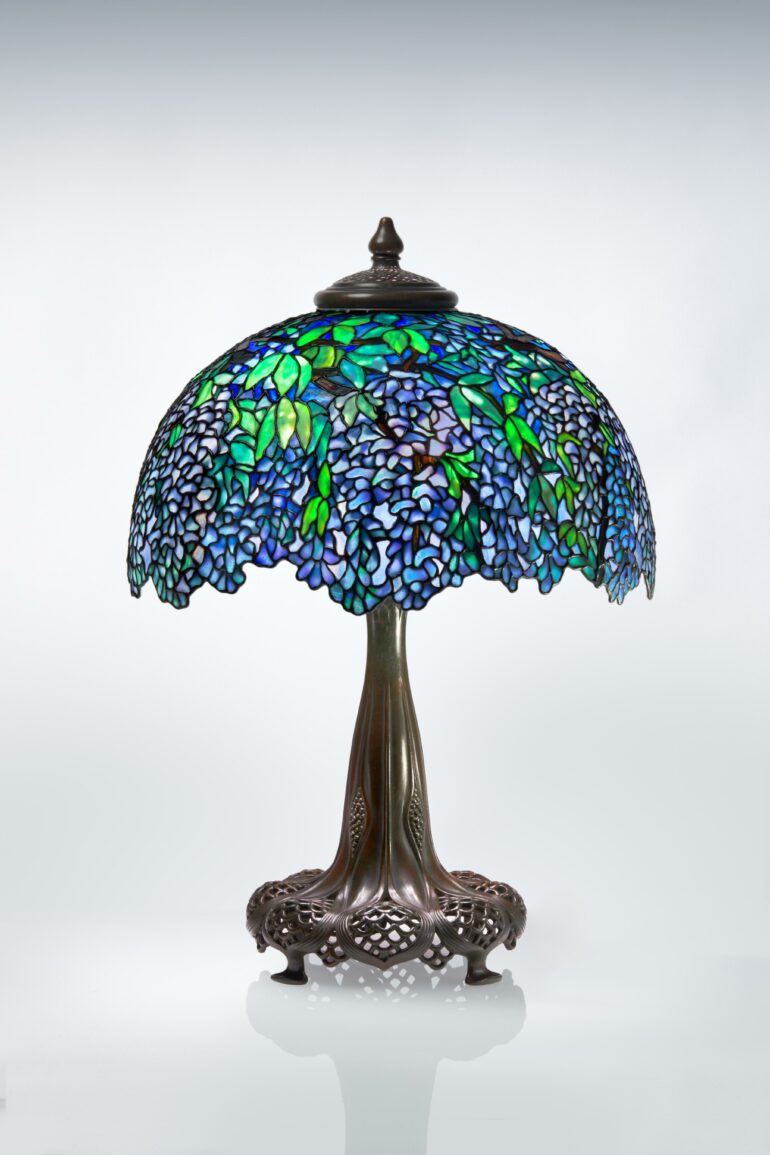
The New York Prism: A Double Immersion in the World of Tiffany
There is a kind of poetic justice in seeing New York adorned with the reflections of Louis Comfort Tiffany at the height of the season. As the light fades over Manhattan, two major institutions simultaneously offer new perspectives on the work of this master designer. This is not merely a tribute to the Art Nouveau aesthetic, but a profound exploration of a body of work that, as visitors move through the galleries, reveals itself to be far more vast and complex than the simple production of leaded-glass lighting fixtures. The Metropolitan Museum of Art and the Nassau County Museum of Art each offer a distinct perspective, forming a diptych that helps us understand why, more than a century after his heyday, Tiffany’s aura continues to fascinate even the most discerning collectors.
This current museum initiative serves as a revelation. It highlights the modernity of a man who knew how to fuse artistic craftsmanship with an almost prophetic industrial vision. Through these two exhibitions, the entire language of iridescence and organic form is scrutinized, offering visitors a rare opportunity to understand the mechanics of a fascination that has never waned in the art market.
The Scope of a Multifaceted Practice
Louis Comfort Tiffany is all too often reduced to his famous lamps featuring botanical motifs. Yet the phrase “expansive practice” takes on its full meaning when one observes the diversity of media presented in these two exhibitions. Glass, of course, remains the central pillar of his genius, but it is only the tip of the iceberg of a much more ambitious creative system. Tiffany was a master of spatial design, a colorist who used materials as a living palette.
The exhibition offers visitors the chance to rediscover his work on stained-glass windows—those “windows” that revolutionized American interior architecture. Unlike his European contemporaries, who painted on glass, Tiffany incorporated color and texture directly into the glass itself, creating effects of depth and light that had never been seen before. This technical mastery, which even today still seems akin to alchemy, largely explains the enduring interest of curators and investors. One can see a constant pursuit of innovation, where every object—whether a delicate piece of jewelry or a monumental mosaic—bears the mark of absolute perfection.
The strength of these two exhibitions lies in showing how Tiffany managed to establish a signature style that is instantly recognizable, all while constantly reinventing himself. The goal was not to reproduce designs, but to adapt a vision of nature to every possible medium. This ability to embrace all scales of creation is what makes his work so unique in the history of American design.
The Market and the Enduring Allure
If Louis Comfort Tiffany continues to “wow” collectors, it is not solely out of nostalgia for the Belle Époque. It is above all because his pieces possess an intrinsic quality that defies the passage of time. The value of his works remains impressively stable, driven by a rarity that grows as major pieces find their way into public collections.
The renewed interest seen today in New York can also be attributed to the rediscovery of these objects’ provenance and history. For a collector, acquiring a Tiffany piece means owning a fragment of the American Gilded Age, a period when decorative art sought to rival the nobility of painting or sculpture. Current exhibitions are showcasing pieces, some of which have not been on public display for decades, thereby reigniting demand in the secondary market.

The dialogue between the academic framework of the Metropolitan Museum of Art and the more specialized approach of the Nassau County Museum creates an interesting dynamic. We move from historical celebration to a more nuanced analysis of the work’s aesthetic and market value. This duality reinforces the idea that Tiffany is not an artist of the past, but a safe haven whose visual relevance remains undiminished in the most cutting-edge contemporary interiors.
A legacy etched in the material
Beyond monetary value, it is the pure emotion evoked by the material itself that takes precedence. The new windows offering a glimpse into his work allow visitors to appreciate the subtlety of his famous Favrile glass, with its iridescent sheen reminiscent of a beetle’s wings. There is something in this pursuit of organic perfection that resonates with our current concerns about the beauty of the natural world and its fragility.
The New York exhibition does more than simply trace a career; it places Tiffany at the center of a reflection on the art of living. By exploring his “expansive practice,” we come to understand that his ambition was to transform every moment of daily life into an aesthetic experience. Perhaps this is the secret to his enduring appeal among collectors: this promise—fulfilled through every object—that art can and must inhabit reality.
While the doors of these two institutions will close in a few months, the lessons learned from this dual exhibition will endure. They confirm that the name Tiffany is much more than a brand or a style: it is a universal visual language that continues to reinvent itself before our very eyes. For those interested in the intersection of art, design, and heritage, this detour to New York is a must—an opportunity to experience a light that, without a doubt, never fades.