
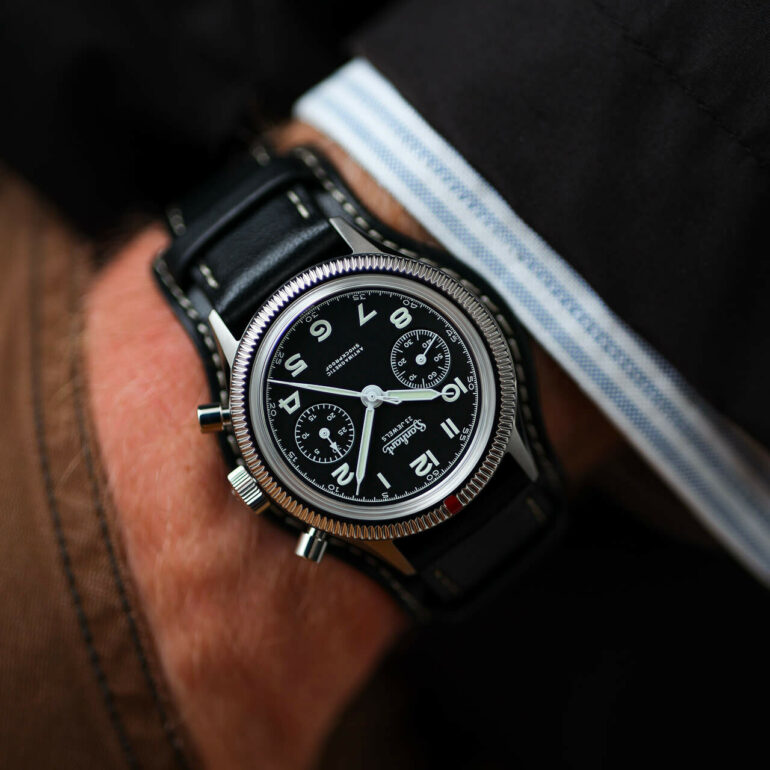
There is an invisible yet palpable line between a collector’s item and a historical artifact. In watchmaking, this boundary is crossed at the precise moment one fastens a timepiece to one’s wrist—one that does not merely simulate the past through the design elements of a reissue, but physically embodies it. This is the unique experience offered by the Hanhart 417 ES chronograph. This watch does not play on nostalgia; it is a relic of an era when a timepiece was not a status symbol but a vital necessity in the cockpit of a jet aircraft.
The model we’re looking at here, on loan from collector @diversewatchcollector, possesses a special aura. It’s not just an example from the late 1950s—it’s a survivor. While most of its contemporaries were worn down to the bone by Bundeswehr pilots, this chronograph followed a radically different path: that of the civilian market.
The Civilian Exception: A Living Archive of the Postwar Era
The story of this Hanhart 417 ES is evident as much in its steel case as in its period documents. A rarity for a piece from this era, it comes with its original warranty certificate and a sales receipt dated January 18, 1961, issued by Uhren-Schmitz in Salzgitter-Lebenstedt. This traceability sheds light on a little-known aspect of the Gütenbach-based company’s production. While the 417 was produced from 1953 to 1962, the vast majority of the watches were intended for the new German Air Force. Only a very limited number were made available to civilians, making this particular watch an absolute rarity.
The gap between its likely production in the late 1950s and its actual sale in 1961 also reflects the economic reality of the time. These military watches, sometimes stored for several years before finding a buyer, were far from the objects of immediate desire they have since become. They were tools. This model belongs to the “ES” category, standing for Edelstahl (stainless steel), a version produced in a run of only about 500 pieces, as opposed to the “E” version, which featured a chrome-plated brass case. This technical distinction is now crucial for collectors, as stainless steel has withstood the ravages of time far better than the original leather Bund strap, whose current suppleness attests to decades of wear.
The Language of Pragmatism: A Design Without Artifice
To examine a 417 ES under a magnifying glass is to understand the concept of subtractive design. Hanhart eliminated everything that did not directly serve the purpose of telling time or measuring an interval. Paradoxically, this aesthetic rigor produces a beauty that never fades. The perfectly balanced bi-compax dial avoids visual clutter. The Arabic numerals—large and generously coated with luminescent material that has aged over time—offer instant readability.
The “syringe” hands, typical of the era, allow for readings accurate to one-thousandth of a millimeter on the peripheral minute track. But it is undoubtedly the fluted rotating bezel that best defines the watch’s identity. Handling it is a tactile experience in itself: it serves as a reminder that this watch was designed to be worn with thick leather gloves. Every scratch on the Plexiglas, every mark on the steel case tells a story of real-world use. In the world of contemporary luxury watchmaking, where pieces are often protected from even the slightest scratch, the Hanhart 417 ES embodies the opposite philosophy: that of an authentic patina that enhances the instrument’s character.
The European Influence: The Shadow of the Type 20
The history of the Hanhart 417 ES does not end at Germany’s borders. It is part of a fascinating European technical dialogue. After World War II, when the French government drafted the specifications for its new onboard chronographs—the famous Type 20 standard—it drew heavily on the technical advancements tested by pilots during the war. The flyback function, exceptional readability, and the case’s robustness were the cornerstones of this government contract.
Prestigious watchmakers such as Breguet, Auricoste, Dodane, and Vixa responded to this call for bids. While the Hanhart is not technically a French Type 20 watch, it is its philosophical first cousin. It shares with them this “instrument watch” DNA, where form is entirely dictated by function. Today, collectors who snap up military Type 20 watches see the 417 ES as the German equivalent of this excellence: a timepiece capable of functioning flawlessly under extreme pressure, whether atmospheric or operational.

Beyond the Steve McQueen Myth
It is impossible to discuss the Hanhart 417 without mentioning Steve McQueen. The actor, a great motorsports enthusiast and seasoned racer, owned his own 417 ES, which he wore regularly, both on film sets and during his motocross competitions. This association undeniably propelled the watch’s popularity to new heights, granting it a “cool” status that even the most sophisticated marketing could not have bought.
However, reducing the 417 ES to the image of a Hollywood icon would be a mistake. McQueen didn’t make the watch; it was the watch that fit McQueen’s lifestyle. He chose it for its discretion and reliability. Even without the endorsement of “The King of Cool,” the 417 ES would remain one of the most accomplished chronographs of its century. It proves that true style lies not in ornamentation, but in the accuracy of its proportions and the clarity of its design. The fact that it looks just as modern on a man’s wrist in 2024 as it did in 1961 underscores the architectural success of its case.
The Enduring Nature of the Pure Timepiece
What strikes one most during an extended immersion with such a timepiece is the sense of finality. The watch does not try to be anything other than itself. In today’s watch market, often saturated with unnecessary complications and ostentatious finishes, the Hanhart 417 ES reminds us of the importance of restraint. Creating a complex object is within the reach of many; creating one that is simple, effective, and timeless is the most challenging feat.
The presence of the original Bund strap on this example accentuates its raw character. This type of strap, featuring a leather lining that protects the wrist from the metal in the event of extreme temperature fluctuations or a fire in the cockpit, underscores the watch’s military purpose. Holding the original 1961 sales receipt in your hands, with its neat handwriting, creates a direct connection to the first owner, who perhaps had no idea that he was purchasing one of only 500 examples of what would become a watchmaking legend.
The Hanhart 417 ES has stood the test of time not because it was protected in a safe, but because it was built to last. It stands as a testament in steel that honest engineering and precise design are the only guarantees of an elegance that never fades. More than just a watch, it is a lesson in endurance—a timepiece that continues to fulfill its original purpose with the same precision seventy years after leaving the factory.