
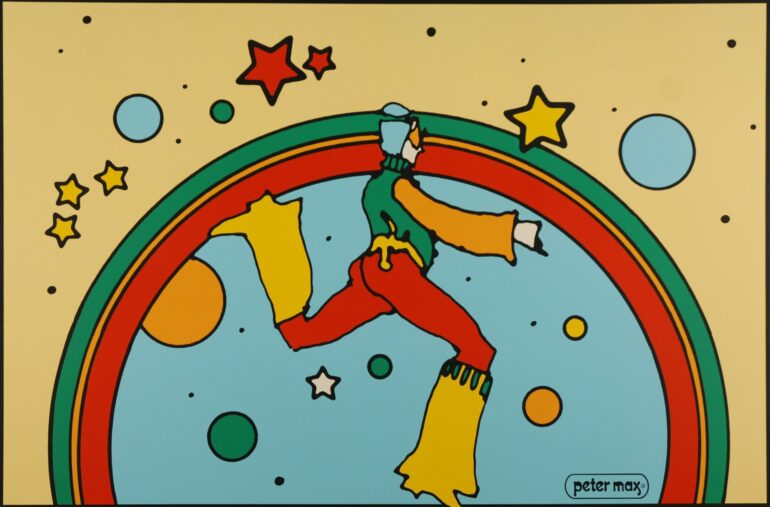
On September 14, 2026, Peter Max passed away at the age of 88 in a hospital in Manhattan, New York. The announcement, made two days later by his son Adam Max via a press release from the Park West Gallery, brings to a close a journey that saw a young exile from Berlin become the visual architect of American counterculture. Born Peter Max Finkelstein in 1937, the artist—who claimed to create “art that people can afford” to make them happy—leaves behind a body of work in which Day-Glo colors and cosmic imagery have come to be inextricably linked with the very identity of the 1960s.
The Odyssey of a Vision, from Shanghai to Brooklyn
Peter Max’s aesthetic, often perceived as quintessentially American, actually draws its roots from a state of perpetual displacement. Fleeing Nazi Germany with his Jewish family in 1938, he spent the first ten years of his life in Shanghai. This Chinese childhood, followed by a five-year stay in Haifa, Israel, shaped his relationship with the visual arts. It was in Israel that he was introduced to drawing under the guidance of Professor Hünik, a Viennese Expressionist, while developing a fascination for astronomy that would later inspire his motifs of planets and galaxies.
After a brief stay in Paris in 1953, where he took drawing classes at the Louvre Museum, Max settled permanently in Brooklyn at the age of 16. His technical training was rigorous: he studied realism under Frank J. Reilly at the Art Students League of New York before enrolling at the School of Visual Arts (SVA). This academic background enabled him to master a precise line, essential for structuring the chromatic explosions that would bring him worldwide fame a few years later.
The Architect of the Psychedelic Era
In the late 1960s, Peter Max became the public face of the Pop Art movement and the “Flower Power” aesthetic. His style is instantly recognizable: vibrant rainbows, stylized flowers, butterflies, and his famous “cosmic jumper”—a floating silhouette that seems to drift among the stars. In 1967, his appearance on The Ed Sullivan Show—where he drew with both hands simultaneously in front of millions of viewers—cemented his fame. Two years later, he graced the cover of Life magazine, confirming his status as a cultural phenomenon.
A persistent misconception often links him to the artistic direction of The Beatles’ 1968 film *Yellow Submarine*. While it is true that his psychedelic universe shares certain affinities with the film’s animation, it is well established that the film’s visual design is the work of German artist Heinz Edelmann, not Peter Max. Max nevertheless capitalized on this imagery to become one of the most prolific artists of his generation, working across a variety of media and collaborations.
From the White House to Border Crossings
Far from being confined to galleries, Peter Max’s art has taken over American public and institutional spaces. As early as 1974, the General Services Administration commissioned him to create welcome murals for more than 200 border crossings across the United States. That same year, he designed the 10-cent postage stamp for the Seattle World’s Fair. His chromatic patriotism reached its peak with his series on the Statue of Liberty, begun in 1976 for the United States’ bicentennial. In 1981, he staged a performance that remains famous to this day by painting six canvases live on the White House lawn.
The worlds of sports and entertainment also frequently sought out his energetic style. Peter Max was the official artist for numerous global events: the Olympic Games, the Super Bowl, the 1994 FIFA World Cup, the Grammy Awards, and the Woodstock ’99 festival. His ability to transform a commercial event into a visual spectacle led him to design everything from the hull of the Norwegian Breakaway cruise ship to the visual identity of MTV.
An Empire Under Pressure and Some Shadowy Areas
Peter Max’s massive success did not come without its share of setbacks. In 1997, the artist pleaded guilty to federal tax fraud for failing to report income from the sale of his artwork. More recently, in 2019, a New York Times investigation revealed a tragic situation surrounding his final years of work. While he was suffering from a severe form of dementia, family members and associates were accused of having him sign large numbers of paintings produced by assistants. This turbulent period, marked by a contentious guardianship, casts doubt on the authenticity of the works created between 2012 and 2019—an issue that continues to fuel numerous legal disputes between experts and heirs.
This mass production of his signature calls into question the value of his legacy, although the market remains active. Around the year 2000, his signed lithographs and T-shirts were selling for between $125 and $200 through specialty stores or television broadcasts. At the same time, his historic original paintings—particularly those from the Statue of Liberty series—could fetch up to $23,000 on the secondary market. Collectors today clearly favor works from the 1960s and 1970s, considered the beating heart of his creative output.
Peter Max has passed away, though his family has not specified the immediate medical cause of his death, although his overall health had been compromised by chronic dementia. He leaves behind a galaxy of motifs that, despite the controversies surrounding the end of his career, succeeded in bringing astronomy and psychedelia into the everyday lives of Americans.