
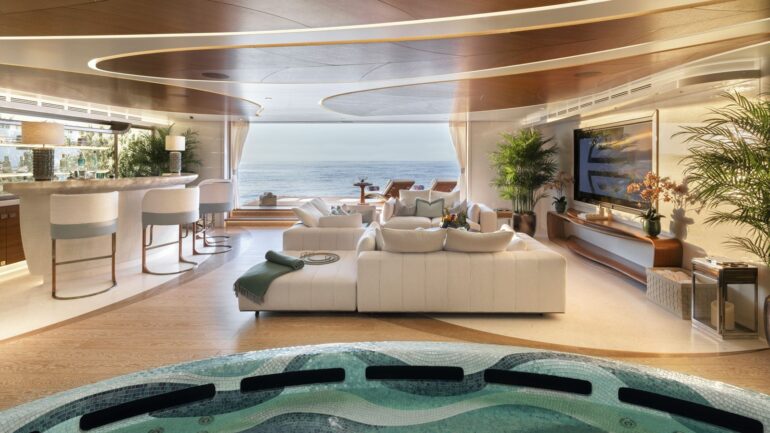
Long confined to the dark corners of the lower decks or hidden away in the technical nooks of the beach club, the gym is undergoing a transformation. A profound architectural shift is taking place in the latest vessels delivered, where the pursuit of physical performance and recovery is taking precedence over traditional uses. Now, superyacht owners prioritize 360° panoramic views and natural light for their wellness routines, even if it means sacrificing conventional entertaining spaces. Formal lounges and grand dining rooms are giving way to active living areas, transforming wellness into a shared social experience rather than an isolated practice in a massage room.
Naval Architecture in the Service of Regeneration
This emphasis on wellness from the very outset of the project is redefining deck layouts. The superyacht Sparta, a 67-meter vessel designed by Heesen Yachts, exemplifies this trend with a 98-square-meter lower deck entirely dedicated to a Japanese-inspired sanctuary. This deck features a spa, a hammam, a gym, and a sauna with large floor-to-ceiling windows, blurring the line between physical exertion and the marine landscape. It is no longer enough to simply add an optional wellness area to an existing layout; the vessel is now designed around this function.
The “Wellness-First” concept is also embodied in new exploration series such as the Sea Rover. On this 42.5-meter vessel designed by Dutch Design, the overall architecture is guided by three pillars: exercise, sleep, and recovery. For equipment, owners are turning to specialized manufacturers like PENT, which designs marine-grade fitness equipment made of stainless steel, precious woods, and leather—capable of adapting to the specific constraints of the ship’s list thanks to AI-connected systems.
Biohacking and Precision Medicine on the High Seas
The onboard technological arsenal now goes far beyond simple fitness, entering the era of biohacking and precision medicine. The mega-yachts Flying Fox (136 meters) and Kismet (122 meters) are equipped with cryotherapy chambers capable of reaching -110 °C. These facilities are designed to accelerate muscle recovery and reduce inflammation in passengers after physical exertion.
The therapeutic arsenal extends to the use of hyperbaric oxygen chambers (HBOT), notably those supplied by AHA Hyperbarics, as well as red-light photobiomodulation panels. Biological optimization extends even to the ship’s behind-the-scenes infrastructure: medical-grade water and air filtration, circadian-synchronized lighting systems to maintain sleep rhythms, and intravenous (IV) infusion stations. Relaxation areas incorporate Himalayan salt bricks to improve respiratory capacity, while some yoga studios—even on more compact vessels—are designed for Bikram yoga with heating systems capable of reaching up to 40 °C.

Sports Facilities: The Technical Feat of Decks
Sports on a superyacht are no longer limited to individual disciplines or deck yoga. The demand for group and regulation-compliant facilities is pushing engineers to achieve structural feats. The Aviva yacht, delivered by Abeking & Rasmussen in 2017, marked a turning point by incorporating the first permanent padel court located below deck. The dimensions are professional-grade: 20 meters long by 10 meters wide, with an impressive ceiling height of 6.65 meters, all nestled at the very heart of the 98-meter vessel’s structure.
For vessels whose original configuration does not allow for such structural integration, modular solutions are emerging. The British equipment manufacturer Shipyard Supply Co. (SSCo) has developed freestanding padel courts. Made of carbon fiber and synthetic glass (Plexiglas) and equipped with protective nets, these courts can be temporarily installed on a helipad or the foredeck without requiring permanent drilling into the yacht’s structure. These versatile installations are also suitable for basketball or pickleball, confirming that a ship’s deck has become, above all, a playground and a venue for athletic performance.
Next-Generation Hydrotherapy
Onboard water management is evolving into complex sensory experiences. Owners now demand advanced thermotherapy facilities that simulate a variety of microclimates. These include Kneipp hydrotherapy circuits, alternating between hot and cold pools, complemented by ice fountains and sensory showers. These showers recreate environments ranging from tropical rain to icy waterfalls, including aromatic mists, transforming the post-workout shower into a key component of the recovery protocol. This holistic approach to health—combining naval engineering, medical technology, and interior design—sets a new standard in which the ship becomes a tool for self-optimization in the middle of the ocean.