
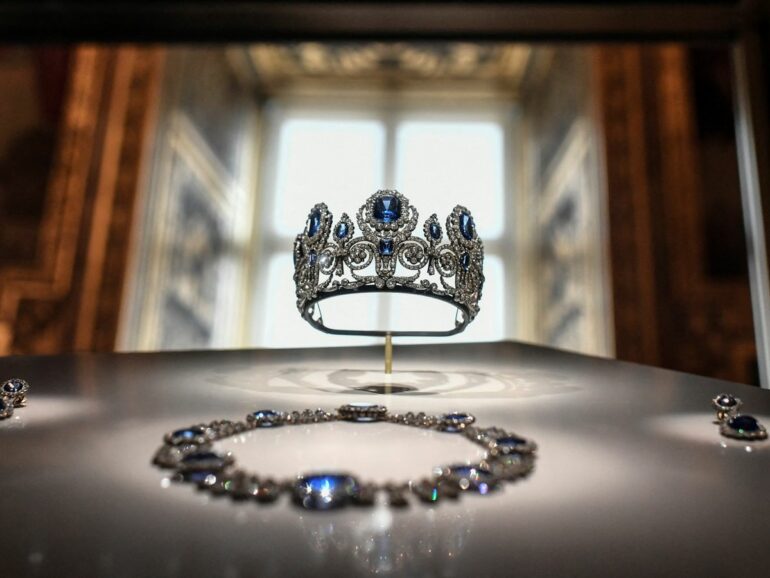
The eye had grown accustomed to seeking out the sparkle of gemstones even before gazing up at the vaulted ceilings. Since July 22, 2026, visitors who cross the threshold of the Apollo Gallery at the Louvre are met with a striking void. Where the Crown Jewels sparkled until recently, the space now stretches out in absolute simplicity, freed from its armored display cases and its treasures under glass domes. The Parisian institution has made a radical choice: to permanently remove its jewels from natural light and relegate them to the shadows of a highly secure room. Behind this decision, which resembles a strategic retreat, lies a complete redefinition of what the contemporary museum experience should be—a shift precipitated by one of the most sensational news stories of the decade.
The Trauma of October 2025
To understand this transformation, we must go back a few months. In October 2025, the Parisian sanctuary suffered a break-in of unprecedented scale. A spectacular heist struck at the very heart of the royal collection, specifically targeting eight masterpieces from the Crown Jewels. The loss, estimated at nearly 88 million euros by experts at *Jeweller Magazine*, sent shockwaves far beyond the circle of art historians.
The severity of the incident is underscored by a relic found shortly after the crime: Empress Eugénie’s crown, abandoned in the immediate vicinity of the museum, damaged by her captors as they fled. This battered tiara is the sole survivor of the heist. The seven other jewels remain, to this day, completely untraceable—a disappearance confirmed by joint reports from the Associated Press and Euronews. Faced with this cultural disaster, the Louvre’s administration found itself at a crossroads. Should it restore the original display at the risk of exposing itself to new vulnerabilities, or rethink the very layout of the space?
The answer came in the form of a deliberate defensive retreat. The precious artifacts still in the museum’s possession have left their historic setting to be housed in a windowless bunker—a room devoid of even a single window. Security took precedence over exhibition design, marking the failure of a concept in which the mere staging of a treasure—however sophisticated it might be—would suffice to guarantee its integrity.
The Mona Lisa Syndrome
This heist does more than simply alter the museum’s visitor flow; it alters the very psychology of the works. Christophe Leribault, who oversees the Louvre’s operations, draws a fascinating parallel with another traumatic event that shaped the institution: the theft of the Mona Lisa in 1911. At the time, the disappearance of Leonardo da Vinci’s panel had drawn massive crowds, who came to gaze at the empty nails on the wall of the Salon Carré. The absence had sparked hysteria, transforming a famous painting into a global icon.
According to the director, whose analysis has been reported in the art press, Empress Eugénie’s surviving crown could well undergo a similar transformation. Stripped of its counterparts, torn from its original context, and physically scarred by the break-in, the piece is shifting from the status of an art object to that of a mythical relic. The theft has given it a new narrative depth. The public will no longer come merely to admire a piece of 19th-century goldsmithing, but rather the remnant of a historic heist—a silent witness to a breach in the supposed inviolability of the world’s greatest museum.
Architecture as the Sole Jewel
By emptying the Apollo Gallery of its gems, the Louvre has not condemned it to silence. Quite the contrary: the museum is restoring it to its original purpose. It is important to remember that in the 17th century, this ceremonial gallery was not designed as a vault intended to display jewelry behind glass. It was a stage. Commissioned under Louis XIV, it was intended to serve as a place for strolling, a space for contemplation, and a tool for visual propaganda, asserting the power of the Sun King through the sheer grandeur of its proportions and gilded details.
Nestled between the Rotunda of Apollo, the Square Salon, and the Grand Gallery, the room is a rare surviving fragment of the original palace. Its architectural DNA brings together the most masterful achievements of the Grand Siècle: the spatial engineering of Louis Le Vau coupled with the decorative genius of Charles Le Brun, all crowned—much later—by the dazzling paintings of Eugène Delacroix. It was here, within these walls, that the aesthetic vocabulary was conceived and tested—a vocabulary that would give rise, a few years later, to the Hall of Mirrors at the Palace of Versailles.
In 2020, a major renovation project equipped the gallery with new display cases, designed to showcase the Crown Jewels. Six years later, this setup has been rendered obsolete by security concerns. Ironically, this forced removal serves as a revelation. Freed from the distracting reflections of the display cases and the hypnotic focus required by the diamonds, the visitor’s gaze is compelled to rise. They rediscover the rhythm of the pilasters, the complexity of the gilded ceilings, and the grandeur of a decor that needs no additional artifice to make its presence felt. The experience of the space becomes strictly architectural.
The Twilight of Excess
The Louvre’s decision is part of a broader reflection on the role of the museum institution in the 21st century. The time is no longer for the element of surprise or the spectacular concentration of treasures, but for a restraint dictated by prudence. Shifting the focus from the treasure to the setting that once housed it is as much an act of contrition as it is a curatorial boldness. The physical environment—the container—regains a value at least equal to that of the vanished contents.
There is a paradox of great severity in this approach: to preserve the splendor of a heritage, one must now accept to remove it from view, to bury it in darkness. The Galerie d’Apollon, stripped of its most immediate splendor, gains in return an almost solemn clarity. This void, imposed by the violence of a theft, forces us to look at things differently, proving that in the corridors of such a palace, the absence of one masterpiece sometimes gives way to another, vaster and older one.