
Make Texture a preferred source on Google to support us
Add Texture to GoogleRight in the heart of Houston Street, where the hustle and bustle of Manhattan seems to condense into a constant buzz, a line invariably stretches out along the sidewalk. Here, there’s no complex reservation system or digital concierge service. You wait your turn, whether you’re a figure in the global hip-hop scene, a former president, or a neighborhood regular. At the helm of this bastion of culinary resistance known as Emilio’s Ballato, Anthony Vitolo embodies a vision of hospitality that seems almost anachronistic in a metropolis obsessed with novelty. It’s not just an Italian restaurant; it’s a sanctuary where the checkered tablecloths and walls lined with frames aren’t mere props, but testaments to a rare family legacy.
The Intimate Geography of Taste
The city’s pace comes to a halt the moment you step through the door. In this narrow dining room, space is a precious commodity, almost as much as the red sauce that has made the restaurant’s reputation. For Anthony Vitolo, luxury is not measured by architectural excess or technological extravagance. It lies in a reassuring sense of permanence. While New York’s urban landscape is transforming at a dizzying pace, his restaurant remains a constant. This stability is the result of a legacy passed down by his father, Emilio, whose name continues to shape the restaurant’s destiny. The man who now holds the reins of this institution does not seek to reinvent the wheel; he strives each day to refine the details that turn a dinner into a memory.
This approach is reflected in his simplest personal choices. When it comes to taking a break from the hustle and bustle of service, his preference naturally turns to an absolute classic: the Negroni. But not just any Negroni. It’s a blend of precision and pleasure, a precise balance between bitterness, the structure of the gin, and the roundness of the vermouth. It’s a drink that mirrors his personality: unpretentious, straightforward, yet with a complexity that unfolds as you savor it. For him, this cocktail is the liquid embodiment of his culinary philosophy. There’s nowhere to hide behind a poorly executed Negroni, just as you can’t mask the mediocrity of a tomato sauce with superfluous herbs. The quality of the ingredients is the sole arbiter.
The Art of Subtraction and Time
When asked about his own definition of luxury, Anthony Vitolo avoids the pitfalls of ostentatious materialism. For a man whose days are punctuated by the demands of an international clientele and the ceaseless bustle of the kitchen, the ultimate luxury takes on an intangible form. It is, above all, a matter of comfort—not that of a plush armchair, but that of the mind. True luxury, in his view, is being able to feel at home anywhere in the world, without having to adapt or put on a facade. It is this ability to establish an immediate sense of familiarity, to transform a stranger into a longtime guest in the span of an evening.
This vision is reflected in the way he handles anticipation and exclusivity. At Emilio’s Ballato, equality reigns on the sidewalk. This golden rule is perhaps the purest form of distinction: one that refuses to succumb to the allure of privilege that can be bought. Luxury is possessing something that money cannot instantly buy—in this case, a table at his restaurant at the exact moment you desire it. You have to earn your spot, soak up the New York atmosphere, and chat with the people waiting in line next to you. The time spent waiting then becomes an integral part of the experience, a psychological appetizer that makes the first course even more memorable.
His conception of luxury aligns with that of craftsmanship: a quest for consistency. For him, nothing is more precious than the certainty that a dish will taste exactly the same as it did ten years earlier. In a world of fleeting trends, this fidelity to oneself has become the rarest of commodities. It is a form of courtesy toward the customer, a promise kept day after day, from the noon service to the midnight service. This daily rigor is the driving force behind an establishment that refuses to grow at the expense of its soul, preferring to remain small and vibrant rather than become a soulless franchise.

A legacy woven into daily life
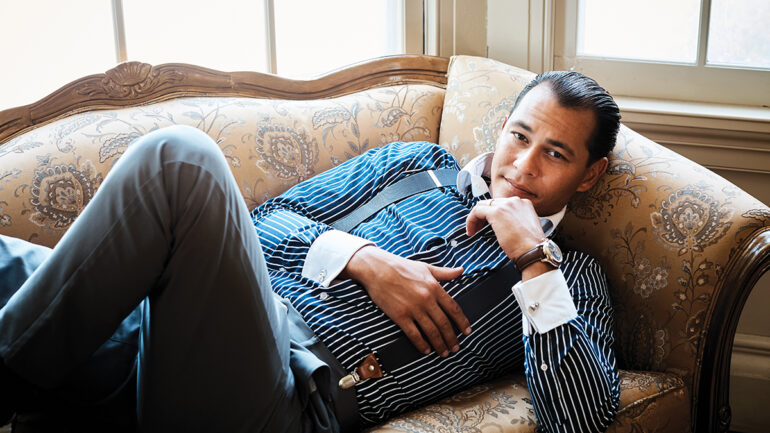
Navigating between tables with an ease that betrays years of observation, Anthony Vitolo embodies the new guard of a lineage that has understood that modernity sometimes means protecting the past. His personal style—often understated yet with surgical precision—echoes this commitment to never overdo it. Luxury is a whisper, not a shout. It lies in the quality of a fabric, the weight of a glass, or the thoughtfulness of a gesture. It’s a way of life that places people at the center of everything, far removed from booking algorithms and standardized reviews.
When asked what makes New York so magical, he often returns to this idea of serendipitous encounters and raw energy. His restaurant is the stage for these social collisions, where an art collector might find himself sharing a wine recommendation with a young creative from Brooklyn. This intermingling of worlds is, in his view, the true driving force behind culture. It fuels his inspiration and reinforces his conviction that a restaurateur’s role extends far beyond the plate. He is the guardian of a certain art of living, a conductor who ensures harmony among the often dynamic personalities that fill his dining room.
Ultimately, Anthony Vitolo’s journey and the aura of Emilio’s Ballato serve as a reminder that the most desirable luxury remains that of uncompromising authenticity. Whether through the selection of a perfectly balanced Negroni or the upholding of a demanding family tradition, he demonstrates that what truly matters is what endures. In an era where everything seems interchangeable, the determination to stay true becomes a gesture of absolute elegance. On Houston Street, the curtain falls late every night, but the story continues to be written with the same ink—that of a passion that knows no shortcuts.