
The Aeffe Group: A Three-Way Split to Preserve Its Italian Roots
The fate of the Aeffe Group is no longer being decided solely on the runways of Milan, but in the hushed and austere atmosphere of the Ministry of Enterprise and Made in Italy (Mimit). During a decisive meeting held to resolve the crisis rocking the San Giovanni in Marignano hub, a radical restructuring plan was unveiled. What is taking shape is not merely a capital injection, but a profound structural transformation. The Ferretti family, the group’s founders and mainstay, has chosen to surround itself with a diverse yet powerful coalition to formulate a binding offer whose objective goes beyond a mere financial bailout.
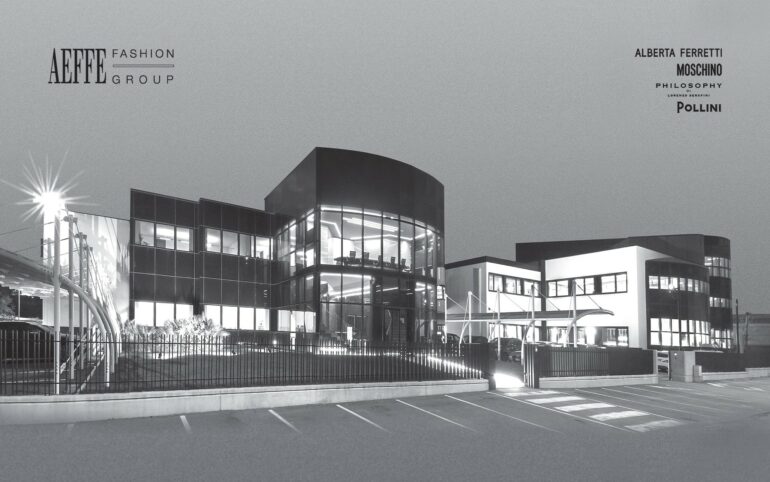
The central idea behind this maneuver is controlled fragmentation. Rather than attempting to maintain a monolithic entity under pressure, the strategy calls for the acquisition of virtually all assets by a new entity, a “NewCo,” before proceeding with a surgical division into three distinct operational divisions. This three-way split is intended to create three independent companies, each with a clear mission and a defined scope: one dedicated to the development of Moschino, the second to the Alberta Ferretti brand, and the third focused on production activities in San Giovanni in Marignano as well as the Pollini brand.
A financial engine worth 115 million euros
To steer this transition, the group is relying on a complex financial arrangement in which the Oxy fund takes the lead in the consortium. The Oxy fund is not acting alone; it is supported by Invitalia, the Italian government’s investment arm, which is involved through its Business Rescue Fund. This public involvement underscores the national significance of Aeffe for the industrial fabric of Emilia-Romagna. Alongside them, the Ferretti family maintains its stake in the company, demonstrating a determination not to abandon the family business despite the storm.
The total funding package on the table amounts to approximately 115 million euros. This capital serves not only as a means of repayment or working capital; it also acts as a guarantee for the continuity of industrial operations. The plan places strong emphasis on preserving employment levels, a non-negotiable point in discussions with government authorities. By spinning off the production operations and the Pollini brand into a separate entity, the buyers aim to protect the local artisanal expertise—the true beating heart of the San Giovanni in Marignano complex—while giving the ready-to-wear brands the agility needed to compete in global markets.
The Sino-Italian Partnership and the Moschino Lever
The most strategic—and perhaps the most forward-looking—aspect concerns the arrival of a Chinese industrial partner. While the exact identity of this publicly traded company remains confidential for now, its role is already clearly defined. It is not merely a passive co-investor within the consortium led by Oxy. The agreement, in fact, provides for the exclusive licensing of the Moschino brand for the Chinese market.
This decision marks a turning point in the brand’s management. By entrusting the Chinese market to a major local player, the Aeffe Group seeks to transform what has until now been an arguably insufficient presence into a massive commercial expansion. The objective is clear: to consolidate Moschino’s foothold in Asia by leveraging the expertise and network of a partner who understands the specific workings of this complex market. This alliance will enable the Milanese house to export its subversive style while securing stable revenue streams through an optimized licensing system.
The Transition Timeline
The transformation process is now underway in a race against the clock. Technical reviews and the finalization of contractual agreements are underway, with a target date of the end of the calendar year. This transition period is crucial to ensuring that the handover from the old structure to the three new operational entities occurs without any disruption to production or loss of market confidence.
The most immediate deadline is set for September 28. On that date, the bidders will return to the ministry to present the detailed business plan. This document must specify how the 115 million euros will be allocated and how each entity—Moschino, Alberta Ferretti, and the Pollini/Production division—intends to return to profitability. This fall meeting will be the true test of viability for this spin-off project, which aims to transform a growth crisis into a model of industrial specialization.