
Make Texture a preferred source on Google to support us
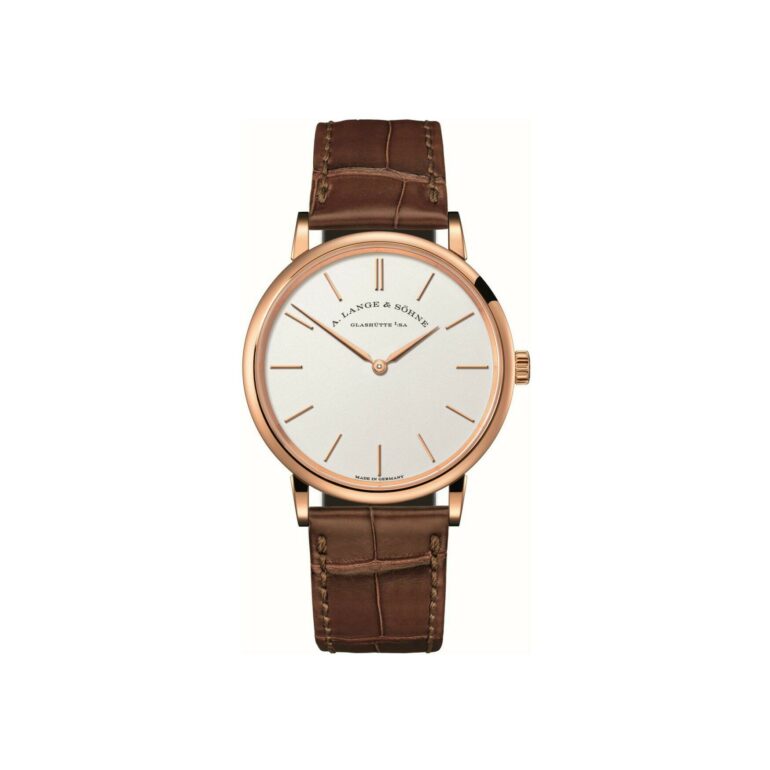
Add Texture to GoogleAll you have to do is turn the case over to clear up the misunderstanding. On the front, the time display is arranged with absolute geometric precision, a formal restraint that at times borders on severity. On the back, through the sapphire crystal, the movement bursts forth with an intimate exuberance. The engraved bridges, the density of the components, and the richness of the finishes offer a spectacle reserved solely for the wearer. This radical divide between the public face—cold and orderly—and the private space—opulent and complex—sums up the essence of A. Lange & Söhne. In an industry where appearances often set the pace, the Saxon manufacture cultivates a structural discretion, countering the industry’s frenetic pace with a quiet strength.
The Guardian’s Doctrine
To understand this resistance to the siren calls of trends, one must observe how the brand is managed. Wilhelm Schmid, a defector from the automotive sector, had to undergo a drastic shift in his relationship with time upon joining the workshops in Glashütte. The automotive industry runs on planned obsolescence, short replacement cycles, and sheer speed. Saxon watchmaking demands the exact opposite. He quickly realized that such an institution cannot be led with aggressive management methods. The very term “CEO” strikes him as inappropriate; he favors the idea of a custodial role.
The word wasn’t casually slipped into a communications plan. It reflects a weighty operational reality: the leader is there solely to preserve an ecosystem that predates him and will outlive him. Schmid discovered an internal culture where the egos of decision-makers take a back seat to the pride of the workers. The validation of a gauge, the adjustment of a component, or the precision of a polished angle take precedence over quarterly targets. The company’s identity thus acts as a load-bearing wall. Every choice—whether aesthetic or commercial—must fit into this architecture without undermining its balance. The atmosphere in the workshops dictates strategy, relegating day-to-day decisions to the level of mere technical adjustments.
Memory as a Navigational Tool
The long term is not a philosophical abstraction for the house; it is a direct consequence of its geography and chronology. Founded in 1815, the brand weathered the upheavals of German history before entering a long period of dormancy, only to be reborn in 1990. This historical hiatus forged a commitment to absolute fidelity to its origins. There is no room for stylistic deviation when one has had to rebuild one’s heritage from scratch.
The aesthetic shock of the rebirth came in 1994. While the market expected reassuring classicism, the manufactory introduced the Lange 1. The watch immediately took everyone by surprise. Its dial is based on a play of mathematical asymmetries, rejecting the traditional centering of the hands. This design choice, jarring at first glance, became the definitive visual hallmark of the new era. Twenty-eight years later, this launch remains the watchmaker’s central point of reference. The memory of that initial risk-taking now serves as a mental buffer. Faced with the upheavals of a luxury market that has become extremely volatile, nervous, and hungry for instant gratification, Glashütte’s industrial heritage enables it to weather crises. Neither the pandemic nor recent economic fluctuations have sparked panic or a defensive retreat. The company weathered the storm, adapted, and stayed the course.
The Aesthetics of Secrecy
This refusal to compromise is evident across all current collections, from the Datograph chronograph to the Odysseus line. In each case, the promise remains the same: apparent simplicity is never a production shortcut, but the culmination of a deliberate constraint. Stripping a dial down to its bare essentials requires absolute mastery of proportions, as even the slightest imbalance is immediately apparent. Opulence is relegated to the background—to the movement plates and gears invisible from the outside.
Maintaining this delicate balance is a feat of acrobatics. The temptation to inflate production volumes, saturate the media landscape, or multiply color variations to capture a more impatient clientele is inevitably present. Yet the chosen growth strategy avoids such ostentation. A piece’s value rests on its intrinsic quality and craftsmanship, effectively eliminating the need to rely on artificial storytelling or verbose marketing.

Location and the Algorithm
While the product itself resists sudden change, the distribution structure has had to confront contemporary realities. A brand’s exclusivity is now measured by its ability to control its geographic and digital accessibility. Driven by recent health restrictions, the bastion of traditional haute horlogerie has had to open its doors to online transactions. This shift to e-commerce could have trivialized the act of purchasing, reducing years of mechanical research to a simple “add to cart” on a phone screen.
To counter this risk of becoming disembodied, the digital expansion has been backed by a drastic strengthening of the brand’s physical presence. The opening of a major boutique in London, on the highly coveted stretch of Old Bond Street, illustrates this commitment to establishing a strong local presence. The location is no accident; it places the manufacture at the heart of the global luxury retail hub. The goal is to offer a tangible sanctuary where the density of the metal, the weight of tradition, and the austere atmosphere of Glashütte can be physically experienced. Digital technology handles the transaction, but the physical space retains the monopoly on cultural transmission.
The Engineering of Perpetual Motion
The watchmaking industry operates on perpetual cycles of announcements, often forcing players to create a buzz just to stay relevant. The brand’s guiding principle, “Never Stand Still,” might suggest a headlong rush forward. Yet it is, in fact, a call for mechanical refinement, strictly detached from aesthetic opportunism.
The roadmap leading up to the Watches & Wonders 2026 fair confirms this uncompromising stance. The models in development—such as the Saxonia Annual Calendar and the Lange 1 Tourbillon Perpetual Calendar Lumen—meet an unrelenting internal standard. No previously unseen component and no new caliber receives approval from the workshops unless it meets a genuine technical necessity. The development of a complex movement requires years of calculations and testing. Initiating this process solely to showcase a watch at a trade show or to satisfy the demand for novelty is viewed as professional misconduct.
This straightforward approach to mechanics is rooted in the tradition of German engineering. Technology speaks for itself; it needs neither flashy embellishments nor over-the-top presentation to prove its relevance. Change at A. Lange & Söhne adheres to rules of absolute constancy. By systematically rejecting empty spectacle, the manufactory demonstrates that permanence—far from being a limitation on creativity—constitutes the very foundation of its economic and cultural survival.