
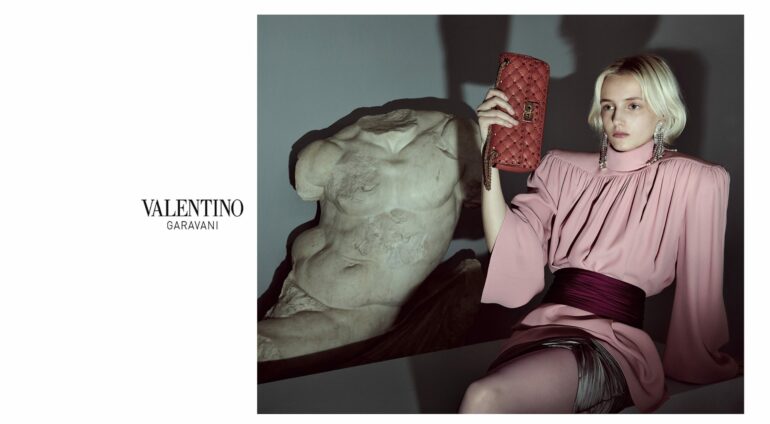
The Spark and the Marble: Valentino’s Temporal Collision at the Centrale Montemartini
At first, the gaze is lost in the darkness, where the cold metal of the turbines still seems to vibrate with a vanished energy. Then, a burst of light reveals a silhouette in silk, brushing against the raw steel of a colossal diesel engine. For Fall-Winter 2026–2027, Valentino sets aside its traditional gilded opulence for a foray into the electric heart of Rome. After taking over the stone galleries of the Palazzo Barberini, the “Interferenze” collection—under the creative direction of Alessandro Michele—finds new iconographic life in a place where the history of art and the history of industry become one: the Centrale Montemartini.
Captured through the lens of Glen Luchford, this campaign does more than simply document a collection; it stages a dialogue between two worlds that, on the surface, seem polar opposites. This choice of location, typical of Michele’s approach, favors historic sites often overlooked by the general public, prioritizing narrative depth over mere aesthetic surface. The Centrale Montemartini, located on the left bank of the Tiber, asserts its hybrid character here, providing a stage of light and shadow for the fashion house’s new creations.
An Archaeology of Energy: From Turbine to Museum
To understand the visual power of these images, one must delve into the building’s origins. Built in the early 20th century, the Centrale Montemartini was the Eternal City’s first major public power plant. A testament to a Rome in the midst of modernization, it fueled dreams of progress before falling into disuse. But in 1997, a transformation took place: the industrial site was repurposed to house part of the prestigious collection of the Musei Capitolini.
It is this dual nature—suspended between the sheer scale of the metal frameworks and the delicacy of classical statuary—that forms the beating heart of the campaign. Michele explains, in a letter accompanying the release of the visuals, that the location is never treated as a mere backdrop. On the contrary, the images extend the Centrale’s intrinsic logic. They create a space where elements that normally belong to incompatible spheres cease to exclude one another and instead coexist seamlessly. It is in this interplay that a unique narrative emerges, blurring the lines between the ancient past and the industrial past.
The contrast is striking: diesel engines, alternators, and overhead cranes—once symbols of mechanical power—now serve as silent guardians of motionless masterpieces. In this engine room transformed into a sanctuary, clothing becomes the connecting thread that links these disparate eras.
The Cinematics of the Moment: The Vision of Glen Luchford
Under Glen Luchford’s direction, the imagery moves away from the stillness of classic fashion photography to adopt the codes of cinema. Light cuts through the space in sudden bursts, revealing fragments of bodies, profiles of polished marble, and the geometric structures of the alternators. This visual construction rejects the linearity of time. Here, time does not proceed in successive stages but is expressed through a logic of “co-presences.”
We witness a genuine encounter between the lightness of textiles and the gravity of steel. The models’ gestures seem to respond to the frozen postures of the statues, extending the movements carved into stone millennia ago. Nothing in these images seems completely still, yet nothing is truly in motion either. It is this in-between state, this limbo, that gives the “Interferenze” campaign its atmospheric depth. The large machines almost vanish into the surrounding darkness, leaving the stage entirely to a silent dialogue between flesh and stone, fashion and archaeology.

Mechanical deities and totemic accessories
Amid flywheels and pistons, mythological figures come to life. The goddess Fortuna, the muse Polymnia, and even Queen Cleopatra inhabit the space, standing proudly among the engines and material-handling carts. This juxtaposition transforms our perception of ancient statuary: it sheds its sacred and distant character to become a protagonist of modernity. Conversely, industrial archaeology acquires a new nobility, shrouded in the mystery of ancient myths.
At the heart of this scene, Valentino’s accessories stand out with particular clarity. Valentino Garavani’s Rockstud pumps, with their iconic studs, echo the sharp edges of the metal structures. The Rockstud Spike bag and the Stud Up sneakers, adorned with delicate butterfly-shaped embroidery, bring a touch of organic sophistication to this mineral and mechanical environment. The oversized sunglasses, meanwhile, seem to shield the eyes from the mystery emanating from the shadows of the power plant.
These objects are not simply placed there; they are an integral part of the installation. They are the vehicles through which the viewer navigates between eras. The butterfly embroidered on a sneaker becomes as precious as the drape of a Roman tunic, and the strap of a luxury shoe seems as technical as the rotation of a turbine.
The Interval as a Space of Freedom
For Alessandro Michele, the meaning of such a work lies not in the objects themselves, but in the void that separates them. “No form speaks for itself,” he asserts, emphasizing that each image arises from its confrontation with another, and each material from its relationship with a different texture. It is in this interval—where the usual classifications of art history or fashion falter—that the visible ceases to merely represent the world and instead invites us to reimagine it.
The Fall-Winter 2026–2027 campaign reminds us that fashion is a science of relationships. By bringing together ancient statuary and the industrial archaeology of the Centrale Montemartini, Valentino does not seek to be modern, but to be timeless. The true essence of elegance lies precisely there—in this ability to bring incompatible worlds together and to transform a former power plant into a theater of pure imagination.