
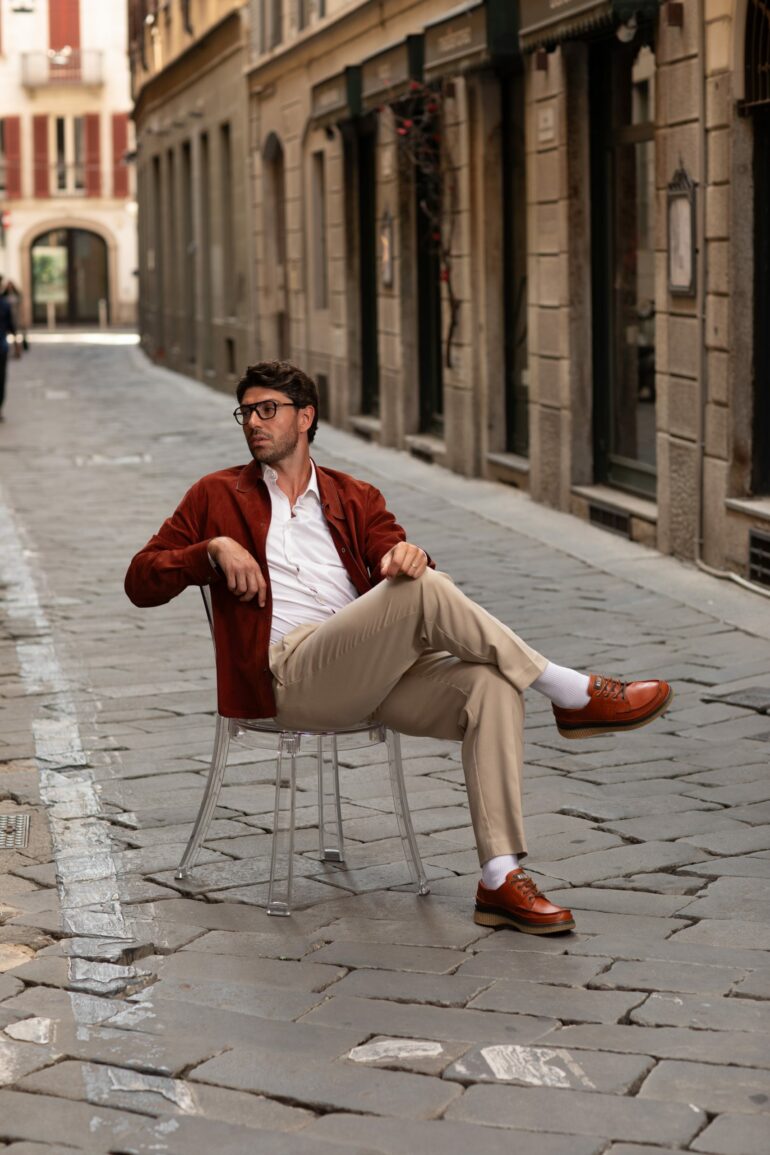
A shoe is admired from a distance, but judged up close—by how well the foot fits into it. It is in this gap between image and function that Ecco’s proposal for Fall-Winter 2026 comes into play. With the Walker 3.0, the Danish shoe brand showcases a leather model with clean lines, whose most tangible selling point is an adjustable fit. Ignazio Moser serves as the face of the campaign. Yet the most interesting aspect of this campaign lies not so much in the ambassador himself as in the role entrusted to him: drawing attention to a shoe designed to accompany everyday life.
Discretion as a Design Choice
The Walker 3.0 does not seek, in its presentation, to impose an aesthetic break. On the contrary, Ecco describes it as one of the most representative styles in its catalog. This clarification changes how the campaign is interpreted. The goal is not to introduce an unexpected direction, but to bring back into the spotlight a design language that the brand already considers its own.
This design language is rooted in a minimalist silhouette that has been a core part of its design identity for several seasons. Continuity is embraced. Where a seasonal campaign might emphasize change, Ecco chooses a model designed to make its approach immediately clear. A minimalist shape, leather, and a focus on fit: the elements highlighted prioritize the shoe itself over any flashy marketing gimmick.
It would be premature, however, to confuse visual simplicity with a lack of purpose. A shoe intended for various occasions must precisely avoid being confined to a single style. This is the versatility that Ecco is championing here. The Walker 3.0 is presented as a pair to be worn regularly, not as a shoe reserved for a special occasion. Its uncluttered design supports this intention, though it is not enough on its own to guarantee its success.
The Foot Before the Photograph
The technical feature has a name: Dual Fit. According to the brand, this system allows the fit to be adjusted to the foot’s needs. The value of this claim lies in its relative precision. Ecco isn’t just talking about comfort in the abstract; the company identifies a specific parameter—fit—that its shoe is designed to address.
This distinction is worth noting. Comfort remains a personal experience that cannot be deduced from either a photograph or the name of a technology. An adjustment mechanism, on the other hand, is a stated response to diverse needs. The model’s presentation does not detail how Dual Fit works. It therefore does not allow us to describe how to use it or to measure its effects. It does, however, indicate where the brand places one of its key selling points: in the relationship between the foot and the shoe.
This aspect provides a useful counterpoint to the simplicity of the design. On the outside, a silhouette intended to work across multiple contexts; on the inside, a fit presented as adaptable. The two intentions complement each other without overlapping. One concerns the shoe’s place within an outfit; the other, its suitability for the wearer. For a model intended for everyday use, the second consideration is at least as crucial as the first.
Leather rounds out this offering. It is the material specified for the Walker 3.0, though its finish or characteristics are not detailed here. It’s best to stick to this fact rather than attribute undocumented qualities to it. The campaign thus provides a few clear points of reference, but leaves it to the fitting to determine what a marketing message cannot: the actual feel on the foot.
A New Face for an Established Identity
This is where Ignazio Moser comes in, chosen as the ambassador for the Fall/Winter 2026 campaign. His mission centers on promoting the Walker 3.0. The choice of a recognizable face introduces a human element into a narrative that, without it, might remain focused solely on materials and technology.
The collaboration is part of Ecco’s strategy to pair personalities from the worlds of sports and entertainment with its iconic products to promote seasonal collections. The approach is clear: to renew interest in the product line through the people who embody it. Innovation can thus stem from how the product is presented, without requiring a complete overhaul of its design language.

In the case of the Walker 3.0, this shift is particularly evident. The ambassador provides the driving force behind the campaign; the shoe retains its role as the flagship within the product line. It is also important to distinguish between representation and creation. The ad assigns Ignazio Moser the role of brand ambassador, not that of a designer involved in creating the model. This distinction prevents a marketing collaboration from becoming a joint creative project.
The background story, not an automatic selling point
Founded in Denmark in 1963 by Karl and Birte Toosbuy, Ecco has a history that this campaign builds upon without making its founding the main focus. This reference point matters: it contextualizes the company. On its own, however, it demonstrates neither the qualities of a pair of shoes nor the relevance of a technology. These qualities must be understandable independently of the date mentioned in the brand narrative.
The Walker 3.0 offers a more concrete entry point into this identity. Ecco places it among the models that best represent its catalog and ties its essential design elements to several seasons of design. The continuity the brand claims is thus embodied in a contemporary product. It is evident in the shoe’s form and intended use, rather than solely in the evocation of its Danish origins.
This choice lends the campaign an interesting tension: how do you create a buzz around a shoe whose stated purpose is to blend seamlessly into everyday life? The collaboration with Ignazio Moser addresses the need for visibility. The Dual Fit addresses a fit issue. Striking a balance between the two, the model must maintain the consistency of a concept that prioritizes regular use.
The campaign attracts attention; trying them on seals the deal
Ecco has an international presence through its company-owned stores and a network of selected multi-brand retailers. These two channels serve as the commercial extension of the campaign. They also place the Walker 3.0 in a less abstract context than the image suggests: that of a shoe you can examine and compare to your expectations.
This is where the adjustable fit really comes into its own. A simple silhouette may win you over at first glance; how well it fits the foot requires a closer look. For the Walker 3.0, the question left open by the photograph is therefore very concrete: once you’ve slipped on the pair, what difference does Dual Fit make?