
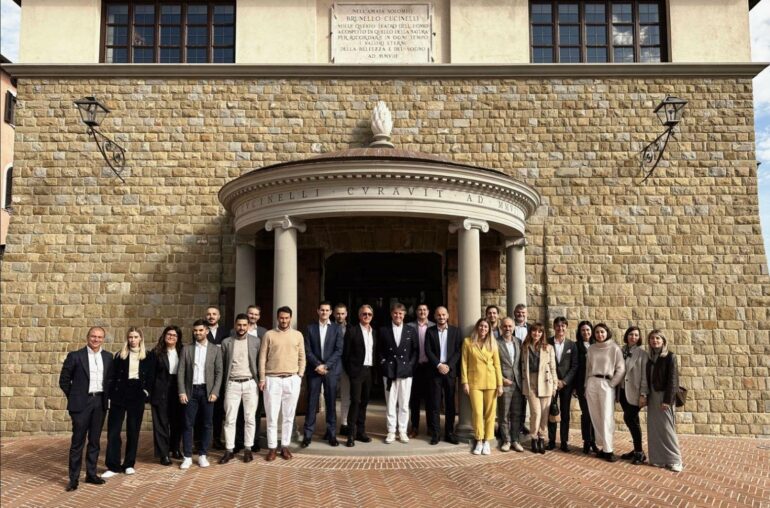
Algorithms and Consciousness: When Silicon Valley Comes to Solomeo
The story doesn’t begin in the hushed confines of a boardroom, but around a table in San Francisco in 2016. That evening, Marc Benioff, the flamboyant founder of Salesforce, and Kevin Systrom, one of the co-founders of Instagram, welcomed a guest whose name resonates with a promise of timelessness and artisanal craftsmanship: Brunello Cucinelli. The Umbrian entrepreneur, known for transforming cashmere into a humanist manifesto, wasn’t there to discuss operating margins. He came to share his vision of an economy that would place the soul at the heart of profits. This dialogue, which began under the California sky, has just reached a decisive milestone with Salesforce’s official investment in Solomei AI, the technology firm behind the Callimacus project.
This investment marks the American giant’s recognition of a unique development model. Solomei AI, backed by Foro delle Arti—the Cucinelli family’s holding company—is not a start-up like any other. It is the result of a slow gestation, nourished by the “Universal Symposiums on Soul and Economics” held in the medieval village of Solomeo. It is there, nestled between olive groves, that Benioff, Reid Hoffman (LinkedIn), and Kevin Scott (Microsoft) have come, year after year, to test their algorithms against Platonic philosophy. From these exchanges emerged a conviction: artificial intelligence should not be a prison of data, but a tool for user liberation.
Callimacus: The End of the Era of Static Pages
At the heart of this alliance lies a platform with an evocative name: Callimacus. Behind this reference to the ancient poet and librarian lies a major technological breakthrough. The idea championed by Brunello Cucinelli and Marc Benioff is to put an end to the dictatorship of predetermined navigation. Today, exploring a website often amounts to getting lost in a labyrinth of categories, drop-down menus, and paths mapped out by developers. Callimacus proposes to do away with these rigid structures in favor of a “conversational” web, capable of adapting in real time to the user’s intent.
The concept is based on an intuitive interface where static pages disappear. The user is no longer a mere “visitor” subjected to a software architecture; they become the protagonist of a fluid experience where the platform guides their desires without imposing a set path. This vision found its first concrete application in January 2026, with the launch of Brunello Cucinelli’s new e-commerce portal. This full-scale test served as a proof of concept for Solomei AI, demonstrating that cutting-edge technology can take a back seat to the simplicity of a nearly human dialogue.
For Brunello Cucinelli, president of Solomei AI, this project is the culmination of three years of relentless work involving mathematicians, engineers, and philosophers. This multidisciplinary approach aims to create a language that is not solely binary. The ambition is clear: to accelerate the development of Callimacus to make it a European and North American standard, radically transforming the way brands and institutions interact with their audiences digitally.
The Financial Implications of Digital Sovereignty
While the official figures for the transaction remain confidential, estimates circulating in financial circles—notably reported by the Corriere della Sera—suggest that Solomei AI is valued at between 70 and 100 million euros. Salesforce’s entry into the company’s capital goes beyond a simple injection of cash. It is part of a broader strategy by the American group, which recently announced a massive $1 billion investment plan in Italy over five years. This program includes the opening of a new headquarters in Milan, an expansion of the workforce, and a major push for artificial intelligence training in both the private and public sectors.
However, this transaction is not just a matter of numbers. It touches on Italy’s technological sovereignty. Due to the strategic nature of Solomei AI’s assets, the transaction is subject to the “Golden Power” procedure. This legislative mechanism allows the Italian government to scrutinize—and potentially impose conditions on—foreign investments in sectors deemed vital to the national interest. The final closing is therefore contingent upon approval from the Presidency of the Council of Ministers. This administrative scrutiny underscores Callimacus’s importance: we are no longer talking merely about an online sales tool, but about a fundamental technological building block capable of redefining the standards of data exchange.
Salesforce’s entry alongside the founders and long-standing shareholders—including Foro delle Arti—guarantees Solomei AI unprecedented commercial clout. The goal is now to deploy the platform’s engineering research capabilities on an industrial scale, while preserving the digital ethics that guided its creation.
From Solomeo to Global Expansion: An Ethics of Code
The bond between Marc Benioff and Brunello Cucinelli extends beyond the realm of business. It illustrates an attempt to reconcile two worlds that seem to be polar opposites: the exponential speed of technology and the contemplative slowness of artisanal craftsmanship. By inviting Cucinelli onto the stage at Dreamforce, Salesforce’s annual flagship event, Benioff sought to infuse a dose of extra soul into an industry often criticized for its moral barrenness. Conversely, Cucinelli has found in the cloud a way to sustain his dream of “humanistic capitalism.”
Callimacus is the direct result of these exchanges. The project would likely never have seen the light of day without this shared desire to think outside the box of traditional engineering. By integrating humanists into the software development process, Solomei AI has made the bet that the machines of tomorrow will need to know how to listen before making suggestions. This philosophy of “conversational” and intuitive AI stands in contrast to the intrusive recommendation models that currently flood the web. The goal is to restore dignity to the internet “user,” respecting their intelligence and freedom of movement.
The planned commercial expansion into Europe and North America will be the true test of this vision. The goal will be to prove that a product born in the tranquility of Umbria can compete with the giants of the West Coast while retaining its identity. Callimacus’s success could pave the way for a new generation of applications where technical efficiency would no longer be the sole measure of success, but where the fluidity of human interaction and data ethics would become essential criteria of luxury. In this near future, code will no longer be just a string of zeros and ones, but perhaps, at last, a form of functional poetry.