
Nearly 10,000 visitors walked through the doors of the first Sodini store, located on the Viareggio boardwalk, during its first few months of operation. For this contemporary jewelry brand based in Lucca, the figure serves primarily as a way to make its mark. Accustomed to selling through retailers, it now has a space where it can directly gauge reactions to its collections. The challenge goes beyond simply opening a store: how does one build a recognizable identity when the constant renewal of jewelry is precisely what drives the brand? This is the core challenge for Sodini—balancing the fast pace of fashion with the process of learning to operate its own retail business.
In Viareggio, the customer becomes the point of contact
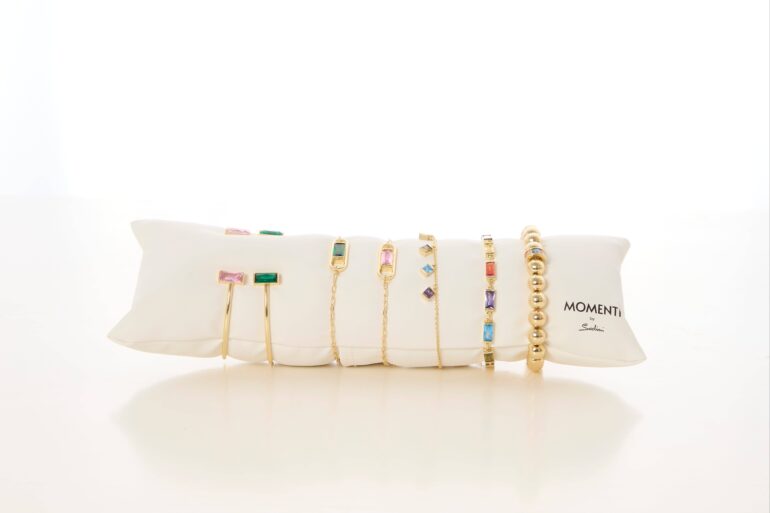
The Viareggio store offers an initial glimpse into Sodini’s ability to thrive outside the context of a multi-brand environment. The company reports a particularly favorable reception from both Italian and international visitors. It highlights, in particular, the success of “Momenti,” its line designed for everyday wear. This experience allows the brand to test a range organized into several collections directly with the people who wear them, rather than learning about their preferences solely through orders from distributors.
The next steps remain cautious. Sodini is exploring the opening of a second pilot store by 2027, without announcing a large-scale rollout at this stage. The term “pilot” is important: the goal is to develop a direct distribution model that can, in the medium and long term, gain consistency and visibility. A potential franchise network is part of this vision, but remains a possibility, not a finalized plan. Before expanding to multiple locations, the brand is therefore seeking to understand what works at the first store.
A piece of jewelry that finds its place in the silhouette
To grasp what Sodini aims to showcase in its stores, one must focus on how the pieces are worn. Federico Sodini, its CEO, emphasizes the physical presence of the pieces: volumes and shapes bold enough to be noticed. Here, the jewelry plays a visible role in the silhouette. This approach explains the importance placed on its emotional dimension, as well as the need to offer varying degrees of intensity. Not everyone is looking for the same effect, nor at the same time of day.
The Fall-Winter 2026 collection divides these uses across several lines. Within the Main line, the Kosmos project takes its name from the Greek concept of the universe. Here, the brand articulates materials, colors, and volumes around jewelry as a form of personal expression. It’s not just about adding an accessory to an outfit: the piece must allow the person who chooses it to express something about themselves. It is in this collection that the formal design finds its most explicit expression.
Momenti by Sodini operates on a different scale. The pieces are smaller, the price is more accessible, and the intended use is less formal—from the office to a night out. The line thus targets a younger audience, without sacrificing continuity across the different moments of daily life. Re-trend rounds out the collection by offering Sodini’s take on contemporary trends. This structure allows for variation in style without requiring a single collection to meet every expectation.
The Fashion Calendar as a Method
The uniqueness championed by Federico Sodini stems less from a specific category of jewelry than from a way of working. The CEO positions his company within the realm of fashion jewelry: collections are designed and refreshed according to a timeline similar to that of apparel. Seasonal change is therefore not merely a matter of adjusting the color palette. According to him, it involves extensive research into style, materials, and production processes.
The calendar presented at Vicenzaoro in September 2026 brings this approach to life. The fall-winter designs on display at the trade show had already been on the market since late August. And two weeks after the event, the company planned to present the spring-summer collection to its sales network. Two seasons are thus underway simultaneously—one for customers, the other for the sales teams. Research must fuel this pace, while distribution must be able to keep up.
This flexibility in the product offering also serves as a selling point for jewelers more accustomed to a traditional selection. According to the CEO, specialty retailers carrying Sodini regularly place new orders and attract a customer base different from their traditional clientele. While this remains the company’s position, it sheds light on its proposal to retailers: to introduce a new way of purchasing and wearing jewelry, without waiting for a special occasion.
Italian design, two production streams
Upstream, the design is handled by an entirely Italian in-house design studio, which combines freehand sketching with three-dimensional modeling. Manufacturing, meanwhile, relies on two production chains, one in Italy and the other in China. This distinction deserves to be made clear: the origin of the design and that of production are not the same.
Federico Sodini presents this organizational structure as a strategic positioning choice, not merely a cost-saving measure. The company’s relationships with Chinese suppliers date back to 2005. The CEO states that, even at that time, he established specific requirements—particularly regarding crystals, electroplating processes, and finishes. In a product line where visual impact is key, these elements matter: they contribute to the final result just as much as the initial design. The brand’s narrative thus places stylistic research and execution on the same continuum.
The multi-brand store continues to fuel the brand’s ambition
The Viareggio store is drawing attention, but Sodini’s economic center of gravity lies elsewhere. Approximately 85% of its revenue comes from wholesale, driven by agents and more than 800 multi-brand retail locations in Italy. This network forms the foundation of its growth. In the first eight months of 2026, revenue from this channel rose by 16.5% compared to the same period in 2025, versus 12.5% for direct sales, including boutiques and online sales combined.
The company ended 2025 with revenue of approximately 5.5 million euros, up 31% year-over-year, and is targeting 6 million for the current fiscal year. The expansion of its own retail operations thus complements an existing network that continues to grow. Internationally, trade shows serve as key touchpoints: in addition to Vicenzaoro and Fashion&Jewels Milano, Sodini is participating in Bijorhca Paris for the first time. The goal is to strengthen engagement with buyers and identify new opportunities outside its established markets.
Fifteen corners to better track sales
Between the traditional multi-brand store and the exclusive boutique, Sodini is developing an intermediate format: the Soft Corner. Fifteen such setups are already in place at selected client locations and in department stores. The model combines specific commercial terms with the sharing of sales data on end consumers. It thus provides a source of information beyond just orders placed with the brand.
This may be where the next step lies. Federico Sodini aims to use this more precise understanding of purchasing behavior to guide future collections, while continuing physical and digital expansion. For a company that prides itself on rapid change, having concrete feedback becomes a key working tool. The fifteen retail corners and the Viareggio store now share this common function: feeding customer choices back to the design studio.