
The Paradox of Paestum, or the Awakening of the Senses
There are few places in the world where the sacredness of ancient stone blends so rawly with the simplicity of rural life. In Paestum, the monumental gateway to the Cilento, the Greek temples do not reveal themselves to visitors in the hushed silence of an open-air museum, but in the scent of grazing flocks. Between the Doric columns that defy the passage of time, the air carries the earthy, musky scent of sheep grazing just a stone’s throw away. This clash between the grandeur of a vanished civilization and the enduring nature of agricultural land defines the very identity of this natural region in the province of Salerno. Here, south of Naples, the compass points inexorably toward a wild south—an enclave of resistance where modernity has not yet smoothed out the terrain or standardized the flavors.
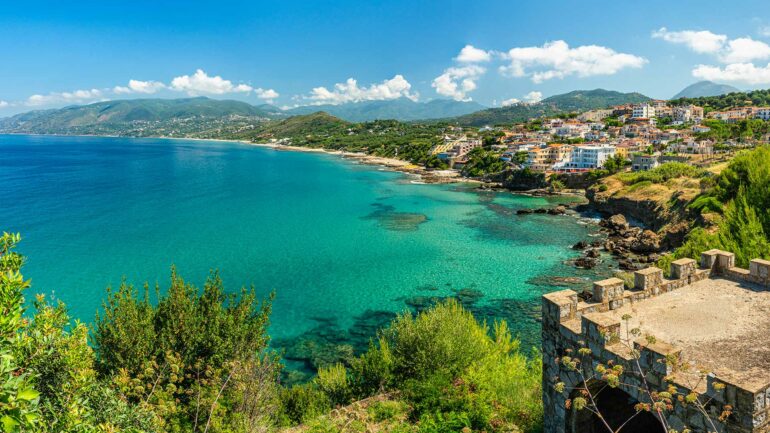
Cilento is not easily tamed. Its topography, largely protected by a national park, is a lacework of rock and forests that follows the whims of the sea. You travel there on national highways that wind through thousands of curves, or via a coastal railway line that seems to be the last umbilical cord connecting these suspended villages to the rest of the world. This rugged landscape has had an unexpected consequence: Cilento has escaped the tourist onslaught that overwhelms the neighboring Amalfi Coast. It is a land of wide-open spaces, stripped of part of its population by past emigration, but one that has managed to transform this silence into a rare luxury: that of a majestic natural landscape best explored on foot or by bicycle.
Pioppi: The Epicenter of a Silent Revolution
To understand how this region has conquered the world through its cuisine, one must stop in Pioppi. This modest fishing village might have remained a footnote in local history had it not been for an American couple of nutritionists, Ancel Keys and his wife Margaret, who settled there in the 1950s. Observing the residents’ exceptional longevity and remarkable health, they developed what we now call the Mediterranean diet. What was then merely a way of life dictated by necessity—little meat, plenty of vegetables, and an abundance of olive oil and grains—has become a nutritional holy grail, now recognized by UNESCO as part of the Intangible Cultural Heritage of Humanity.
Yet behind the scientific veneer of the “diet” lies a deeper reality: cucina povera. In Cilento, historical poverty did not lead to food scarcity, but rather to a culinary ingenuity that today delights food lovers in search of meaning. Long before vegetarianism became an urban trend, the farmers of Cilento practiced a cuisine that was plant-based at its core, yet possessed an unsuspected complexity of flavors. Here, one rediscovers that simplicity is the ultimate sophistication, particularly when it is grounded in ingredients of raw, unadulterated quality, born of volcanic soil and iodine-rich sea air.
The Art of the Terroir: From Myrtle Leaves to White Figs
The local cuisine reads like a catalog of rarities. Take “mozzarella ind’a murtedda”: a far cry from industrial production, this cheese is preserved here in myrtle leaves. This ancestral method does more than simply protect the stretched curd; it infuses it with resinous and wild aromatic notes, transforming a classic tasting into a unique sensory experience. This attention to natural detail is also evident in the celebration of legumes. The cuccia, the region’s iconic dish, is a soup that combines thirteen varieties of legumes and slow simmering. It’s a concentration of biodiversity in a bowl, an ode to patience.
The Cilento terroir also finds expression through its DOP-certified products and Slow Food Presidia. The white fig of Cilento, sun-dried and sometimes stuffed with almonds, is a concentrated source of natural sugar that once served as an energy reserve for work in the fields. Seasonal vegetables, meanwhile, dictate the rhythm of the menus. The eggplant, queen of summers, is served as “mulignane mbuttunate,” stuffed with local goat cheese according to dialect recipes that the nuns pass down like state secrets. To accompany these feasts, the region draws on distinctive winemaking, boasting five DOC labels that attest to the revival of native grape varieties on these steep slopes.
A Landscape of Effort and Contemplation
Exploring the Cilento requires embracing a certain slowness. Whether strolling through the labyrinthine alleyways of Castellabate, a medieval village overlooking the sea, or venturing toward the promontory of Punta Licosa, every journey is an immersion. At Punta Licosa, the bicycle reigns supreme for exploring the trails that overlook the waves, where legend places the song of the sirens. It is this mythological dimension that surfaces everywhere: the landscape seems imbued with an ancient memory, from the Cappelli di Venere waterfalls—whose waters flow like a cascade of vegetation—to the cliffs of Palinuro.
Here, water is more than just a backdrop. It is a playground and a source of sustenance. The port of Agropoli is ideal for kayaking expeditions, offering access to coves inaccessible by land, while the ports further south, such as Sapri, mark the transition to the drier lands of Basilicata. Travelers who choose Cilento forgo standardized infrastructure in favor of the authenticity of a jagged landscape that never ceases to whet the appetite.

Sanctuaries of Flavor: Four Must-Visit Stops
To truly immerse yourself in this culture of fine dining, you must step inside places where time seems to have stood still, without, however, turning your back on the present. In Pioppi, the Casa di Delia is undoubtedly the most historic spot. Delia Morinelli, who served as housekeeper and cook for the Keys couple, carries on a culinary legacy that spans nearly a century. In her kitchen, vegetables are paired with anchovies and bluefish with a simplicity that borders on devotion. It’s a place steeped in nostalgia where every dish tells the story of the origins of the Mediterranean diet.
Higher up in the hills, the village of San Mauro Cilento is home to Al Frantoio. This restaurant, an offshoot of a cooperative comprising more than two hundred producers, is the beating heart of the local region. Here, the decor takes a back seat to the ingredients. You’ll start with a tasting of olive oils pressed on-site, before indulging in scarola’mbuttonata, a salad stuffed with cheese, eggs, and raisins that perfectly captures this blend of rustic simplicity and culinary indulgence. It’s a place for sharing, where the concept of a short supply chain has been a daily reality for decades.
The culinary journey continues to Roccagloriosa, a hilltop village where the osteria U’ Trappitu is a beloved local institution. The restaurant’s reputation rests on a trio of seasonal vegetables served as an appetizer, followed by fresh pasta topped with caccioricotta—a firm, salty sheep’s-milk cheese—or zucchini flowers. The highlight of the meal is the parmigiana di melanzane, served here with a dollop of warm ricotta, creating a contrast of textures and temperatures that alone makes the trip worthwhile.
Finally, on the edge of the national park, Locanda Le Cocole in Moio della Civitella offers a more contemporary take on tradition. In a setting that departs from the usual rustic aesthetic, the restaurant serves a streamlined menu executed with exemplary precision. Marinated squash with red onions sits alongside the famous mozzarella wrapped in myrtle leaves, proving that Cilento’s cuisine, while rooted in the past, is a living art form, capable of reinventing itself without ever betraying its peasant roots.
Conclusion: the elixir of simplicity
Visiting Cilento is, ultimately, an experience of a refreshing disconnect. Far from the tourist crowds of northern Campania, this region offers an alternative where luxury is measured by the clarity of the water, the shade of the holm oaks, and the flavor of olive oil pressed that very morning. It is a land that doesn’t cut corners, where one comes to understand that the famous Mediterranean diet is not a medical prescription, but the result of a millennia-old dialogue between humankind and a demanding natural world. As you leave these stone villages, you take more than just memories with you: a certain sense of enduring tradition, rooted in the simple pleasure of honest, wholesome food.