
Make Texture a preferred source on Google to support us
Add Texture to GoogleThe MTM (Made to Measure) collection, unveiled during Milan Design Week 2026, embodies an innovative approach where geometric coherence, artisanal craftsmanship, and flexibility come together. It brilliantly illustrates the continuity of Herzog & de Meuron’s architectural philosophy, subtly transposed into the world of furniture.
An architectural logic on the scale of furniture
With MTM (Made to Measure), Herzog & de Meuron continue to explore an idea close to their hearts: designing a system capable of generating variety while maintaining absolute coherence. Presented by the manufacturer UniFor, this collection brings to the realm of furniture a methodology that has structured their architecture for decades. The logic seems simple on the surface—consistent geometry and a clear structure—but its application, as functions and materials vary, is a true feat of engineering.
The project does not seek to impose a one-of-a-kind piece or a sculptural work. On the contrary, it offers a fluid constructive vocabulary, capable of expanding, contracting, or reconfiguring itself according to the spaces. This is where its greatest strength lies. In a field often seduced by ostentatious signature styles, MTM elevates the discipline of architecture to a bulwark against fleeting spontaneity or mere stylistic whim.
A shared design language in the service of functionality
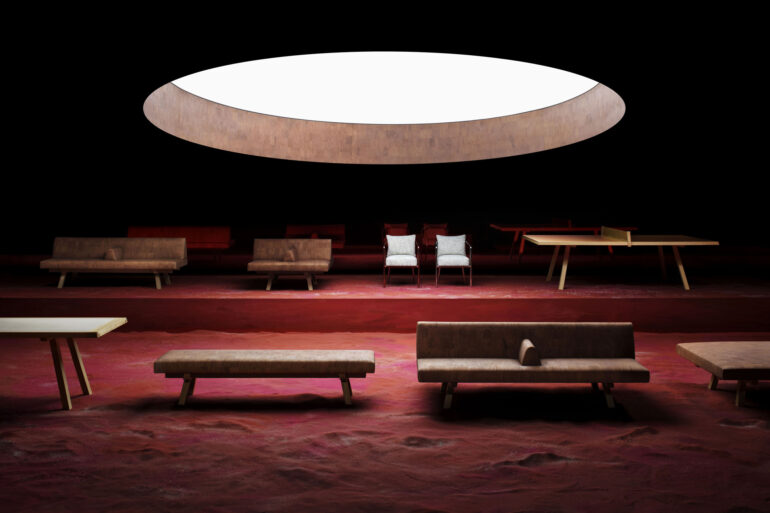
This collection features a wide range of pieces: tables, benches, sofas, coffee tables, daybeds, and even a ping-pong table. Upon closer inspection, one thing becomes clear: the entire collection is based on a strict 12-degree angle, a true visual thread that runs from the legs to the vanishing point of the tabletops. This unique geometric rule serves as the backbone for uses that are, however, radically distinct.
The furniture thus becomes a micro-infrastructure, an agile system designed to adapt to diverse environments—offices, cultural institutions, educational spaces, or public places—without ever diluting its visual identity. This approach echoes the most rigorous works of Herzog & de Meuron, where form is never an end in itself, but rather the result of specifications precise to the millimeter.
Construction Detail as a Signature
The very essence of this collection lies in a detail that is almost imperceptible at first glance: the assembly of the four solid wood beams. Here, UniFor and Herzog & de Meuron reinterpret a traditional interlocking technique rooted in the art of cabinetmaking. The design of the joint ensures the structure’s stability and strength through the sheer power of its geometry alone, relegating conventional fasteners to the background.
This artisanal elegance is complemented by cutting-edge engineering: metal rods, subtly concealed within the beams, create tension that allows for spectacular spans. The intention is not to hide the technique or gloss over it, but to make it fully visible. At Herzog & de Meuron, the construction transcends its primary function to become a true language.
A Dialogue of Materials and Timelessness
While solid wood forms the structural framework of the collection, the tabletops introduce sophisticated sensory variations: natural oak, tinted glass, travertine, and Lepanto Red stone. A version in mirror-polished steel enriches this vocabulary, while the seating elements give pride of place to cork. This material was selected both for the warmth of its texture and for its tendency to develop a patina over time, thereby anchoring the object in both duration and memory.

This material choice avoids the pitfall of uniformity without succumbing to purely decorative heterogeneity. Cork, a recurring signature in the work of the Basel-based architects, infuses a welcome softness that tempers the rigor of the overall design. The overall aesthetic remains one of self-assured simplicity, at times bordering on noble austerity, without ever veering into coldness.
Non Places: Rethinking Scenography
The collection was unveiled within Non Places, a conceptual installation designed by Studio Klass, engaging in a dialogue with “Giuditta,” another creation by Herzog & de Meuron. Designed by UniFor, this setting liberates the furniture from traditional conventions and the routine of the commercial display window, giving it a truly spatial and conceptual dimension.
The choice of this title is highly symbolic. It evokes the idea of transitional spaces—those hybrid areas straddling the boundary between the private and the public. The installation embraces this ambiguity and rejects the smooth, sometimes overly formulaic nature of contemporary design. It allows the structure of the objects themselves to dictate the narrative, rather than mimicking an idealized lifestyle.
By partnering with UniFor, a historic figure in interior design since 1969, the Basel-based firm extends its philosophy to the scale of the individual object. One brings the architectural vision; the other, manufacturing excellence. Together, they deliver not just a collection, but a constructive manifesto. In a market often saturated by aesthetic obsolescence, MTM reminds us that a piece of furniture can be conceived as a work of architecture in its own right. A proposal marked by elegant discretion, confirming that in the realm of design, silences are often the most eloquent when faced with the test of time.