
Make Texture a preferred source on Google to support us
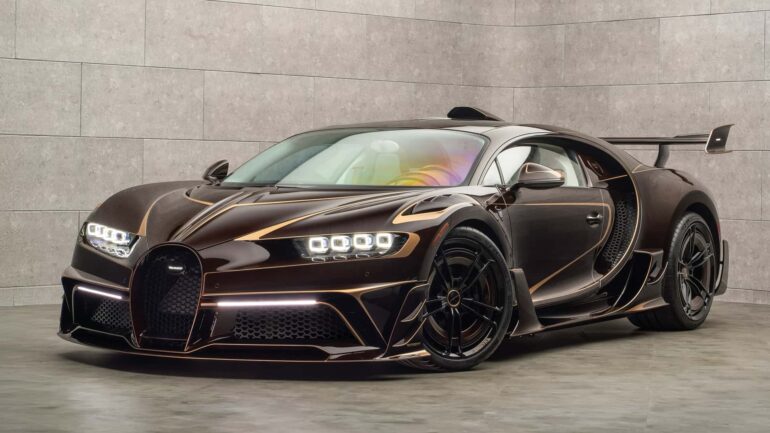
Add Texture to GoogleThe immaculate lawn at Pebble Beach regularly serves as the stage for the most spectacular displays of automotive extravagance, but the recent unveiling of the Vivere there shed a unique light on the psychology of the hypercar market. This one-of-a-kind creation, crafted by the German tuner Mansory from a Bugatti Chiron, comes at a specific moment: the doors of the Molsheim factory have closed for good on production of this model. The factory has turned the page. Yet, far from Alsace, the machine refuses to shut down. Mansory’s creation offers a stark look at a reality of hyper-luxury: the end of a car’s industrial life cycle in no way signals its media or stylistic death knell. On the contrary, this sealed-in rarity acts as a catalyst for tuners, eager to fill the void left by the manufacturer.
Aesthetic Break with the Norm as a Manifesto
Standing out from the crowd when you already belong to a caste limited to 500 units is a form of deliberate one-upmanship. Between 2016 and 2024, the Chiron made its mark with restrained brutality—a line that the Vivere deliberately shatters. Mansory’s approach moves away from any notion of discretion to embrace a self-assured, almost aggressive theatricality.
The bodywork abandons traditional colors to showcase exposed, brown-tinted carbon fiber accented by copper-colored details. The car’s original architecture remains, but its exterior is infused with new design intentions. The front hood has been extensively redesigned; the fenders now feature open-work vents, and numerous aerodynamic appendages disrupt the base model’s fluid silhouette. Resting on special FB.5C forged wheels, the car’s stance seems to have taken on a new, more aggressive edge. At the rear, the visual impact reaches its peak with a massively redesigned diffuser, whose structure incorporates no fewer than six exhaust outlets. The final result is akin to a statement of power, a categorical rejection of restraint, illustrating the very essence of customization pushed to its limit.
The Ergonomics of Excess
The Vivere’s interior extends this logic of personalization. The tuner has infused it with its own material vocabulary, covering the space with two-tone upholstery that blends brown and white leathers, punctuated by the ubiquitous presence of carbon-fiber inserts. The interior becomes a showcase of self-celebration for Mansory, which has taken care to scatter badges bearing its name throughout the cabin, replacing most of the original markings with parts custom-made for this project. The immaculate leather contrasts sharply with the starkness of the carbon fiber, creating a visual tension that mirrors the excesses of the bodywork.
But beyond purely aesthetic considerations, this particular example features an option that reveals the paradoxes of the hypercar: the Sky View. These two laminated glass panels, precisely mounted above the driver’s and front passenger’s seats, carried an additional cost of more than $62,000 at the time of the initial order. Far from being a mere interior lighting gimmick, this glasswork served a strict physical purpose. It freed up a few centimeters of headroom—a vital margin to allow taller owners to put on a racing helmet during track sessions. This juxtaposition between the opulence of an interior refined to the extreme and the pragmatic brutality of the track epitomizes the car’s duality.

Respect for the Mechanical Sanctuary
While Mansory chose to rewrite the hypercar’s visual design, the tuner faced a limitation imposed by the technical complexity of the Molsheim-built vehicle. The Vivere’s powertrain remains completely unmodified. The titanic 8.0-liter W16 engine, boosted by its four turbochargers, remains in its factory configuration. This decision speaks volumes about the level of engineering achieved by Bugatti: even the most daring players in the aftermarket hesitate to tamper with a mechanical system of this magnitude.
The power delivered to the all-wheel-drive system therefore remains, depending on the exact variant that served as the basis for this conversion, fixed at 1,479 chevaux (1,500 ps / 1,103 kW) or 1,578 chevaux (1,600 ps / 1,177 kW). This technical consistency directly links the Vivere to its prestigious lineage. Beneath its brown carbon fiber panels, it still shares the same DNA as the most extreme variants developed by the brand itself, from the W16 Mistral barquette to the radical Bolide, including the highly exclusive Centodieci and Divo.
Today, a Chiron sells on the secondary market for between 3 and 4 million dollars. This colossal price tag does not prevent the emergence of a visceral need for differentiation. The Vivere proves that the end of official production was merely a preliminary step. The market is now seizing these chassis to turn them into blank canvases, transforming objects that were already out of reach into polarizing statements. At the center of the cockpit, redesigned by Mansory, a single detail has miraculously survived the total overhaul: the Bugatti emblem, fixed in the center of the steering wheel. A visual afterimage, a silent remnant of the original manufacturer, lost amid an interior that has chosen to shout its uniqueness.