
Make Texture a preferred source on Google to support us
Add Texture to GoogleHanging glass lacework above the waves is a physical challenge. The sea dictates its own rules, the decks reverberate with the power of the underwater engines, and the salty air seeps in constantly. Yet it is in the heart of this unstable environment that Explora Journeys has chosen to establish the aesthetic core of its future cruise ship, the EXPLORA III. By partnering with the Venetian manufacturer Venini, the shipowner transposes the extreme fragility of Murano’s kilns into the constrained space of an ocean-going vessel. This approach marks a sharp break from the monolithic decor that has historically dominated the maritime industry. It represents a direct confrontation between the weight of naval engineering and the delicacy of the decorative arts—a way of rethinking prestige through materiality rather than through pure ornamentation.
Mechanical Constraints as a Creative Force
Installing Venini’s blown glass pieces in the silence of a Milanese gallery demands precision. Anchoring them in the steel of a ship destined to cut through the swells of the Atlantic or the North Sea requires a scientific approach. Since its founding in 1921, the Italian manufacturer has elevated glasswork from its strictly utilitarian status to that of a museum-worthy art form, collaborating with leading designers throughout the century. But on the EXPLORA III, the specifications challenge traditional workshop practices.
The illuminated pieces developed for the ship must absorb the continuous vibrations of the machinery and adapt to the imperceptible twists of a moving hull. Maritime regulations impose safety standards that leave little room for breakage. To ensure these installations survive storms without losing any of their grace, traditional craftsmanship is combined with invisible mounting and suspension systems. The beauty of the result rests entirely on this paradox: an apparent visual lightness supported by an engineer’s framework.
The Spatial Redefinition of Circulation Paths
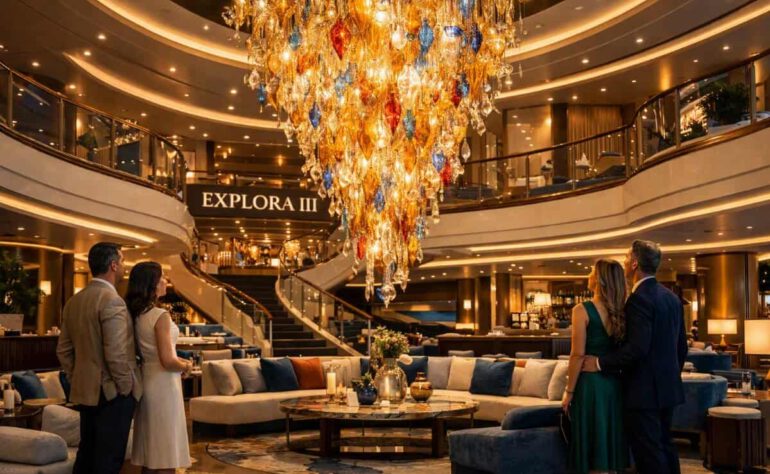
This alliance of art and steel reaches its climax in the main atrium. Historically, a ship’s central hall served as a logistical hub—a bustling crossroads dedicated to directing the flow of passengers. The design of the EXPLORA III takes the opposite approach to this legacy by treating the lobby as a vast public square. Spanning two stories, the space is organized around asymmetrical flights of stairs and a circular bar.
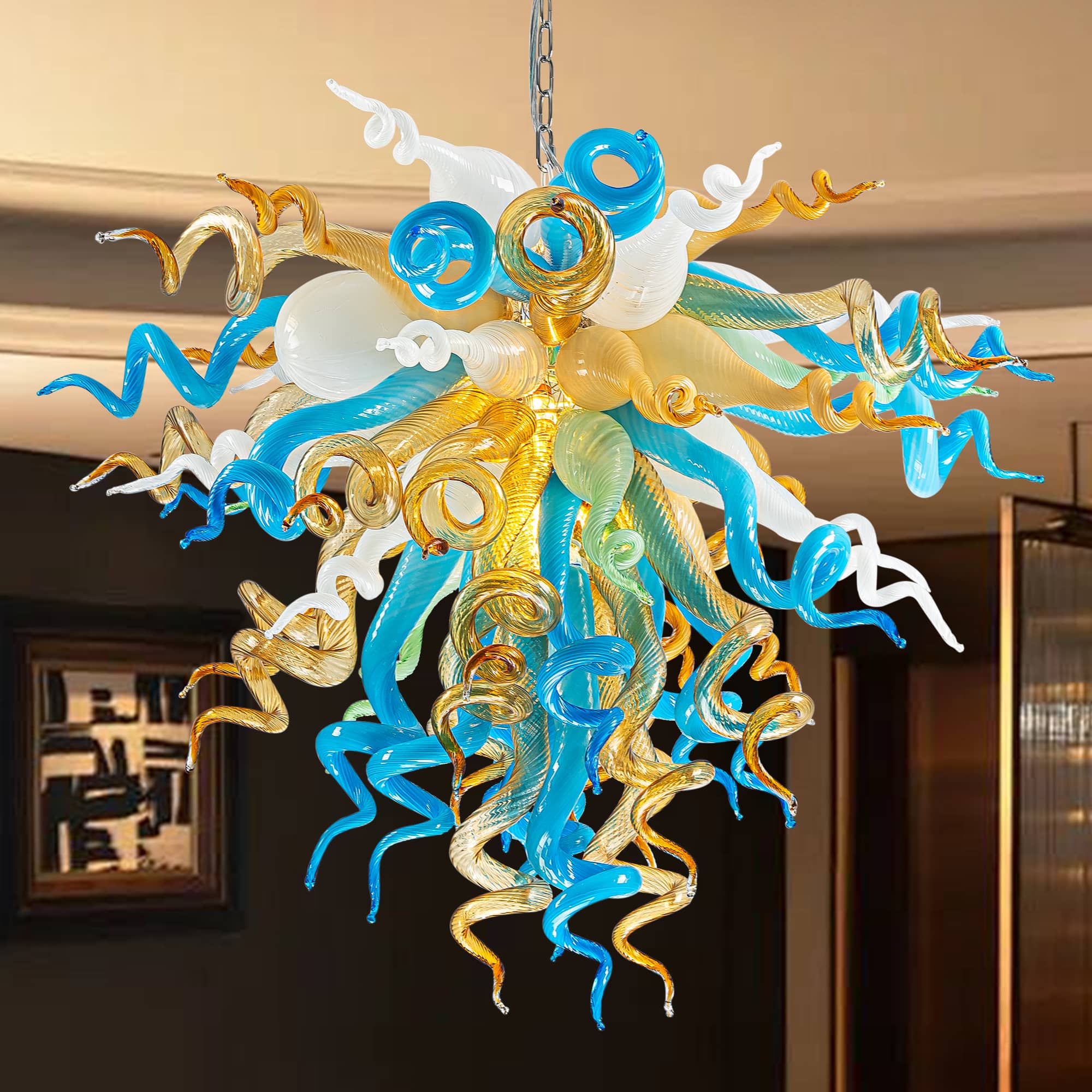
Above these structural elements, cascading Venini chandeliers capture the eye. Here, contemporary naval architecture seeks to hold the traveler’s attention, transforming the simple passage between two decks into a contemplative experience. Drawing inspiration from the standards of cutting-edge land-based hospitality, the space is no longer intended solely to serve as a gateway to the cabins, but to define the company’s visual identity. The lobby serves as a manifesto of interior architecture.
Floating Living Spaces and the Rejection of Ostentatious Decorum
The rejection of ostentatious opulence is also evident in the design of the private spaces. The ship will house 463 guest units, including suites, penthouses, and residences. All adhere to a rigorous structural principle: floor-to-ceiling glass walls and private terraces designed to blur the physical boundary with the ocean. The concept of a floating hotel—often overused by the tourism industry—is grounded here in a very specific physical reality.
The interior design evokes a tactile quality far removed from standard cruise ship aesthetics. The raw oak hardwood floors interact with marble surfaces featuring irregular veining. The choice of furniture extends this commitment with pieces by Kettal, Moroso, and Cassina, featuring clean, home-like lines. This ethos of residential sophistication culminates in the Owner’s Residence. Entrusted to Spanish architect and designer Patricia Urquiola, this space takes the concept to a new level of heightened intimacy, favoring muted textures and a subtle approach to comfort.
Sculpting volumes through the subtraction of light
This restraint is particularly evident in the lighting design. In spaces of this scale, artificial light is often used to dazzle, emphasizing the sheer magnitude of the volumes. The EXPLORA III takes the opposite approach. The designers have overwhelmingly opted for concealed light sources, shaping the space through shadow and depth.

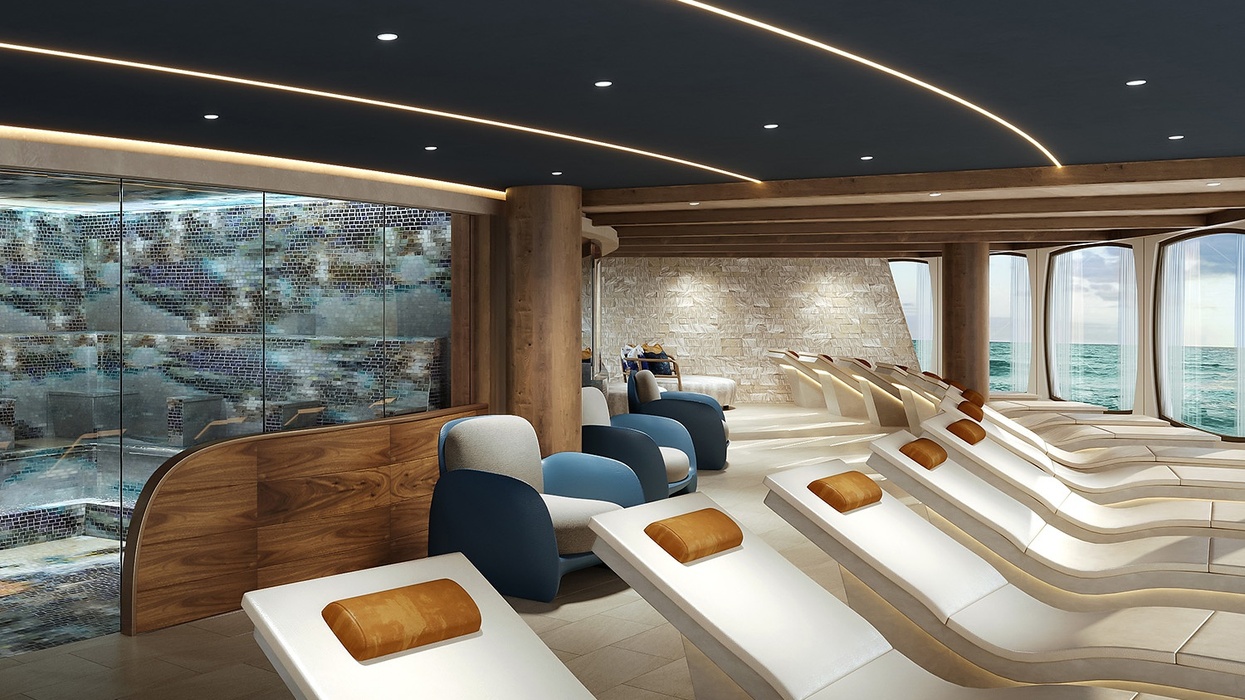
LED technology, chosen for its energy-efficient properties, is set to warm color temperatures to counteract the inherent coldness of large metal structures. The use of Murano glass fits perfectly into this design language: the installations in the atrium are not designed to aggressively reflect light, but to filter it, diffract it, and give it a physical depth. This strict control over the lighting atmosphere unifies the profusion of design interventions, thereby avoiding the pitfall of a sterile furniture catalog.
The Inevitable Equation of Energy Efficiency
The sophisticated aesthetic of these interiors is integrated into a vessel subject to the industrial realities of its time. Scheduled ahead of the construction timeline, the EXPLORA III will make its debut in late July 2026 during sea trials in the western Mediterranean. The official ceremony will begin with a christening in Barcelona on August 1, followed closely by the maiden voyage departing from Lisbon on August 3. The cruise ship will then set course for more challenging waters, charting routes to Northern Europe, the coast of Iceland, and the fjords of Greenland.
Exploring these northern latitudes demands operational rigor that the interior design cannot overshadow. The vessel will be the first in its class to use liquefied natural gas (LNG) for propulsion. This choice of propulsion system is accompanied by a hydrodynamic redesign of the hull and the integration of heat recovery systems. Today’s luxury ship cannot ignore its carbon footprint. The oak floors and blown-glass sconces rest atop machinery whose thermal efficiency is scrutinized with as much rigor as the patina of the materials.
The Enduring Legacy of an Architectural Signature
By entrusting the creation of its central core to a century-old master glassmaker, Explora Journeys seeks to leave a lasting impression on the minds of its travelers. The shipbuilding industry produces vessels whose silhouettes and layouts often tend to blend together. In this context, embracing a specific craftsmanship—rooted in the history of European decorative arts—is a strategic response to establish a distinctive brand identity.
The success of this approach will be tested over the course of the seasons. The aesthetic impact of a solid-glass chandelier is striking on the day of embarkation. Its true success will depend on its ability to withstand repeated ocean crossings, to resist the ravages of time without succumbing to banality in the face of fierce technical competition. The line between a mere exercise in style and an interior design capable of defining its era will be drawn precisely by this resistance to the monotony of the waves.