
Make Texture a preferred source on Google to support us
Add Texture to GoogleThe Mechanics of Excess: When Fine Watchmaking Defies the All-Electric Trend
The automotive industry has embraced silence. Drawn in by the promise of zero-emission mobility, it has made the lithium-ion battery the sole focus of its development. Yet, at the dizzying summit of this industrial pyramid, a dissenting voice is rising. That of Mate Rimac. By unveiling the Tourbillon in June 2024, the CEO of Bugatti did not merely present the highly anticipated successor to the Chiron. He put forward a premise that runs counter to the spirit of the times: the predicted demise of the internal combustion engine will not occur in the stratosphere of luxury. While the mass market is normalizing through electrification, hyper-luxury seeks its salvation in the roar, the vibration, and the cult of rarity.
This vision divides the market into two hermetic realities. On one side, individual, utilitarian, and silent transportation. On the other, the collector’s item, whose value depends intimately on its irrationality. For the Molsheim manufacturer, the equation is clear. Stripping a car of its cylinders to house an all-electric powertrain would be tantamount to stripping it of its emotional substance. Mate Rimac’s challenge, therefore, is to freeze time—or rather, to suspend it—by elevating the internal combustion engine to the status of kinetic art.
Hybridization as a Bodyguard
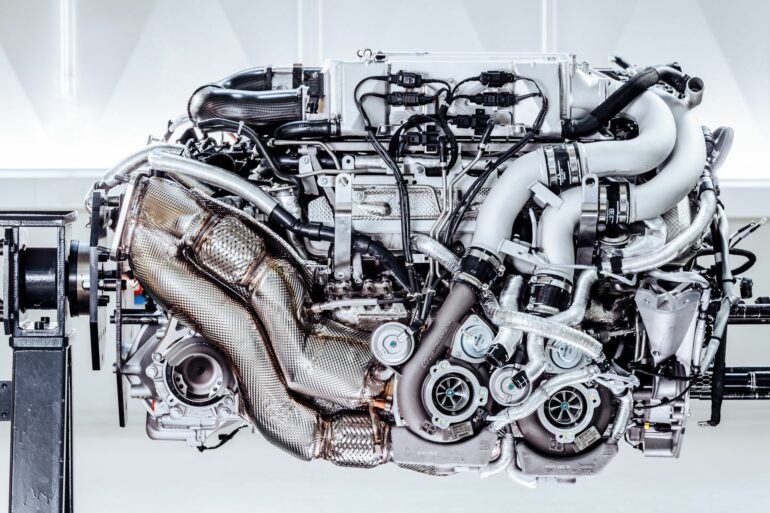
Behind its spectacular bodywork, the Tourbillon conceals a spec sheet that amounts to an engineering tour de force. Bugatti turns its back on the simplicity of a purely electric powertrain to impose a hybrid architecture of mind-boggling complexity. The heart of the machine? An 8.3-liter naturally aspirated V16 engine. In an era of downsizing and widespread turbocharging, the choice of a naturally aspirated engine—capable of delivering 1,000 chevaux through the sheer force of its pistons alone—comes across as a magnificent provocation.
This metal monster doesn’t work alone, however. Three electric motors assist it, bringing the combined power to a peak of 1,800 chevaux. The subtlety of this approach lies in the hierarchy of forces. Electricity is not meant to stifle the V16 or steal the spotlight from it. The electric range, in fact, remains deliberately limited. Here, the batteries and electric motors act as a technological armor: they provide essential dynamic support while ensuring the car maintains a degree of contemporary acceptability. Hybridization becomes the safe passage that allows the internal combustion engine to survive within an increasingly restrictive regulatory and societal framework. This is not a transition to electric power; it is a strategy to preserve the internal combustion engine.
The Obsolete Stopwatch Syndrome
To understand this relentless determination to save connecting rods and crankshafts, one must look at the evolution of pure performance. For decades, supercar manufacturers justified their exorbitant prices with the exclusivity of their acceleration. But electric technology has shattered that monopoly. Today, a high-performance family sedan can tear up the asphalt and blast from 0 to 100 km/h in the blink of an eye. Top speed has become commonplace; it has lost its status as the ultimate privilege.
What’s left to offer when a customer is about to sign a check for several million? The experience. Bugatti has understood this perfectly: the spec sheet is no longer enough to justify the purchase. The Tourbillon responds to this commoditization of performance with hyper-sensory stimulation. The experience is no longer limited to pinning the driver to the seat. It involves the raw sound of the V16, the complexity of airflow, the roughness of the road transmitted through the chassis, and the pure contemplation of craftsmanship. An exceptional automobile is now judged by its dramatic intensity rather than by its lap times alone.
Analog Versus Planned Obsolescence
This desire to create a timeless object finds its most literal expression in the cabin. Bugatti claims a direct lineage to Swiss watchmaking, an industry that itself survived the quartz crisis by transforming timekeeping instruments into works of mechanical art. The Tourbillon, which even takes its name from a watchmaking complication designed to counteract the effects of gravity, rejects the dominance of digital screens.

The dashboard appears as a piece of fine craftsmanship that is entirely analog. An aesthetic choice, certainly, but above all an absolute defense against obsolescence. Nothing becomes obsolete faster than software or a touchscreen. By featuring hands, exposed gears, and sculpted dials, the Alsatian brand ensures that the interior of its car will retain its fascination intact half a century from now. The driver no longer simply consults flight data; he observes the beating of a mechanical heart. Complexity becomes deliberately visible, almost exhibitionist, for it is in this complexity that the very essence of the ultra-luxury segment lies.
The unapologetic celebration of an inaccessible world
Excess has always been part of the brand’s DNA, and this new model embraces it with relentless industrial discipline. No feigned restraint, no timid compromises. The manufacturer has planned an extremely limited production run: only 250 units will be produced. The starting price is set at 4.5 million U.S. dollars (approximately 6.7 million Australian dollars), a base price to which the cost of an unlimited customization program will inevitably be added.
Exclusivity is in full swing. The bespoke configuration phases are already underway, well ahead of the first deliveries scheduled for 2026. The buyer of such a vehicle is not simply purchasing a means of transportation. They are commissioning a bespoke sculpture—an expression of their own uniqueness encapsulated in carbon fiber and aluminum.
The Tourbillon thus embodies a profoundly paradoxical era. By glorifying classic mechanical engineering while surrounding it with a state-of-the-art electric shield, it sets a historic milestone. It remains to be seen whether this masterpiece of engineering will set the standard for automotive luxury for decades to come, or whether it will be remembered as the last and most magnificent cry of defiance from the internal combustion engine before silence finally descends upon the road.