
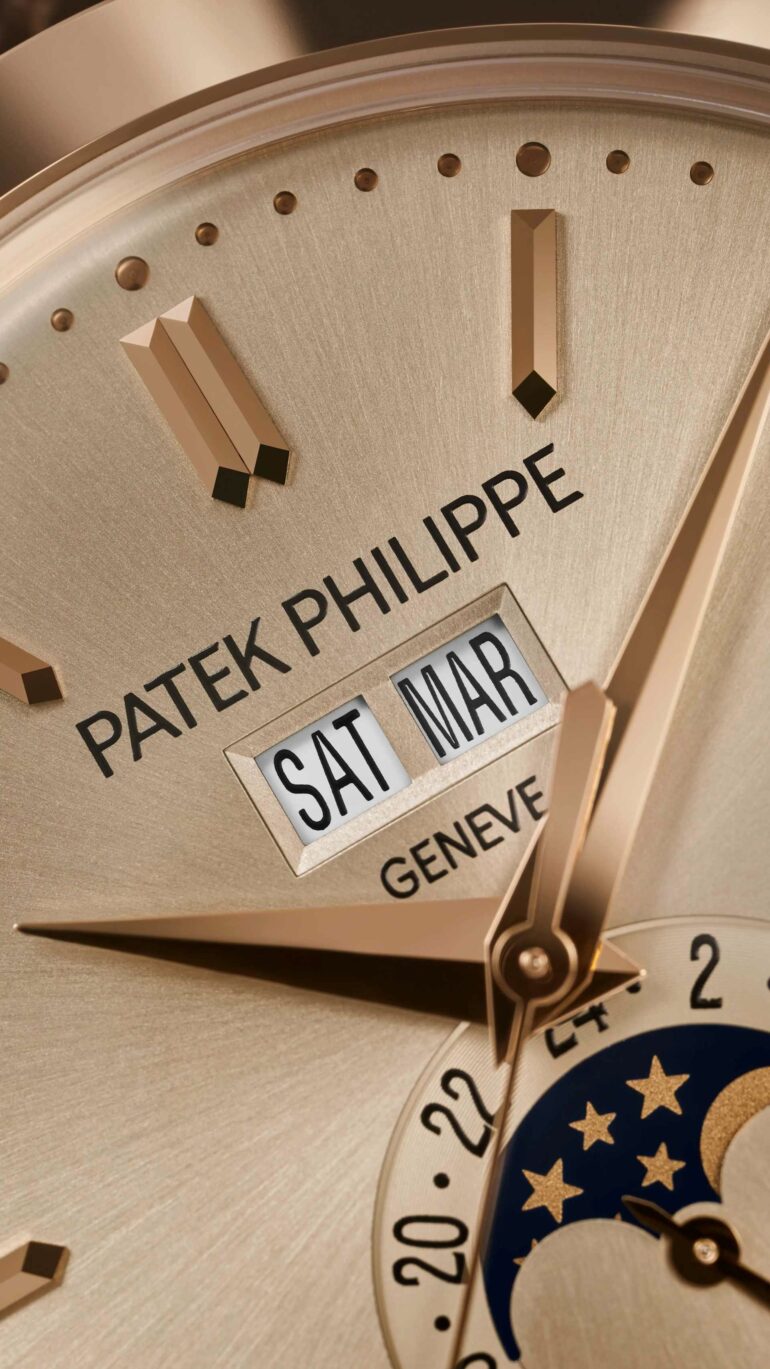
The Geneva-based watchmaker unveils a new version of its classic Annual Calendar, blending understated elegance, harmony, and technical refinements—without any radical changes—to embody timeless elegance.
The Art of Geneva Discretion
At Patek Philippe, even the slightest change can speak volumes, and this is clearly the case with this new version. The watchmaker presents the 5396R-016 as a classically styled Annual Calendar, featuring a luminous sand-beige dial—evoking the sun—and a rose gold case measuring approximately 38.5 mm. On paper, nothing revolutionary. In reality, this watch is part of a line they launched in 2006, revived for the 20th anniversary of the Annual Calendar mechanism—a concept invented and patented by Patek in 1996. (patek.com)
This continuity demonstrates that luxury watchmaking often evolves through subtle refinements rather than major breakthroughs. Patek describes this piece as having a “rather classic elegance,” without claiming to represent a complete departure from tradition. (patek.com)
The Appeal of “Pink on Pink”
The main change lies in the dial. Patek describes it as a “sunburst” sandy beige, featuring faceted rose gold “shell-shaped” hour markers and Dauphine hands, also in rose gold. This design evokes those tone-on-tone watches that appeal for their understated elegance. The moon phase disc remains blue, and the calendar windows stay white, thus maintaining a genuine aesthetic simplicity. (patek.com)
This dial, with its metallic finish and radial texture, is a major highlight. This shade—more understated than “salmon” or “rose gilt opaline”—is favored for its subtlety, while still asserting a certain modernity thanks to its pairing with the rose gold case. The overall design maintains a simple harmony, perfectly faithful to the spirit of the collection. (patek.com)
The Legacy of a Sculptural Design
What makes this 5396R-016 captivating is not so much its boldness as its balance: a style inseparable from the Calatrava lineage, with its elegant curves and rounded silhouette, evoking the Reference 96 launched in 1932. Patek has long emphasized this heritage, a true cornerstone of its design language. (patek.com)
The case, unchanged since the first version, draws on this historic design. Its clean lines, free of superfluous ornamentation, and its balanced proportions (38.5 mm in diameter and just over 11 mm thick) give it a discreet yet distinctive presence. The Manufacture has, however, refined its attention to detail, with ever-greater care devoted to the finishes and the choice of materials.

A mechanism focused on the essentials
The Annual Calendar, the brand’s iconic complication, combines the day, date, and month, requiring only a single manual adjustment per year, at the end of February. On this model, the layout remains perfectly legible: the day and month in small windows, the date at 6 o’clock, and a 24-hour indicator accompanied by the moon phase. (patek.com)
The Caliber 26-330 S QA LU 24H powers this watch. The movement has been refined over the years, notably incorporating a bidirectional winding mechanism and various optimizations that enhance its slimness and precision. Offering a power reserve of between 35 and 45 hours at a frequency of 4 Hz, it is visible through a sapphire case back, allowing one to admire its details and the gold rotor. While the calendar adjustment system requires the use of pushers and a specialized tool, this ritual remains a fully accepted—and even sought-after—limitation within the watchmaking tradition. (patek.com)
Although this watch does not represent a radical change, the continuous refinement of its caliber and the enhancement of its design perfectly illustrate Patek Philippe’s approach: prioritizing excellence, history, and subtlety. Priced at CHF 54,000 before taxes, it maintains a price point consistent with the manufacturer’s prestige. (patek.com)
The philosophy embodied by this model proves that true innovation in the world of luxury does not always lie in breaking with tradition. It is often found in the absolute mastery of detail and fidelity to an aesthetic language capable of standing the test of time.