
Make Texture a preferred source on Google to support us
Add Texture to GoogleAutumn in London begins with a buzz the National Gallery hasn’t seen in a long time. In Trafalgar Square, the excitement stems not only from the fading October light but also from a figure-driven announcement: the exhibition dedicated to Pierre-Auguste Renoir has already set a historic record for advance ticket sales. This major project, which will run from October 3, 2026, to January 31, 2027, marks a close collaboration between the British institution, the Musée d’Orsay in Paris, and the Museum of Fine Arts in Boston. Far from the sometimes simplistic image of decorative Impressionism, the exhibition focuses on the pivotal years from 1860 to 1880, exploring the nuances of love, camaraderie, and the thrills of modern life.
Renoir and the Geography of Emotions
The highlight of this London retrospective is undoubtedly the arrival on British soil of *The Ball at the Moulin de la Galette* (1876). This marks a historic first for this masterpiece from the Musée d’Orsay, which has never before crossed the English Channel. This painting, a celebration of collective joy and the soft light filtered through the acacia trees of Montmartre, serves as the focal point for a broader exploration of bonds of affection. The exhibition curators—including Chiara Di Stefano and Christopher Riopelle for London, as well as Paul Perrin for the Musée d’Orsay and Katie Hanson for Boston—have structured the exhibition around Renoir’s unique ability to capture intimacy without voyeurism.
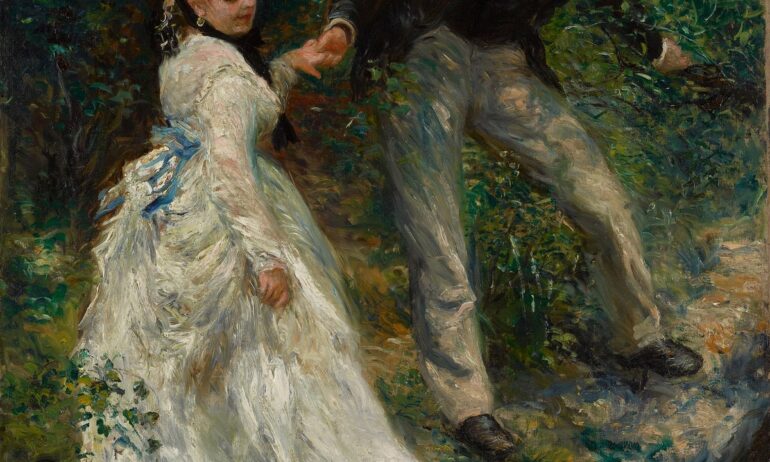
The dialogue between the works promises rare moments of technical and emotional confrontation. On view will be *La Promenade* (1870), a gem from the J. Paul Getty Museum in Los Angeles, as well as *Les Canotiers à Chatou* (1879), on loan from the National Gallery of Art in Washington. One of the most anticipated highlights is the juxtaposition of two visions of the same location: Renoir’s *La Grenouillère*, on loan from the Nationalmuseum in Stockholm, will be displayed alongside Claude Monet’s *Baigneurs à la Grenouillère*. This side-by-side comparison captures the moment when Impressionism crystallized, between the shimmer of the water and the movement of the bodies.
Access to this exploration of 19th-century modernity is also available through academic events. An introductory lecture is scheduled for October 19, 2026, with tickets starting at £20.00 (approximately €23.70). To extend the experience, a hardcover catalog has been published, priced at £35.00 in the museum shop (approximately €41.50), compared to a suggested retail price of £40.00. After London, the exhibition will continue its tour to the Museum of Fine Arts in Boston, where it will be on view from February 20 to June 13, 2027.
Brussels: The Kanal’s Tense Awakening
A few hundred kilometers away, Brussels is preparing for a turning point in its cultural landscape. The weekend of November 28–29, 2026, will mark the official opening of KANAL, the future museum of modern and contemporary art and architecture. Housed in the former Citroën garage on Square Sainctelette—a 1930s modernist building whose glass and steel structures overlook the canal—the project is impressive in scale: approximately 16,000 m² dedicated to the arts.
However, its creation has not been without its challenges. The construction project—which involves the clearly complex architectural task of transforming industrial workshops into museum spaces that meet international standards—has been the subject of heated political debate in Belgium. At the heart of the issue are budget overruns for a project whose construction costs are now estimated at approximately 230 million euros. Beyond the initial investment provided by the Brussels-Capital Region, discussions are focusing on the sustainability of the future public funding model, against a backdrop of increased budgetary pressures.
Despite these administrative storms, the inaugural program aims to be ambitious and inclusive. To mark its opening, admission will be free all weekend, offering the public access to ten concurrent exhibitions. Among them, *A Truly Immense Journey* is expected to set the tone for the venue’s artistic direction. The museum, which benefits from a strategic partnership with the Centre Pompidou in Paris and the CIVA Foundation, will also feature performances and concerts, affirming its commitment to being not merely an exhibition space but a vibrant, multifaceted hub in the heart of the European capital.
The Quiet Figure of Ronald Moody
While major institutions capitalize on historic names or monumental structures, a more intimate and equally essential exploration is taking place in west London, in Twickenham. The Orleans House Gallery is dedicating an exhibition to Ronald Moody (1900–1984), a major figure in sculpture who was born in Jamaica and settled in the United Kingdom. Titled “Ronald Moody: Sculpting Life,” this traveling exhibition, conceived in collaboration with The Hepworth Wakefield, runs from October 2, 2026, to February 28, 2027.
The centerpiece of this exhibition, *Seated Sarong Figure* (1938), embodies the quest for serenity and spiritual presence that characterizes Moody’s work. Carved just before the outbreak of World War II, this sculpture reflects the artist’s synthesis of European modernist influences and an aesthetic rooted in his Caribbean heritage and his exploration of Eastern philosophies.
Admission to this exhibition is free, reflecting the Orleans House Gallery’s commitment to fostering the rediscovery of an artist whose contribution to 20th-century British sculpture is now being reevaluated with greater rigor. This cultural offering, nestled in the Borough of Richmond upon Thames, provides a necessary counterpoint to the large tourist crowds in the city center, reminding us that art history is also being rewritten in the tranquility of neighborhood galleries.