
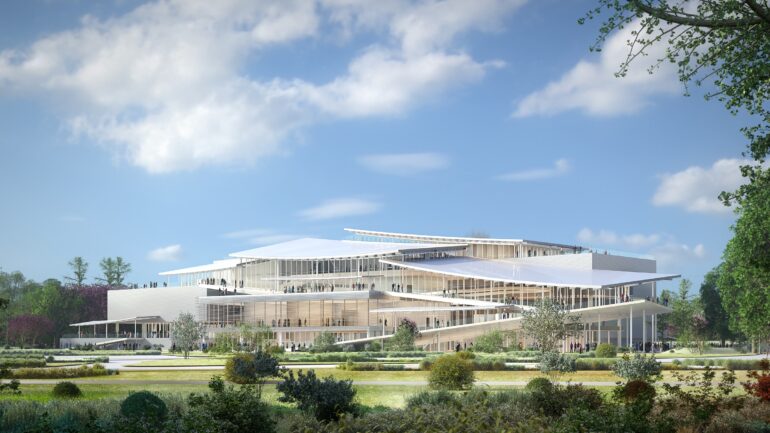
Városliget Park, Budapest’s historic “lung,” will not see the ephemeral structures envisioned by the Japanese firm SANAA take shape. On June 18, 2026, a decree by the Hungarian government sealed the fate of the New National Gallery construction site, putting a definitive end to the remaining construction work as part of the Liget Budapest project within the municipal park. This decision, confirmed in September 2026 by Dávid Vitézy, Minister of Transportation and Public Works, leaves a premier national collection in a logistical and technical impasse, as the site originally set aside for the museum must be returned to the public as green space.
An architectural vision without a home
Yet the ambition was monumental. In 2015, the firm SANAA, led by 2010 Pritzker Prize laureates Kazuyo Sejima and Ryue Nishizawa, won the international competition to design a building spanning nearly 50,000 m². This project, carried out in collaboration with the local firm Bánáti + Hartvig, was intended to occupy the site of the former Petőfi Csarnok concert hall. The architectural goal was to bring together, within a unique contemporary setting, the modern art collections of the Museum of Fine Arts and the Hungarian National Gallery.
Despite the cancellation of the project in Városliget Park, the government does not appear ready to completely abandon the Japanese architects’ design. In September 2026, Dávid Vitézy expressed the government’s desire to find an alternative site to bring SANAA’s vision to life. However, to date, no new official site has been announced. This situation leaves the project in a state of conceptual limbo: a 50,000-square-meter building designed specifically for a precise urban landscape setting, but now lacking a site to house it.
The Final Chapter in the Standoff Between the State and the City
The Liget Budapest project, launched in 2013, aimed to transform Városliget into a true museum district. While certain phases of this development plan were successfully completed—such as the Hungarian House of Music, the new Museum of Ethnography, and the renovation of the Museum of Fine Arts—the New National Gallery has hit a political wall. Since late 2019, construction has been paralyzed by a head-on clash between the government and Gergely Karácsony, the mayor of Budapest elected on an environmentalist platform.
Backed by environmental groups, the mayor has consistently opposed what he described as the “concreting over” of the park. This institutional deadlock persisted despite attempts to revive the project by the museum’s management and the organization Városliget Ltd., which, as late as October 2024, still hoped that construction would begin in 2025. The decree of June 2026 definitively dashed these hopes for mediation, marking a victory for defenders of green spaces over proponents of large-scale cultural infrastructure.

The Urgent Need for a Museum Amid the Deterioration of Budavár Palace
Behind the architectural issues and political power struggles lies a more alarming reality for Hungary’s cultural heritage. Since 1975, the Hungarian National Gallery has occupied the Budavár Palace, within Buda Castle. However, this historic setting is now considered completely unsuitable for the demands of a modern institution. According to reports from the Ministry of Public Works, the castle’s technical infrastructure no longer meets the standards necessary for the long-term operation of an art gallery.
The situation is critical for the preservation of the national collection, which comprises more than 100,000 works. The deterioration of the climate control systems and the very structures of the Budavár Palace poses real risks to the physical integrity of the paintings and sculptures. While a complete renovation of Buda Castle is regularly cited as a fallback solution, it would be a monumental undertaking. Bringing the building fully up to code would require work spread over a period of 8 to 10 years, during which the collection’s fate would remain precarious.
Astronomical Financial Challenges
The budgetary aspect undoubtedly weighed heavily in the final decision. Cost estimates for the construction of the SANAA building have risen significantly between 2024 and 2026. Initially estimated at 150 billion Hungarian forints (approximately 372 million euros), the projected budget rose to 250 billion HUF, or about 620 million euros. This cost increase, coupled with a lack of clarity regarding the construction schedule, made the project increasingly difficult to justify within the overall budget for the Liget project.
By ordering the conversion of the undeveloped plots into green spaces, the government is closing an uncertain chapter in the budget but opening a period of uncertainty regarding the cultural appeal of the Hungarian capital. While Budapest has successfully opened internationally acclaimed institutions in recent years, the absence of the New National Gallery leaves a void at the heart of the state’s planned museum network. The question of whether SANAA’s design will one day be built elsewhere—or whether it will remain merely a paper archive—remains one of the major unknowns in Hungarian cultural policy for the coming decade.