
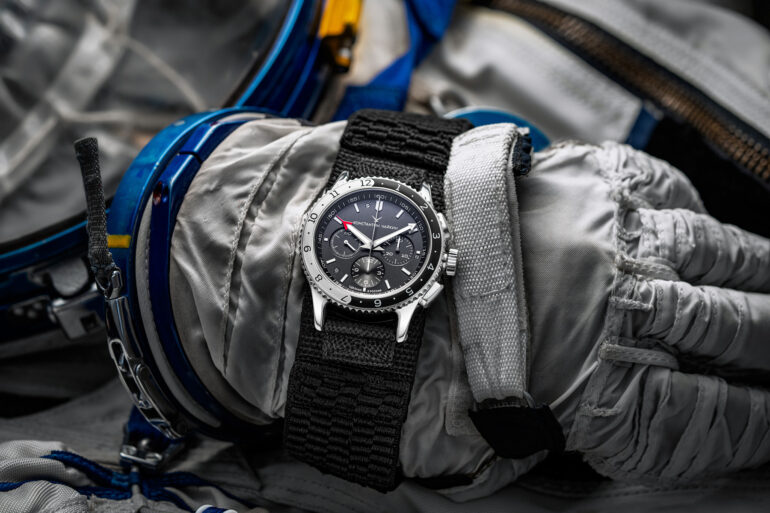
There’s something quite heartening about seeing Konstantin Chaykin set aside—if only for the duration of a watch—the mischievous faces and whimsical complications that have made his reputation. The SC02C wasn’t designed to elicit a smile from behind a store window: it was worn on an Orlan spacesuit, outside the International Space Station, where a design flaw doesn’t result in a return to the workshop but in failure in orbit. Beneath its appearance as an old-school pilot’s chronograph, this 44-mm timepiece tells a far less ornamental story: that of a mechanical watch whose testing ground lies beyond the atmosphere.
A watch born from orbital specifications
The career path of this Moscow-based watchmaker may come as a surprise. Konstantin Chaykin has made a name for himself in haute horlogerie with a deliberately unconventional approach, capable of envisioning a Martian time display with an almost steampunk aesthetic, or of pushing the limits of ultra-thin design with the ThinKing. This professional-grade timepiece—massive and devoid of any visible mechanical displays—seemed far removed from that world.
Yet space has long been a focus of the manufacture’s thinking. Its early work already included the Lunokhod and Mars Time projects, developed with a view to use on Mars. In 2018, a dialogue began with Roscosmos. The request was straightforward: to design a mechanical chronograph capable of accompanying cosmonauts during their extravehicular activities.
This is not merely a stylistic exercise inspired by space exploration. It is a device intended to function during a spacewalk, secured over a spacesuit. Beginning in 2019, the teams began working on a chronograph specifically designed for this mission. The initial development was based on a significantly redesigned Swiss movement, before a second phase in 2022 led to a revised architecture. The version now offered to collectors is the civilian culmination of this program, not its starting point.
Space is no mere backdrop
The constraints of space completely redefine the concept of durability. A watch designed for Earth must generally withstand everyday shocks, humidity, water pressure, and temperature fluctuations encountered in a hectic daily life. In space, the parameters are of a different order: significant vibrations, accelerations, intense solar radiation, extreme temperature fluctuations, and the movement’s behavior in zero gravity.
The SC02C was therefore designed as an assembly in which every detail must serve a function. Its steel case is protected against magnetic fields up to 4,800 A/m thanks to a dedicated inner lining. It is water-resistant to 100 meters—a familiar figure in sports watchmaking—but its most striking specification lies elsewhere: it is designed to withstand a vacuum of nearly 1 × 10⁻⁶ atmospheres.
The sapphire crystal illustrates this design philosophy well. It isn’t simply placed on the case: its inverted dovetail mounting and beveled edge are designed so that changes in pressure and stress help press it even more firmly into its housing. It’s a discreet solution—one that doesn’t look particularly impressive in a photograph—but it addresses a very practical issue of structural safety.
Before leaving the factory, the watches undergo centrifuge tests, vibration tests, shock tests, and thermal cycle tests. The black fabric wristband meets the same standards. Its fasteners feature pins with two additional locking threads. Two lengths are provided: one for a bare wrist, the other loose enough to fit over a spacesuit.
From Prototype to Extravehicular Activity
The first Space Conqueror reached the space station in April 2021. A prototype then accompanied cosmonaut Oleg Novitsky during two separate spacewalks. This phase did more than just validate a great communication story: the data collected led to a return to the drawing board to refine the glass mounting. Once this issue was addressed, the watch headed back into space.
In May 2026, two cosmonauts spent just over six hours outside the ISS wearing the latest generation of the watch. It is this version, dubbed SC02C, that is now available to the general public. This distinction is worth emphasizing: its narrative is not based on a vague symbolic connection to space, but on tests conducted during actual extravehicular activities.
This heritage explains its size. With a diameter of 44 mm and a thickness of 14.5 mm, the SC02C is neither discreet nor slim. It must remain easy to handle and read when worn over a spacesuit. Its size follows the tradition of professional instruments, with the added ruggedness required of a watch designed to function far from any watchmaker.
The Ingenuity of a Classic Design
At first glance, the SC02C could pass for a pilot’s chronograph with vintage accents. Its rounded lugs, matte black dial, and large hour markers set it apart from the futuristic designs typically associated with space equipment. That is precisely what makes it so appealing: the watch eschews aerospace caricature and prioritizes immediate readability.
The generous hour markers and wide hands meet this need. The red tip of the hour hand echoes a design already used on the Mars Conqueror Mk3. Its shape evokes a rocket, but its purpose goes beyond a mere graphic reference: it enhances the perception of the time in an environment where quick reading is essential. Luminescent material covers the hands, the dial markers, and the bezel. The anti-reflective sapphire crystal, meanwhile, minimizes unwanted glare, whether from terrestrial lighting or light in the darkness of space.

The rotating bezel adds a simple and highly legible backup function. By aligning the hour hand with the 12 o’clock marker at the start of an operation, the wearer can track elapsed time without using the chronograph pushers. This redundancy is, in essence, one of the watch’s most consistent features: if an accessible mechanical solution exists, it deserves to be incorporated.
A few details, however, break the watch’s very restrained symmetry. The dial-securing screws appear near 3 o’clock, 7:30, and 11:30, in a deliberately irregular arrangement. At 12 o’clock, the brand’s logo takes the form of hands positioned at 10 o’clock. The signature remains, but it is almost obscured by the watch’s utilitarian purpose.
A vintage movement, rebuilt to withstand the rigors of space
For a watch intended to be worn in orbit, choosing a brand-new movement would have been a risk that would be difficult to justify. Konstantin Chaykin therefore turned to the Poljot 3133, a hand-wound chronograph with several decades of history. The choice is unexpected for a manufacturer renowned for its independent creativity, but perfectly consistent with the objective: to start with a proven foundation and transform it into a movement suited for more demanding use.
The result is the K.20-5 caliber. It retains the heritage of the 3133 but incorporates 60 components manufactured in-house. Modifications include a 12-hour counter, a stop-second function, and a damping ring. The balance wheel is adjusted using micrometric weights rather than a traditional index, a choice made to better withstand vibrations and overloads.
This 25-jewel movement beats at 21,600 vibrations per hour—or 3 Hz—and offers a 45-hour power reserve. It displays hours, minutes, seconds, and a chronograph. Its finish is meticulously crafted, even though the solid, protective case back prevents the owner from viewing it. This is a rather rare reversal in the industry: here, the mechanism is designed to withstand wear and tear rather than to be admired.
A civilian timepiece that retains the weight of its mission
The SC02C does not claim to turn its owner into a cosmonaut. With very few visible compromises, it adapts a tool originally designed for orbital use. This is what gives it a unique position in contemporary watchmaking, a field often quick to invoke the spirit of adventure without having to demonstrate its technical implications.
Limited to 28 pieces and priced at 50,000 Swiss francs—approximately 45,700 British pounds or 61,970 dollars—it is aimed at an extremely exclusive circle. Its price reflects both this limited production run and the lengthy development cycle undertaken with Roscosmos. For those interested in learning more about the manufacture’s history and projects, information is available on Konstantin Chaykin’s website. As for the 28 future owners, they will receive, above all, a watch whose crystal, bracelet, and movement have already withstood a test that most collectible timepieces will never face.