
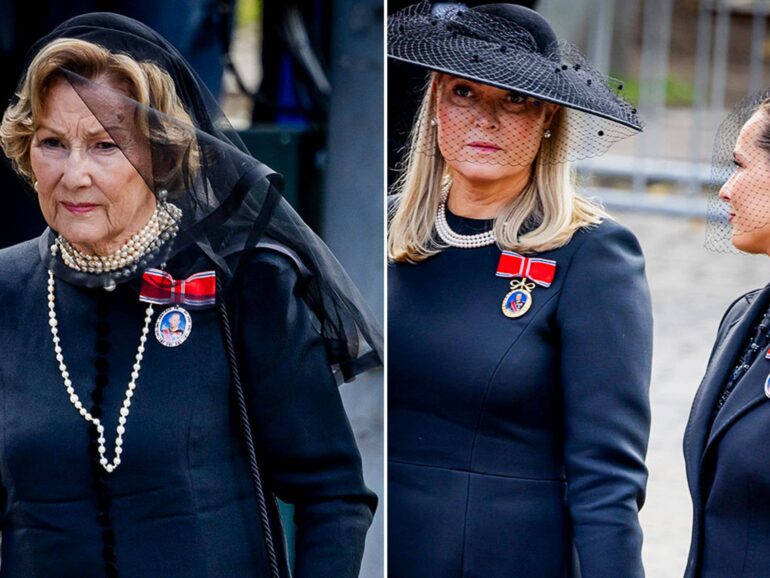
On Wednesday, September 9, 2026, the air in Oslo stood still for a final farewell. In the silence of the cathedral, as Norway laid King Harald V to rest—he had passed away on August 28 at the age of 89—eyes were not fixed solely on the coffin draped with the royal standard. They were searching for the faces of the women of the royal family. In a country where gender equality is a constitutional and social cornerstone, the choice of attire by Queen Sonja and Princesses Ingrid Alexandra and Märtha Louise raised a question that went far beyond the bounds of etiquette: how should the modern monarchy express its grief?
From Secrecy to Openness: A Shift in Perspective
Memories of King Olav V’s funeral in 1991 still lingered in the discussions of court experts. At the time, Queen Sonja and her daughter Märtha Louise had appeared wearing long, opaque, heavy black veils that completely concealed their features from the public. This European tradition, inherited from Victorian customs, was historically intended to protect the privacy of women of royal rank, allowing them to mourn away from prying eyes. However, as the funeral of Harald V approached, a segment of the Norwegian public took up the issue, questioning this archaic practice. Why should women hide their emotions behind a veil of fabric when men—starting with the new King Haakon VIII—express theirs with their faces uncovered?
On September 9, the response from the Norwegian Royal Court marked a break with the past, without sacrificing the solemnity of the occasion. Queen Mother Sonja, the new Queen Mette-Marit, Crown Princess Ingrid Alexandra, and Princess Märtha Louise have abandoned the long veil worn in 1991. Instead, they opted for black hats and fascinators adorned with a short mesh veil, known as a “birdcage veil.” This stylistic choice allowed them to maintain a formal distance while keeping their expressions and gazes visible during the ceremonies, thus conveying an image of shared mourning rather than withdrawal.
The Mourning Procession: A Balance of Protocol and Endurance
The 1.2-kilometer route connecting the Royal Palace to Oslo Cathedral illustrated the family’s hierarchy and physical constraints. While Queen Sonja, aged 89, and Queen Mette-Marit followed the procession from the shelter of a car, King Haakon VIII led the procession on foot. Behind his father’s coffin, he was flanked by Crown Princess Ingrid Alexandra, Prince Sverre Magnus, and Princess Märtha Louise. This public procession, watched by tens of thousands of people gathered along the capital’s main streets, highlighted the immediate transition to the new reign.
The period of mourning at court, declared by Haakon VIII to last one month, will end on October 9, 2026. During this period, every detail matters. While the cost of the ceremonies and royal attire has not been officially disclosed, the symbolism has been meticulously planned. The female members of the family wore the Order of the Royal Family of King Harald V, a portrait of the late monarch set with diamonds and pinned to a red ribbon edged in white and blue.

Jewelry as a Historical Link
Beyond the veil, the jewelry worn during the ceremony served as powerful genealogical reminders. Queen Sonja chose to wear a Maltese cross brooch that had belonged to Queen Maud, the wife of King Haakon VII and granddaughter of Queen Victoria. This piece, of British origin, was not a random choice: Sonja had already worn it in 1991, during Harald V’s swearing-in ceremony. By wearing it again for her husband’s funeral, she forged a direct link between the beginning and the end of his thirty-five-year reign.
This sense of continuity is all the more poignant given that the royal family was struck by a second loss almost immediately. Princess Astrid, King Harald V’s sister, born in 1932, attended the September 9 funeral despite her advanced age. She passed away just two days later, on September 11, 2026, at the age of 94. This successive death definitively closes a chapter in Norwegian history—that of a sibling group that had accompanied the country through its most profound transformations.
King Harald V’s private burial, which took place in the chapel of Akershus Castle following the state ceremony, marks the effective beginning of the Haakon VIII era. While the debate over the headscarf revealed a heightened sensitivity to issues of gender equality even within the realm of protocol, the royal family’s understated choice of attire seemed to reconcile tradition and modernity. The fact that their faces were visible, despite their grief, was interpreted as an act of transparency toward a people who, too, were mourning a monarch who reigned until his last breath at Rikshospitalet.