
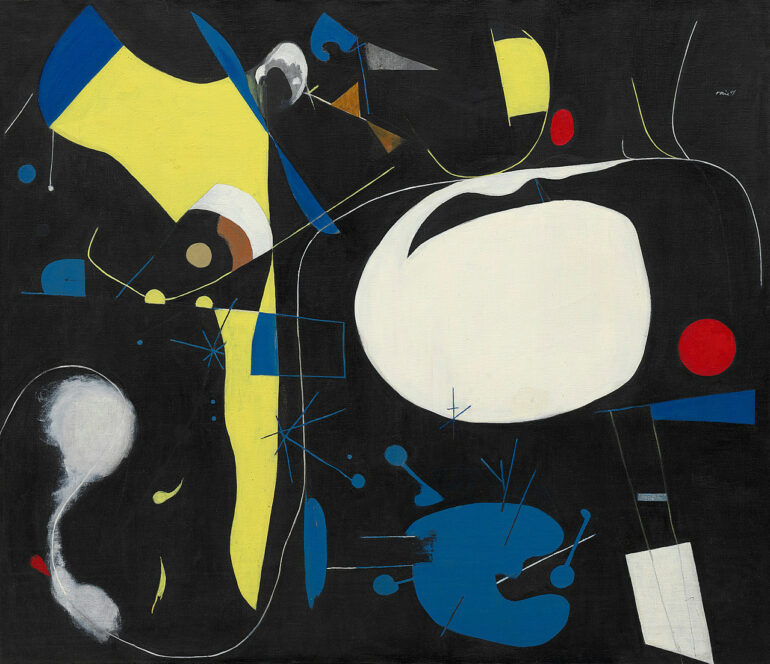
In May 1951, in the heart of Greenwich Village, a group exhibition forever changed the course of American art: the Ninth Street Show. Among the seventy-two artists gathered in that dilapidated building slated for demolition, only eleven women were listed in the catalog. Perle Fine was one of them. Already recognized by her peers and supported by the most prestigious institutions of the time, she occupied a place that art history—often quick to masculinize Abstract Expressionism—had long left in the shadows. Today, an exhibition at the Berry Campbell Gallery in New York, titled “Ninth Street Woman,” invites visitors to rediscover this central figure through fifteen rare works that trace her career from the 1940s to the early 1960s.
The Intellectual Roots of the New York School
Born in Boston in 1905 to a family of Jewish immigrants from Eastern Europe, Perle Fine honed her early skills at the School of Practical Art in her hometown before moving to the bustling art scene of New York City. Her academic background reflects a solid technical rigor, having studied at the Grand Central School of Art and the Art Students League under the guidance of Kimon Nicolaïdes. But it was her encounter with Hans Hofmann in the late 1930s that marked a turning point. Between New York and her summer residencies in Provincetown, Fine immersed herself in the theories of color and spatial tension dear to the German master, without ever allowing herself to be confined to a single doctrine.
By the 1940s, she had established herself as a leading figure. Her standing was by then not a matter of debate, but a fact acknowledged by her peers. In 1949, thanks to Willem de Kooning’s sponsorship, she was admitted as a voting member of the 8th Street Club—the famous “Club,” an intellectual salon and sanctuary of the New York School. She was one of the very few women there with a voting voice. At the same time, beginning in 1946, she became involved with the American Abstract Artists (AAA) group, affirming her desire to take abstraction beyond traditional boundaries. This pioneering role was quickly recognized by the art market and institutions: she received a grant from the Solomon R. Guggenheim Foundation and enjoyed the unwavering support of figures such as Hilla Rebay and Peggy Guggenheim.
An Evolving Stylistic Trajectory
Perle Fine’s work is characterized by constant evolution, refusing to be confined to a repetitive visual “style.” While this freedom of expression may have confused some art historians, it is today the strength of her legacy. In the 1940s, her paintings, such as *Soft Spot* (1945) and *Bristling* (1946), explored biomorphic abstractions. In these works, she blended irregular geometric shapes, complex grids, calligraphic lines, and collages, creating a tension between structure and spontaneous gesture.
In the early 1950s, her work shifted toward the Prescience Series. The compositions softened, the forms became curvilinear, and the palette grew more subtle. Nearly a decade ahead of her time, Perle Fine foreshadowed the beginnings of the Color Field movement. This quest for simplicity reached its peak between 1961 and 1963 with the “Cool Series.” Her abstraction became contemplative, favoring vast fields of color and an almost meditative geometric clarity. The monumental diptych *Wall of Silence* (1961), measuring 4.2 meters in length, embodies this ambition of visual silence and monumentality.
Later, between 1969 and 1980, she developed the Accordment Series, minimalist and serial works in which line and color interact in rigorous harmony. This ability to navigate between raw expression and pure geometry attests to a visual intelligence that never succumbed to market trends.
The Legacy of Springs and Academic Commitment
In the mid-1950s, Perle Fine and her husband, photographer Maurice Berezov, left the hustle and bustle of Manhattan to settle in East Hampton, in the hamlet of Springs. There they joined a vibrant community of artists, living and working in close proximity to Jackson Pollock and Lee Krasner. Far from being a retreat, this move to Long Island marked a phase of intense artistic production and deep local roots in one of the epicenters of American modern art.
Fine also devoted a significant portion of her career to teaching. After a year of teaching at Cornell University in 1961, she became a professor at Hofstra University, where she taught from 1962 to 1973. Her influence on subsequent generations of artists is undeniable, although her own name has sometimes been omitted from major chronological accounts of the period. Archives and certain bibliographic sources sometimes mention her birth name as “Poule Feine” or “Perlita Dubsky”—names that remain speculative in the absence of confirmation by a published civil registry record, but which underscore the complexity of her historical legacy.
Rediscovery and Recognition in the Art Market
The process of institutional rehabilitation has accelerated in recent years. Following a retrospective organized by Hofstra University in 2009, Perle Fine’s inclusion in the landmark exhibition *Women of Abstract Expressionism* at the Denver Art Museum in 2016 marked a turning point. Today, her works are included in the permanent collections of major American museums, from the Metropolitan Museum of Art to the Whitney Museum of American Art, as well as the Guggenheim and the National Gallery of Art.
This museum recognition has translated into a rise in her market value. Represented internationally by the Berry Campbell Gallery, Perle Fine’s market value has reached significant milestones at auction. On September 27, 2024, at Sotheby’s New York, the painting *Autumn in the Air* (1958) set a record at $57,600. This result surpasses the previous record of $50,400 set by *The Far Side of a Thought* (1971) at Christie’s a year earlier. In the gallery, at recent art fairs, major oil-on-canvas works from the 1950s have even fetched prices as high as $125,000.
Although no comprehensive catalog raisonné has yet been published—making it difficult to estimate the exact volume of her output over fifty years—interest in her works from the 1940–1960 period continues to grow. The current exhibition at Berry Campbell, on view through October 24, 2026, highlights the importance of these formative years, during which Perle Fine—far from being a mere follower—established a singular and erudite voice within the New York School.