
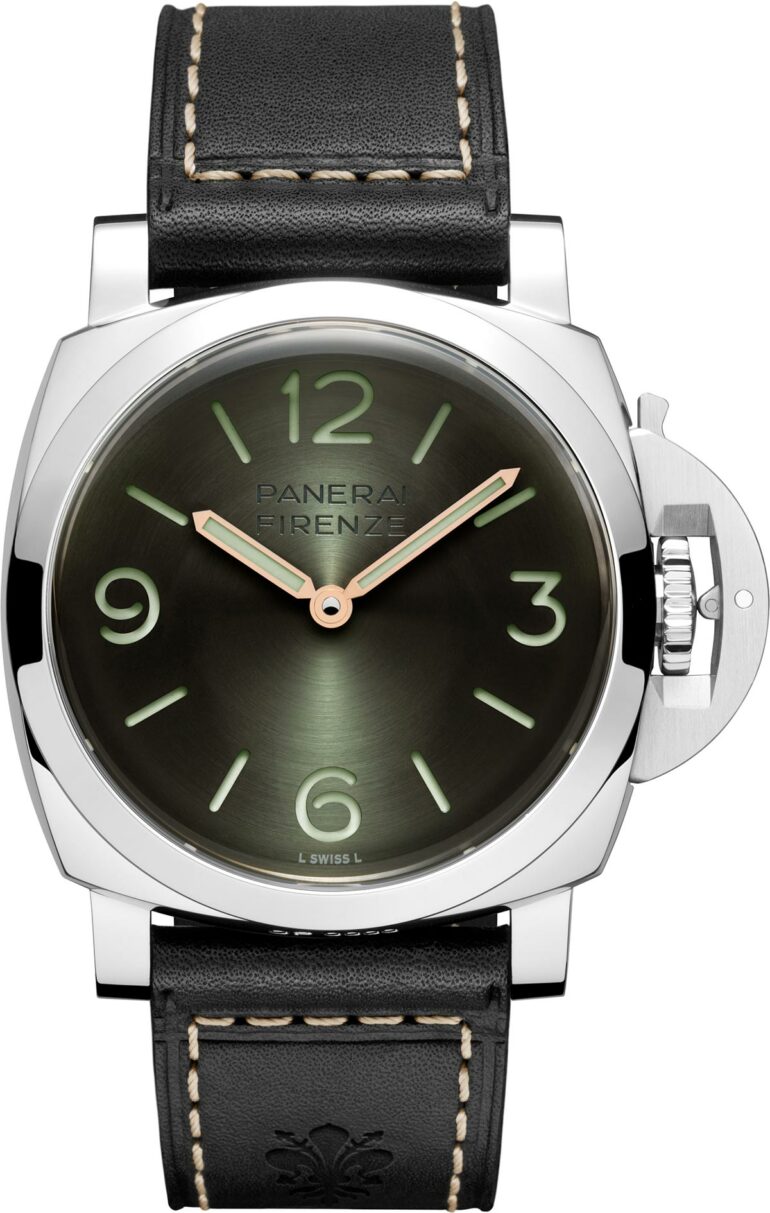
One hundred years after settling in Piazza San Giovanni, Panerai has chosen to celebrate Florence not with a literal reissue, but with a head-to-head comparison of two distinct styles. The Luminor Firenze 8 Giorni is available in two versions, reference numbers PAM01734 and PAM01794, two 44-mm watches that share the same local heritage, a hand-wound movement, and a historic inscription on the dial, while clearly contrasting in their materials, water resistance, and positioning. One speaks the language of platinum and ultra-limited editions; the other retains more of the functional ruggedness associated with the brand’s origins.
A Florentine address as a starting point
Panerai’s history began in Florence in 1860, at a time when the city was undergoing a drastic transformation. Turin had just lost its status as the capital of the Kingdom of Italy to Florence, and the city was then embarking on extensive urban redevelopment projects. Entire sections of the medieval cityscape were demolished to meet the ambitions of a modern capital, even after power was subsequently shifted to Rome.
Panerai’s first workshop did not survive this period of upheaval. After several moves, the company settled in 1926 in a shop on Piazza San Giovanni. It is this specific connection to the city that gives meaning to the anniversary collection: 2026 marks the centennial of this Florentine address. Rather than reducing the celebration to a commemorative engraving or a box lining, Panerai makes it visible at first glance, on the dial itself.
This decision also reflects a particular way of viewing history. The brand evokes not just an abstract “golden age,” but a city, a boutique, and a journey marked by relocations. Florence is not merely a backdrop for marketing here: its name is inscribed on the watch in its Italian form, “Firenze.”
The Return of an Almost-Forgotten Dial
The two new Luminor models draw their inspiration from a rare 6152/1 reference dating back to the 1960s. This vintage piece bore the inscription “Panerai Firenze” at 12 o’clock—an unusual detail that has now become the hallmark of the PAM01734 and PAM01794. The historic model is on display in the “Immersion” exhibition, organized as part of the boutique’s centennial celebrations.
The choice of this inscription avoids the pitfall of an anniversary watch overloaded with symbols. On the new models, it serves as an almost discreet indication of origin, yet one rich in meaning for those familiar with the brand’s history. It shifts the focus: the dial no longer simply refers to Panerai, but to Panerai in Florence.
The design then varies depending on the model. The PAM01734 features a green sandwich dial with a circular brushed finish. The PAM01794 responds with a gray sandwich dial. This multi-layered construction, a hallmark of Panerai’s design vocabulary, serves the purpose well: the dial’s visual depth complements a historic reference without attempting to slavishly imitate the patina of a 1960s watch.
The chosen case size, 44 mm, remains faithful to the familiar proportions of the contemporary Luminor. It nevertheless represents a significant reduction compared to the 47 mm of the 6152/1 from which it draws inspiration. Panerai therefore does not claim to reproduce the original’s dimensions; instead, the brand extracts specific design elements and transposes them into a more contemporary format within its collection.
Two Interpretations of the Luminor
The most striking difference lies in the case. The PAM01734 is crafted from Platinumtech, Panerai’s proprietary platinum alloy, while the PAM01794 is made of stainless steel. This choice does more than just alter the lustre or the weight felt on the wrist: it redefines the purpose of each watch.
With its 100-meter water resistance, the Platinumtech version establishes itself as a collector’s item. Produced in a limited run of 100 pieces, it pairs the green dial with a black Tuscan calfskin leather strap. Its price is set at 47,200 British pounds. In this configuration, the Florentine model stands out as a rare object, intended for those seeking not only a specific material and a limited edition but also a distinctive watch design.
The PAM01794, available in a limited run of 1,000 pieces, takes the opposite approach. Its steel case, gray dial, and dark brown Tuscan calfskin strap give it a more direct presence. It is water-resistant to 300 meters—three times that of the Platinumtech version. Priced at 9,200 pounds sterling, it more closely embodies the concept of a Luminor designed as a robust instrument, even though its “Firenze” dial clearly sets it apart from the standard production line.
A comparison with the standard steel Luminor 8 Giorni sheds light on the premium charged for this edition: the latter is priced at 6,400 pounds sterling. The price difference is therefore substantial for the PAM01794. It reflects the limited edition, the unique dial, and the details borrowed from the historic model. Panerai does not present this watch as a mere color variation: it claims a more deliberate lineage, linked to the Florentine boutique and an unusual Luminor from the 1960s.

The detail that sets the platinum model apart
The PAM01734 features an even more subtle detail, located around the crown. The steel version retains a crown guard with perfectly flat upper and lower surfaces. On the Platinumtech watch, these surfaces are carved with grooves that slope down toward the crown. At first glance, the detail may seem decorative. However, it stems from a test conducted in the 1960s.
This experimental design was not adopted as a standard solution. Its purpose was practical: to make winding easier while wearing gloves, thanks to an improved grip around the crown. This design was featured in the 6152/1 model, which was also equipped with a manual-winding movement. By reintroducing it exclusively on the Platinumtech version, Panerai transforms an old technical quirk into a marker of contemporary rarity.
This is undoubtedly where the PAM01734 is most compelling: not when it showcases its platinum, but when it brings back a solution that had never become widespread. The crown guard bridge, one of the Luminor’s most recognizable features, becomes the backdrop for a story less visible than the dial, yet even more distinctive.
Eight Days to Reconnect with the Craft
Both editions are powered by the P.5000 caliber, a hand-wound mechanical movement. It operates at 21,600 vibrations per hour—or 3 Hz—and displays only the hours and minutes. Its dual-barrel architecture ensures a power reserve of eight days, equivalent to 192 hours.
This extended power reserve is not treated as an isolated feature. It maintains a coherent dialogue with the act of winding, which is central to the legacy of the 6152/1. The wearer is not required to wind the crown every morning, but the mechanism retains the deliberate nature of a manual-winding watch. Eight days is long enough to break away from routine without severing the physical connection to the watch.
Panerai already has a history tied to extended power reserves, and the choice of the P.5000 is a natural fit for a collection that looks to Florence and its archives. The Luminor Firenze 8 Giorni watches do not seek to pile on functions. They stick to the essentials: a clear time display, a protected crown, a 44-mm case, and eight days of power reserve.
Between the PAM01734 in Platinumtech and the PAM01794 in steel, the centennial celebration does not, therefore, offer a single answer. It presents the collector with two ways to experience the same story: that of a limited-edition piece of 100 units, enhanced by an experimental bridge, or that of a watch water-resistant to 300 meters, produced in a run of 1,000 units and more closely aligned with the utilitarian spirit that has defined the Luminor.