
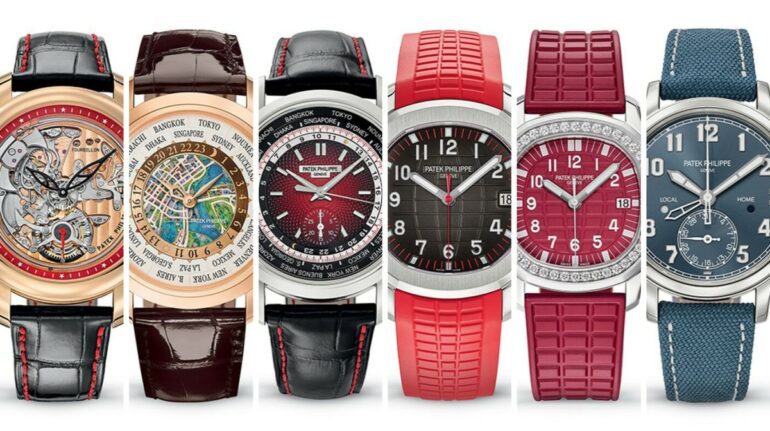
In Singapore, appraising a Patek Philippe goes beyond the mere notion of price. Taking into account authenticity, documentation, rarity, and market dynamics, experts reveal the keys to accurately appraising these exceptional timepieces, whose true value often far exceeds the price tag displayed in the store window.
An Approach That Goes Beyond Face Value
In the city-state, appraising a Patek Philippe is a delicate balancing act that combines watchmaking expertise, traceability, and liquidity. In a secondary market that continues to show resilience in 2026, the firm Qollateral estimates that the average value of the Geneva-based manufacturer’s watches remains between 95% and 100%. Certain particularly sought-after pieces are, in fact, selling for well above their original retail price. Steel sports models, such as the Nautilus and the Aquanaut, remain unquestionably the most coveted items.
The conclusion is clear: rarity alone is not enough. Demand, condition, documentation, and the timing of the sale are equally crucial factors. LuxMetrix also notes that following the boom of 2021–2022, the market has stabilized. This normalization is excellent news: it fosters more rational—and consequently, much more rigorous—appraisals.
Authenticity: The Foundation of Appraisal
Any serious appraisal invariably begins with a meticulous verification of authenticity. Experts point out that Patek Philippe, founded in 1839, has built its legendary reputation on mechanical engineering of unparalleled finesse and an extremely exclusive clientele. This aura inevitably attracts a parallel market of counterfeits, which requires absolute vigilance.
The analysis therefore focuses on the case, the dial, the hands, the movement, and the various hallmarks. Be careful, however: parts replaced during previous servicing can affect a watch’s value, even if the watch itself remains original. Savvy collectors know this well—a piece quickly loses its appeal once its historical integrity is compromised.
The True Drivers of Desirability
Industry professionals agree that multiple factors shape a watch’s value. While the model itself is central, its era of production, the alloy used, its condition, and its documented provenance are equally decisive. For both pocket watches and wristwatches, Life123 emphasizes that these tangible criteria consistently outweigh fleeting trends. Once fashion trends have passed, it is truly the documentation that makes the difference.
The presence of the original case, original paperwork, and a clear maintenance history establishes the trust that is essential for the buyer. For vintage timepieces, the Archive Extract issued by Patek Philippe often becomes a decisive document. In the upper echelons of collecting, the lack of documentation can sometimes prove far more costly than a poorly executed polish.
Singapore: The Demands of an International Hub
Singapore boasts a watch market that is both dense and cosmopolitan, driven by a clientele of connoisseurs. While this concentration offers exceptional visibility to sellers, it also imposes extremely high standards. Local buyers compare prices, do their research, and are hardly swayed by rough estimates.
Local auction houses and appraisal firms prioritize a methodology of absolute transparency: rigorous physical inspection of the watch, comparison with recent auction results, and analysis of transactions on the secondary market. This pragmatic approach helps avoid any confusion between a theoretical price and the amount one can realistically expect to receive.

The distinction between valuation and net return
While Calcix’s analyses indicate that a Patek Philippe can achieve an average annual growth rate ranging from 5% to 12%—with certain iconic models far exceeding these thresholds—it is important to factor in the costs associated with preservation. Insurance, secure storage, and regular maintenance services erode the net return by 3% to 4%.
This is the reality of the market: a paper valuation does not always translate into optimal profitability in practice. Experienced collectors have long understood this. A classic line like the Calatrava will offer a relatively stable value curve, while a Nautilus will be subject to much more dramatic fluctuations, both up and down.
The Influence of Heritage and Discontinued Models
The launch of a new collection often reignites interest in earlier models. This is the “halo effect” as it applies to luxury: the new enhances the rarity of the past. As such, discontinued models—particularly the highly sought-after steel versions—are closely monitored.
Since the beginning of 2025, Patek Philippe market indicators have shown a notable increase. This growth remains asymmetrical, however: classic “dress” watches are experiencing a measured rise, while sports models are consolidating their competitive advantage.
Precision: The Hallmark of Watchmaking
A valuation worthy of the name does more than simply state a figure: it explains and justifies it. It must clearly distinguish between market value—intended for transactions—and replacement value—intended for insurance purposes. This clarity is the best defense against illusions and disappointments.
This is the very essence of the “Patek-style” valuation: there is no room for noise; only accuracy matters. In a market that has settled down but is infinitely more transparent, meticulous preparation is essential. Sellers who thoroughly document their timepieces and demonstrate patience maximize their chances. The others quickly realize that prestige alone is not enough to drive up a price.