
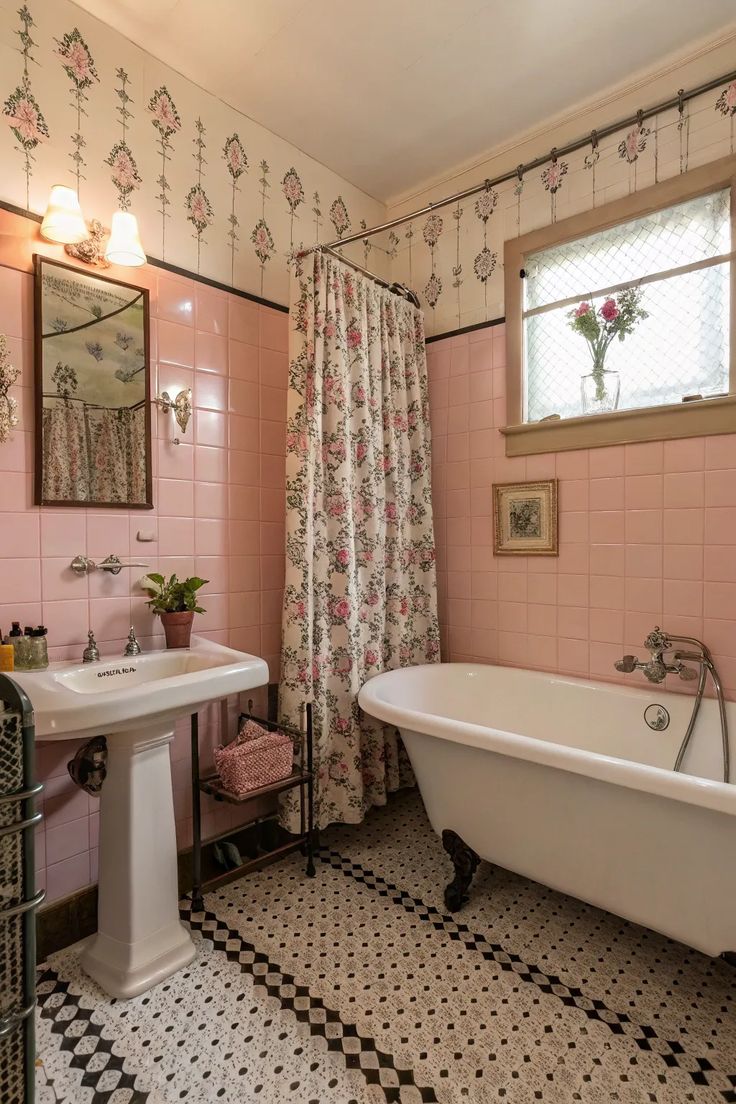
The sound of a sledgehammer striking powder-pink or aqua-green 1950s ceramic tiles has, in just a few months, become the trigger for immediate online backlash. On TikTok, Instagram, and Reddit, the practice of “gutting”—which involves completely stripping a historic bathroom to start from scratch—is no longer acceptable. In the face of cookie-cutter renovations dominated by “millennial gray,” a movement of resistance is taking shape. Between a fetish for mid-century tile and health concerns related to lead, the debate over vintage bathrooms divides homeowners and design professionals alike.
The Revival of Eisenhower Pink
At the heart of this aesthetic battle, the “Save the Pink Bathrooms” movement—led by blogger Pam Kueber of the Retro Renovation website—has restored the prestige of a shade once considered tacky. It is estimated that approximately 5 million American homes built between 1946 and 1966 were originally equipped with a pink bathroom. This massive popularity owes much to First Lady Mamie Eisenhower, who made this color the hallmark of her domestic world. Today, these spaces are no longer seen as obsolete relics, but as architectural heritage worth preserving.
This enthusiasm for preservation is grounded in a practical reality: the high quality of craftsmanship from that era. Specialists like Michael Taylor, founder of Vintage Tile Preservation, devote their work to recovering and sourcing original ceramic tiles to prevent their destruction. According to preservation advocates, enameled cast-iron bathtubs and vintage tiles often exhibit greater durability than the entry-level synthetic alternatives produced today. Preserving these structures not only maintains their historic character but also reduces environmental impact by preventing heavy debris from ending up in landfills and limiting the carbon footprint associated with transporting new bathroom fixtures.
The Industry’s Bet on Heritage Colors
The industry has clearly recognized this shift in attitudes. For its 150th anniversary in 2023, the American giant Kohler gauged public sentiment by organizing a vote that garnered more than 100,000 votes. The result is clear: consumers are calling for a return to color. The brand has thus reintroduced several historic shades into its modern lines, blending retro aesthetics with today’s comfort standards.
Among the revived shades are Spring Green from 1927 and Peachblow from 1934, as well as more recent tones such as Fresh Green (1971), Aspen Green (1978), and Teal (1987). This trip down memory lane, however, comes at a price. In Kohler’s current catalog, a two-piece toilet from the Memoirs collection in the Heritage Colors edition is priced at $744 USD (approximately €670). For a centerpiece like the Artifacts freestanding bathtub, the price is $6,121 USD (approximately €5,500), while the Farmstead kitchen sink costs $4,025 USD (approximately €3,620). These prices position the historic reissue as an unapologetic luxury, a high-end alternative to restoring older pieces.

The Shadow of Lead and Technical Obsolescence
While the aesthetic appeal argues for maintaining the status quo, technical considerations add a necessary nuance to the debate. The main drawback of vintage fixtures lies in the composition of their materials. The enamel used on bathtubs, sinks, and tiles manufactured before 1978 frequently contains lead. Tests conducted by independent health inspectors reveal that 62% to 77% of older enameled cast-iron bathtubs show traces of leachable lead, which can contaminate the water or be released if the surface cracks or is sanded down.
Beyond the potential toxicity, the hidden structure of these bathrooms often poses problems. Behind impeccable tiling may lie corroded cast-iron pipes, electrical systems without grounding, or water leaks that promote mold growth. Finally, the issue of water efficiency is key: vintage toilets consume considerably more water per flush than contemporary models that meet current water-saving standards.
The Hybrid Strategy as a Compromise
Faced with this dilemma between heritage and safety, many designers now advocate a mixed approach, often referred to as “Restoration-lite.” The idea is to preserve the visual elements—the original wall tiles and bathtub—while radically updating the technical components. This involves replacing the faucets, installing modern ventilation (mechanical ventilation), and completely overhauling the concealed plumbing.
To mitigate lead-related risks without sacrificing the cast-iron bathtub, encapsulation is the preferred method. Professional refinishing isolates the damaged layers of enamel beneath a new, sound surface. Financially, this method is often more cost-effective: restoring tile and refinishing a bathtub generally costs less than a complete demolition followed by reconstruction. However, return on investment (ROI) remains a complex variable. According to Remodeling Magazine’s 2022 report, a mid-range bathroom renovation offers an average return of 58.9%. The impact of preserving a vintage design on resale value remains highly dependent on the local market: it can be a major asset for a “pre-war” apartment in New York or a mid-century villa in Los Angeles, but a deterrent for buyers less attuned to design history.