
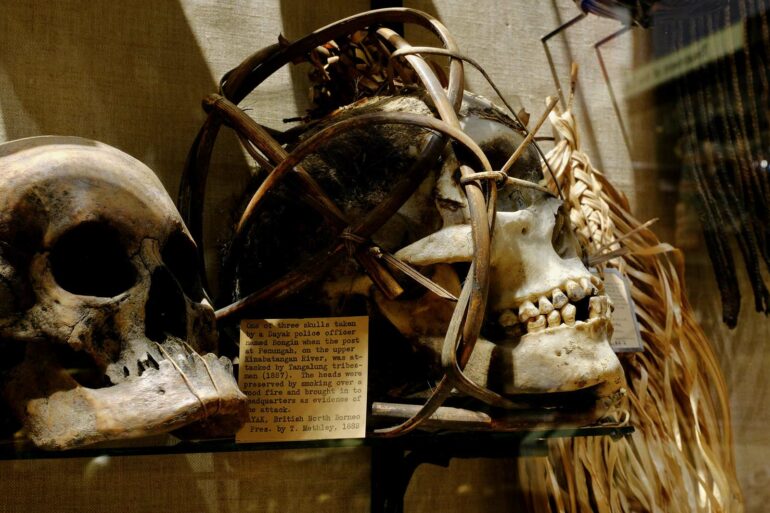
In the dark, cramped galleries of the Pitt Rivers Museum in Oxford, silence has taken on a new dimension since the summer of 2020. The display cases that once held human remains have been emptied, giving way to a profound reflection on the ethics of anthropological collections. This decolonization process is now reaching a decisive milestone: the University of Oxford has formalized the largest repatriation of human remains in its history. By the end of 2026, 39 sets of ancestral remains—primarily skull fragments, but also a finger and a piece of skin—will be returned to the indigenous Naga people, ending more than a century of forced exile in British repositories.
A Colonial Legacy Under the Scrutiny of Ethics
The collection of these remains was no accident. Between 1910 and 1940, while the British Empire exercised its authority over India and Burma, colonial administrators who were also anthropologists traveled through Naga lands. John Henry Hutton and James Philip Mills, central figures in the *Indian Civil Service*, were the primary contributors to this collection. Under the guise of science, the acquisition of these artifacts was part of a brutal reality of coercion and military violence. The museum now acknowledges that some of the items were seized during punitive expeditions, such as the one in Pangsha in 1936.
The Naga people, a community of 2.5 to 4 million people spread across northeastern India and northwestern Myanmar, are organized into 17 main tribal groups. For these communities, these remains are not specimens, but ancestors whose absence has left an open wound in the social and spiritual fabric. The Pitt Rivers Museum, which holds between 6,000 and 7,000 Naga artifacts — the world’s largest collection — began a process of self-reflection in 2020, leading to the permanent removal of human remains from public display in order to engage in direct dialogue with indigenous representatives.
Six years of dialogue and participatory research
The decision, formally approved by the University of Oxford Council on July 13, 2026, is the result of a six-year collaboration. This long-term effort was coordinated by the *Forum for Naga Reconciliation* (FNR) and a research team called *Recover, Restore, and Decolonize* (RRaD). Established in 2021, this organization—co-led by scholars Dolly Kikon and Arkotong Longkumer—enabled the precise documentation of the provenance of each artifact. Of the 40 sets of remains initially requested, 39 will make the journey home; only one was excluded from the process, as its Naga origin could not be established with certainty.

The culmination of this mediation process took place in June 2025. A delegation composed of Naga tribal chiefs (*Hohos*), elders, and researchers traveled to Oxford. This visit, marked by deep emotion, culminated in the signing, on June 13, 2025, of the *Naga Oxford Declaration on Repatriation*. This document sealed the repatriation agreement and defined the terms of the transfer, ensuring that the ancestors would return to their land in accordance with appropriate cultural protocols.
The Final Journey to Kohima
The administrative and logistical process is now entering its final phase. Although the total cost of the operation, including cross-border transportation, has not been disclosed, funding is provided by a consortium of university and philanthropic funds. The University of Edinburgh, the AHRC, the Bertha Foundation, and the American organization *The Homebound Project* are supporting this complex effort. The physical repatriation requires at least two months of procedures to obtain the international export permits necessary for the transfer of human remains.
An official handover ceremony will be held at the Pitt Rivers Museum. Following this tribute, the delegation will accompany the 39 ancestors to Nagaland. The journey will end in Kohima, where specific rituals will precede a final burial. This return marks a major transition for the Oxford institution, shifting its role from that of a custodian of seized objects to that of a partner in the restoration of memory. The completion of this process, scheduled for the end of 2026, represents a historic milestone in the management of colonial collections in Europe.