
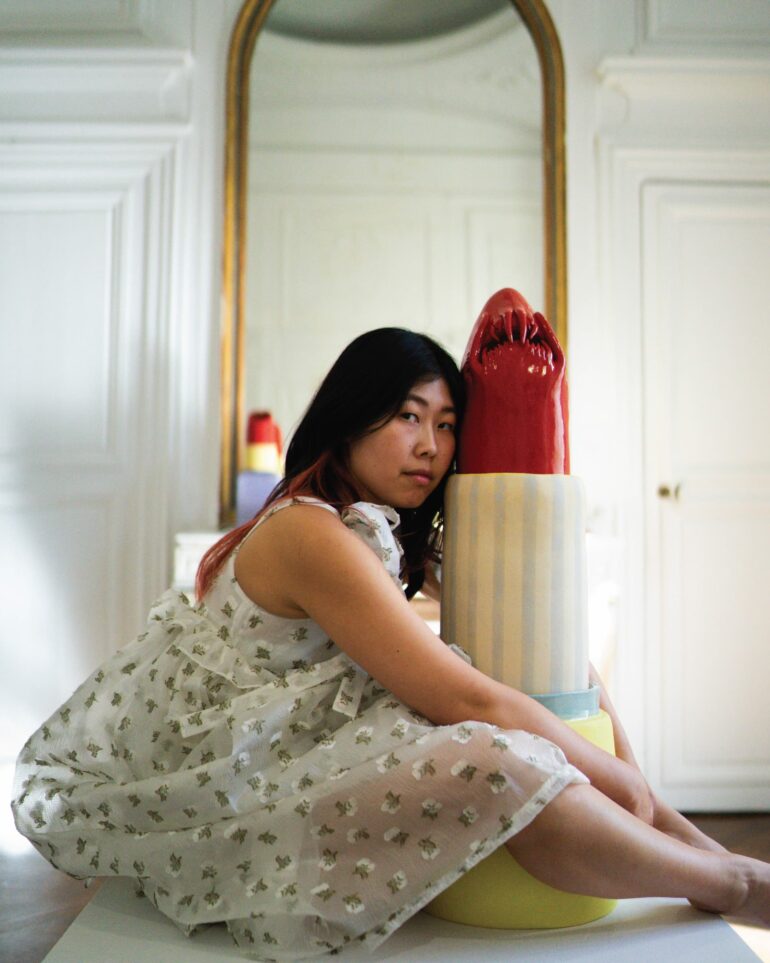
Eri Maeda’s first solo exhibition in Paris unveils a sculptural universe where the grotesque rubs shoulders with social criticism, inviting viewers to an immersive and experimental experience centered on her unconventional monsters.
A stoneware bestiary in the heart of Paris
Last February, Eri Maeda opened her very first solo exhibition in Paris, *Come Meet the Monsters*, at the Triquetra Artist Collective. The Japanese artist, based in the capital, unveiled a series of hand-modeled stoneware sculptures, enhanced by vibrant hues and deliberately distorted forms. Her aesthetic skillfully plays with the conventions of the grotesque, moving beyond mere visual indulgence. These figures serve as much as a mirror of our society as they do as pure sculptural fantasies.
Her approach is rooted in a profound reflection on the invisible tensions that permeate our daily lives. Through her artistic lens, Eri Maeda explores rebellion against social norms and gender expectations, transforming everyday objects into surrealist hybrids. The “monsters” that populate her work go beyond purely decorative folklore: rather, they emerge as contemporary satires, both subtle and persistent.
Sensory Immersion and the Art of the Table
To view the exhibition as merely a space for observation would be reductive. Eri Maeda’s intention was to immerse visitors in the ecosystem of her sculptures. The opening, held on February 12, offered a first encounter with these singular creatures, oscillating between awkwardness and mischief. This curatorial setup continued in the days that followed in an intimate atmosphere, almost reminiscent of the warmth of a private home.
Taking the experience off the beaten path, the artist orchestrated “Dining With Monsters,” a conceptual dinner co-created with chef Liza Ivanova. The menu read like a gustatory extension of the works on display. The inclusion of fermented elements—specifically requested by the artist—carried a highly symbolic dimension: fermentation, that invisible yet essential process, echoes her own approach to creation, where the material takes shape in silence and slowly transforms before revealing itself to the world.

An Unapologetic Aesthetic of Turbulence
This dialogue between ceramics and gastronomy went beyond a mere stylistic exercise to anchor the exhibition in an almost anthropological dimension. Beyond aesthetic contemplation, the audience was invited to a table where emotions, instincts, and social conventions were literally laid bare.
The project gains in depth what it loses in neutrality. This direct, fully embraced intimacy constitutes the very essence of its strength. It aptly underscores that contemporary ceramics has broken free from the labels of traditional craftsmanship or mere decorative objects. It now merges with sculpture, installation, and performance. In Eri Maeda’s work, this interplay of disciplines is embodied with great clarity, fueled by a practice that blends manual skill, narrative power, and social critique.
Material as a Vehicle for Expression
In addition to clay, Eri Maeda’s practice also explores photography, reflecting a multidisciplinary creative vision. The artist also shares her passion at her studio in the 18th arrondissement, where she leads workshops on modeling and slab building. This commitment to teaching illustrates her philosophy: material is never an abstract entity; it is intrinsically linked to the act of creation, the passage of time, and the art of transformation.
This first solo exhibition in Paris stands as a defining milestone. It highlights an artistic voice in full bloom, whose coherence already commands admiration. Blending subtle satire, sensual forms, and a fascination with the imperceptible, Eri Maeda crafts an undeniably powerful visual vocabulary. Her monsters do not seek to frighten; they invite us to look squarely at what we usually prefer to leave in the shadows.