
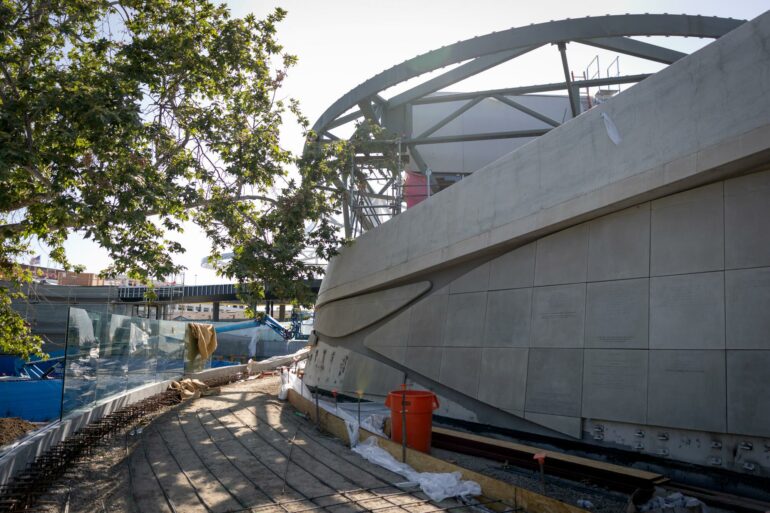
In Los Angeles, the expansion of the Holocaust Museum LA—now known as the Goldrich Cultural Center—elevates the museum experience, transforming it into a true space for learning, dialogue, and emotion. An architectural masterpiece where technological innovation interacts with the timeless narrative of Jewish memory.
Architecture Conceived as a Passing of the Torch
In the heart of Pan Pacific Park, the construction site reveals a major architectural ambition: to transform a sanctuary of remembrance into a fluid space where movement, reflection, and exchange can flourish. Scheduled to open on June 14, the future Goldrich Cultural Center will span 70,000 square feet, doubling the footprint of the original building to accommodate growing visitor numbers.
The architectural vision goes beyond a simple spatial expansion; it reimagines the narrative. While the historic complex was primarily rooted in the depths underground, this new wing opens majestically to natural light, offering more accessible, airy spaces punctuated by areas for contemplation. The ambition is clear: to transform a solemn visit into an intellectual and sensory experience, without detracting from the gravity of the subject matter.
The Evolution of a Memorial Sanctuary
Founded in 1961 by Holocaust survivors who met during an English class at Hollywood High School, this museum was established to fulfill a fundamental mission: to preserve the faces and testimonies of survivors before time erased them. After several decades of moving from place to place, the institution found a permanent home in 2010 in an iconic building designed by architect Hagy Belzberg.
Public enthusiasm quickly surpassed initial expectations. As Belzberg points out, the original estimate of 15,000 annual visitors was far exceeded, with attendance nearing 100,000. Today, the institution aims to welcome half a million visitors each year, a large portion of whom are students. This spectacular growth made it essential to rethink this space, which had become too cramped for its educational mission.
Staging the Absence and the Passage of Time
The new museum itinerary is conceived as an uninterrupted stroll. The immersive experience begins with a poignant evocation of pre-war European Jewish life—a vital introduction to give substance to what was destroyed. The intention is poignant: to recall the annihilation of cultures, families, and entire civilizations, moving beyond the tragic anonymity of the victims.
The following galleries trace the escalating dangers, the world of the concentration camps, and the indelible scars of the Holocaust. More than 25,000 objects—priceless donations from survivors and their descendants—will fill these spaces. Among them is an authentic railcar excavated near the Majdanek camp. An absolute rarity, this artifact strikes the viewer with its mechanical and industrial coldness, a relentless symbol of deportation.
Hagy Belzberg deliberately avoided the coldness of the traditional display case. The exhibition design invites a slow pace, encouraging the viewer to linger. It is an approach of great nobility—a moral architecture that sculpts the space to ward off indifference.
A Dialogue Across Eras: When Technology Serves the Personal
The expansion is enriched with new, interactive features. The S. Mark Taper Theater becomes a hub for cultural exchange, hosting concerts, lectures, and screenings. As the culmination of this modernity, an immersive theater will offer the opportunity to engage in dialogue with survivors through holographic technology. It is an avant-garde way to preserve their stories and their presence: a conversation that defies time.

While this technology may raise questions, its purpose is not to replace human interaction but rather to extend it in the absence of direct witnesses. Aware of the delicate line between historical transmission and sensationalism, the museum grounds this initiative in a rigorous philosophy of preservation, respect, and education.
The Intimate Imprint Within the Stone
This expansion is driven by a deeply personal conviction on the part of Beth Kean, the museum’s executive director, and architect Hagy Belzberg. Belzberg, whose father fled Poland as a child for Palestine, saw much of his family wiped out. Beth Kean, for her part, grew up listening to the stories of her grandparents, who survived Auschwitz and the Polish labor camps.
This personal foundation permeates every aspect of the project. For Beth Kean, the primary goal is to educate younger generations about absolute dignity. She speaks emotionally about a photograph she found in Mexico, capturing a glimpse of her grandfather’s childhood in front of a Polish synagogue. A simple image that brings to life an entire world that has been lost.
The soul of the building rests on this philosophy. “We must understand what existed before to grasp the magnitude of what has been lost,” she reminds us. The narrative design approach extends beyond the community sphere to embrace a universal scope, exploring the resonance of a historical tragedy in our present and inviting each visitor to forge connections with their own history.
With just a few weeks to go before the opening, Hagy Belzberg makes no secret of his emotion, the result of tireless dedication. “I’ve devoted twenty years of my career to this—from the very first museum to this one,” he confides. “That is precisely why I became an architect.”
This new jewel of remembrance will reveal its luminous contours on June 14, with free admission for the public on opening day—and free admission for those under 17, which will remain in effect indefinitely.