
Make Texture a preferred source on Google to support us
Add Texture to GoogleThe Horizon Within Reach of a Rotor: Flying Taxis' Daring Leap Toward Reality
The silence that envelops the test tracks is a far cry from the usual clamor of heliports. It’s a faint whirring, a sort of electric murmur that barely disturbs the air. For more than a decade, this scene was confined to computer-generated videos and the futuristic promises of tech trade shows. Yet the era of eVTOLs (electric Vertical Take-off and Landing) is finally leaving the realm of abstraction to face the harsh reality of the tarmac. The dream of escaping urban traffic jams by taking to the skies is no longer just a figment of the imagination, but a complex industrial equation whose first unknowns are only just beginning to be solved.
The excitement surrounding massive fundraising rounds and high-profile IPOs has given way to a phase of technical realism. We no longer speak of “flying cars”—a term now considered too amateurish by engineers in the sector—but rather of advanced aerial mobility. For major players like Joby Aviation and Archer Aviation, the focus has shifted from proof of concept to certification. This is where the true fate of these aircraft will be decided: in the offices of the Federal Aviation Administration (FAA) in the United States and the European Union Aviation Safety Agency (EASA). Every rivet, every line of flight software code, and every battery cell must pass under the yoke of regulators who have no intention of compromising on safety to satisfy Silicon Valley’s impatience.
The tyranny of weight and the glass ceiling of batteries
The major challenge remains, unsurprisingly, that of energy. While an electric car can afford to carry a battery weighing several hundred kilograms, an aircraft is subject to the unforgiving law of gravity. The ratio between the energy density of current batteries and the total weight of the aircraft drastically limits range. Most models being developed today are designed for short trips, typically between 30 and 80 kilometers. The goal is clear: to connect city centers to international airports, such as the route between Manhattan and JFK, or between downtown Paris and Roissy-Charles-de-Gaulle.
This technical constraint requires a redefinition of air travel. People don’t buy an eVTOL to cross a country, but to save time. Manufacturers like Germany’s Lilium are trying to get around this problem with innovative designs, using dozens of small electric fans integrated into the wings. Every design choice is a trade-off between top speed, payload capacity, and energy consumption during vertical takeoff and landing phases, which are the most power-intensive stages.
Fast charging is the other key challenge. For an air taxi service to be profitable, the aircraft cannot remain grounded for hours to recharge. The infrastructure will need to be capable of delivering massive amounts of power in just a few minutes, which requires a major overhaul of urban power grids near landing zones.
The Architecture of the Sky: The Challenge of Vertiports
The aircraft itself is just one piece of the puzzle. Without places to land, these taxis are nothing more than luxury gadgets doomed to remain in hangars. The concept of the “vertiport” is emerging as a new architectural category. It’s not simply a matter of placing a concrete slab on a rooftop, but of designing hubs capable of managing passenger flow, implementing security protocols on par with airports, and providing sophisticated technical maintenance—all in the heart of the city.
Specialized companies are already working on these structures, designing modular platforms that integrate with street furniture or hover above existing parking garages. Visual and acoustic integration is essential to achieving social acceptance. While helicopter noise has become a nuisance for many city dwellers, electric taxi proponents promise an acoustic signature so low that it would blend into the city’s natural hubbub. Only under this condition will municipalities agree to see their skies filled with these new silhouettes.
The location of these stations also shapes the social dynamics of this new mode of transportation. Will it be a privilege reserved for an ultra-wealthy elite able to afford a flight over the city for the price of a gourmet dinner, or a shared service integrated into public transportation networks? Traditional airlines, such as United Airlines and Delta Air Lines, have already taken a stance, viewing these aircraft as a natural extension of their business-class service—a promise of seamless travel from the moment you step out your door to your seat on a long-haul flight.
A Matter of Trust and Pilot Skill
Beyond the technical aspects, it is passenger psychology that will determine the industry’s success. Stepping onto an aircraft without an internal combustion engine and equipped with several small rotors can be intimidating. To reassure passengers, most first-generation models will still have a pilot on board, even though the technology already allows for near-total autonomy. The transition to pilotless flights—controlled from the ground or by artificial intelligence systems—is the next logical step toward reducing operating costs, but it won’t happen for several years, or even a decade.

Managing low-altitude air traffic is another invisible but very real barrier. The sky above our heads is not empty; it is already occupied by emergency corridors, delivery drones, and police helicopters. Integrating dozens, then hundreds, of flying taxis into this complex ballet requires unprecedented digital coordination. We are witnessing the birth of a “UTM” (Unmanned Traffic Management) system that will need to be capable of responding in real time to weather conditions and unforeseen urban events.
The year 2024 served as a full-scale test, particularly with the experiments planned around major international sporting events. While flight demonstrations are on the rise, large-scale commercialization remains contingent on industrial production. Making the leap from a hand-assembled prototype to a production line capable of delivering hundreds of units per year is a feat few startups have achieved in the history of aviation.
The End of Utopia, the Beginning of Service
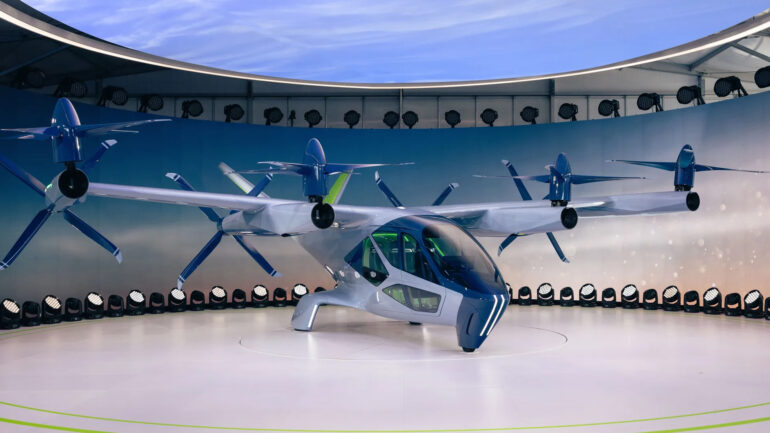
We are moving beyond the era of polished computer-generated imagery and entering one of maintenance procedures and profitability calculations based on seat-kilometers. The transition from fiction to reality is often less poetic than expected, but far more fascinating. It is no longer isolated inventors driving the project, but consortia bringing together aerospace giants, investment funds, and automakers like Hyundai with its Supernal division.
The horizon for flying taxis has cleared, but it has also come closer to the ground. The goal is no longer to revolutionize the lives of every citizen, but to resolve specific bottlenecks in the world’s most congested cities. From Dubai to Los Angeles, via Paris and Singapore, the race is no longer about who will fly the highest, but about who will integrate most intelligently into the urban fabric. The true triumph of the air taxi will not be to make passersby look up at the sky, but to become so commonplace that it goes unnoticed.
A ticket for the first commercial flight is no longer a distant pipe dream. Reservations are starting to be made, partnerships with luxury hotel chains are being forged, and the first professional pilots are completing their training on these new aircraft. The technology is ready, and regulations are being refined. The question remains whether the public is ready to trade the tarmac for the blue of the sky—even if it means saving just a few minutes of travel time away from the hustle and bustle of the world below.