
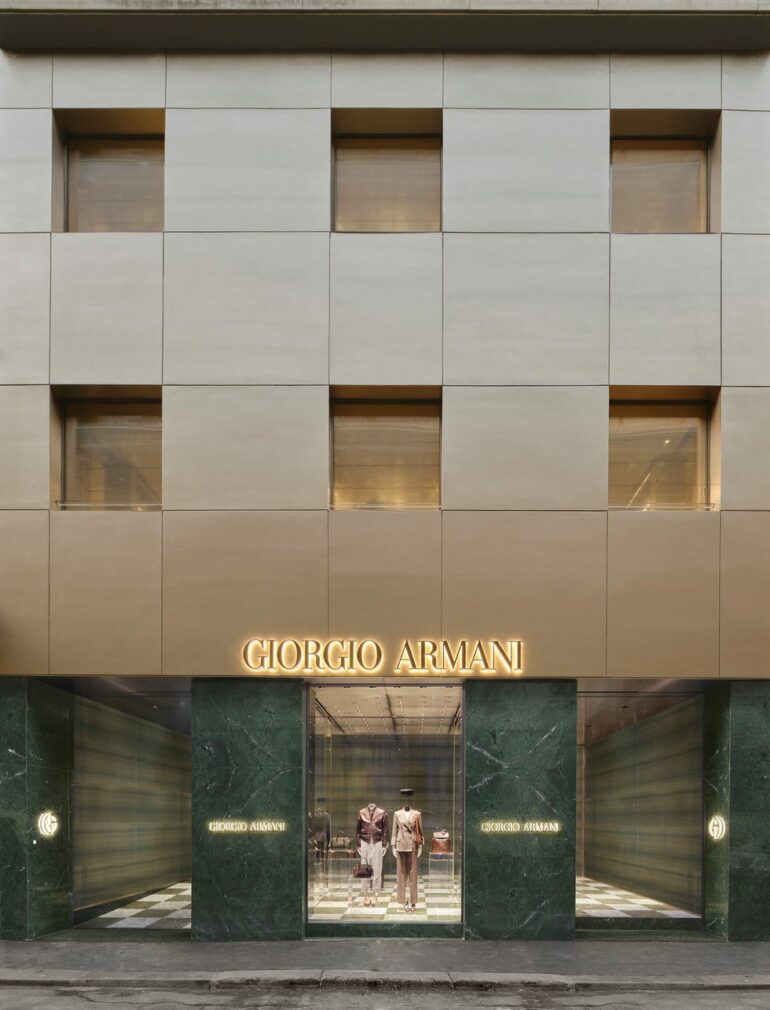
Giorgio Armani's Legacy Amid Market Turmoil
Since Giorgio Armani’s passing in September 2025, the fashion industry has been watching the seismic shifts within the Milanese fashion scene with almost religious attention. The designer, a tireless architect of an empire built on fierce independence, left behind a roadmap of surgical precision. This legacy, a true strategic compass, initially called for the sale of an initial 15% stake in the company by March 2027. However, the latest rumors from Italian financial circles suggest the pace is slowing. The timeline is stretching out, certainties are fading, and the deadline for this pivotal transaction now appears to be shifting toward the end of 2027.
This delay is not the result of sentimental hesitation, but rather a clear-eyed assessment of the current economic climate. The eponymous foundation, which now holds the reins at Giorgio Armani, is navigating turbulent waters as the global luxury industry continues to search for its equilibrium. Sources close to the matter emphasize that the timeframe guidelines left by the maestro are not binding. In this world where prestige is measured over the long term, haste makes for poor decision-making. Postponing the sale would allow the foundation to wait for more favorable conditions to maximize the value of this jewel of Italian haute couture, thereby avoiding the fire-sale of a legacy that never succumbed to the siren call of haste during his lifetime.
The Reality of the Numbers: Between Resilience and Erosion
To understand this caution, one must delve into the company’s financial health report. The first two months of fiscal year 2026 paint a mixed picture, marked by a decline in revenue. Giuseppe Marsocci, the group’s current CEO, recently revealed a 7.5% drop in net revenue at current exchange rates. When currency effects are excluded, the decline levels off at 3.9% compared to the same period the previous year. These figures are not isolated anomalies but reflect an industry that is adjusting to a period of normalization after years of euphoria.
A closer look at these results reveals an interesting divide in the distribution model. The wholesale segment, which supplies department stores and multi-brand boutiques worldwide, is showing severe signs of weakness, with a 10.7% drop at constant exchange rates. In contrast, direct-to-consumer sales have shown remarkable resilience, posting a 3.5% increase. This dichotomy confirms that while intermediaries are struggling, the direct emotional and commercial connection between the brand and its end customers remains a driver of growth. It is precisely this dynamic that must be preserved before opening up the company’s capital to outside investors.
The parade of suitors: a triumvirate of giants
The sale of a stake in a fashion house of this stature is not merely a transaction; it is a geopolitical event in the fashion world. Giorgio Armani’s will did more than just set dates; it drew up a list of potential successors—a sort of inner circle deemed worthy of carrying on his legacy. Three names keep coming up, representing the full spectrum of modern luxury expertise. On one hand, LVMH, Bernard Arnault’s colossus, whose financial clout and expertise in haute couture and leather goods make it a natural buyer for the fashion division.

On the other hand, there are long-standing partners who already know the inner workings of the house intimately. L’Oréal, which has successfully managed the brand’s beauty and fragrance licenses for decades, might see this stake acquisition as a way to secure its most valuable asset. Finally, EssilorLuxottica, the global leader in eyewear, rounds out this top trio. For the group, whose ties to Armani are rooted in the design of its eyewear collections, such a deal would strengthen an already fruitful synergy. Each candidate brings a different vision of what the brand could become without its founder, but they all share one ambition: to stabilize an empire that carries significant weight in the peninsula’s economy.
Toward an IPO or preserving the institution?
Beyond the sale of this 15% stake, another shadow looms over the future of Piazza Cavour: that of the stock market. The group has never ruled out a potential initial public offering (IPO). This option, though risky by nature, would offer transparency and liquidity that could facilitate the generational transition within the foundation. However, a public listing requires metronomic consistency—something the figures from early 2026 make difficult to guarantee at this time. The slowdown observed in the wholesale distribution network suggests that the brand must first complete its internal transformation before facing the demands of financial analysts.
The current strategy therefore appears to be one of active delay. By postponing the sale until the end of 2027, management is giving itself the necessary breathing room to restore margins and consolidate direct sales growth. The challenge is to prove that the Armani aesthetic—that blend of rigor and fluidity—can thrive in a post-founder environment without losing its commercial soul. For the market, this additional delay is not a sign of weakness, but proof that Giorgio Armani’s legacy is being treated with the same meticulous care that the designer applied to the cut of a deconstructed jacket. The world of luxury operates on its own timeline, distinct from current events, and in Milan, it seems they have chosen to let the storm pass before sealing the fate of one of the last bastions of creative independence.