
Architecture of the Gaze in the Face of Roman Brutalism
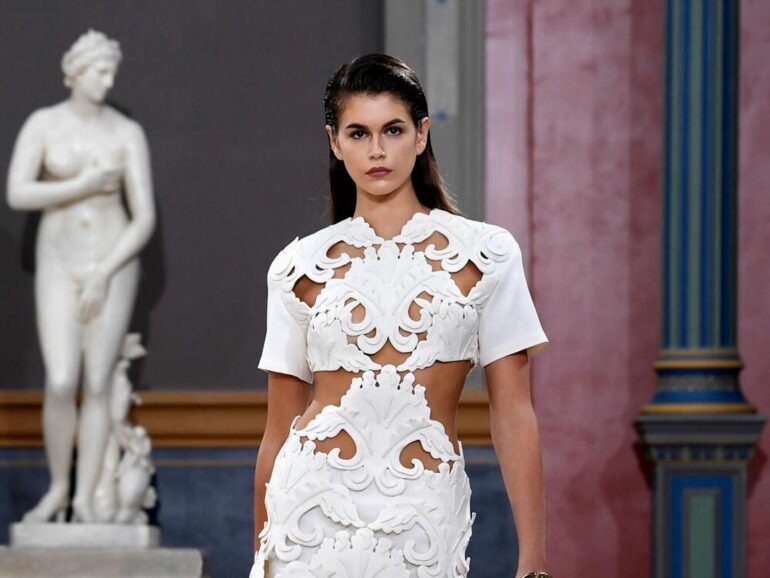
Blackened steel turbines frame deities frozen in stone. A space of contrasts where industrial archaeology engulfs classical antiquity, the Centrale Montemartini offers Rome one of its most striking visual paradoxes. It is precisely in this collision of time periods that Valentino chooses to set its Fall-Winter 2026 eyewear campaign. Photographer Glen Luchford’s lens captures the features of Qiuyie Li and George Anderson as they move among the machinery and marble busts. The approach goes beyond a mere aesthetic staging. Beneath the vaults of this former power plant, the collection—dubbed “Interferenze”—finds its literal embodiment: a point of stylistic friction where the object ceases to be an accessory and instead asserts its presence. The frame no longer adorns the face; it structures it.
Material and clothing reimagined as a pedestal
In the conventional grammar of fashion, eyewear comes at the end of the process, like a punctuation mark. Designer Suzanne Koller has chosen to reverse this chronology. Responsible for the overall look of this series, she creates a wardrobe that acts as a showcase—a silent yet texturally rich base. The fabrics draped on the models serve a specific purpose: to draw the eye upward toward the top of the silhouette.
A complex balancing act takes shape. The sculptural draping, the rich sheen of satin, or the intricate detail of dark lace do not seek to draw attention to themselves. Even the most imposing pieces of jewelry—heavy necklaces falling onto the collarbone or oversized earrings—strategically recede into the background. Far from competing with the frames, they frame the line of sight and highlight the richness of the acetate.
Geometric Tensions and the Duality of Forms
This supremacy of the object over the silhouette is expressed through a series of geometric choices. The season’s guiding lines take on a radical form, directly echoing the décor of La Centrale. A mask-like variation immediately captures the light: designed with oversizing in mind, the frame extends well beyond the temples. Its frame is punctuated by an exceptionally slender upper metal bar, which contrasts with the ruggedness of the studded details on the front.
The cat-eye silhouette, meanwhile, is split into two contrasting interpretations. The first version adopts an ivory hue to create an overtly graphic aesthetic, revealing unapologetic retro influences. The second version adopts a strictly subdued color palette. Darker in tone, with softer, less angular curves, it lends the model a deliberate opacity—an almost elusive air of mystery.
The Engineering of Vision
The transition to prescription frames extends this exploration of exaggerated volumes. The simplicity of a black rectangular frame—whose angles have been softened for effortless sharpness—contrasts with more extreme experiments. One geometric model, in particular, explores hyperbolic proportions, drawing on the raw thickness of the material. The proportions are intentionally distorted, transforming the vision correction tool into a standalone design element.
The house’s signature is integrated into these miniature architectures through the exclusive lens of the hardware. Far from being merely a surface embellishment, the VLogo penetrates the object’s mechanics. It is anchored in the metal plates and becomes the pivot point of the hinges, fusing Valentino’s identity with the technical constraints of eyewear.
This embedding of the accessory within a powerful narrative heralds further developments for the brand. The focus on the face will soon give way to the embodiment of the fragrance’s trail, with the anticipated appearance of Dakota Johnson as the face of the campaign for the house’s new fragrance, Vendetta.