
A New Take on Luxury Takes on the Cliffs of Mallorca
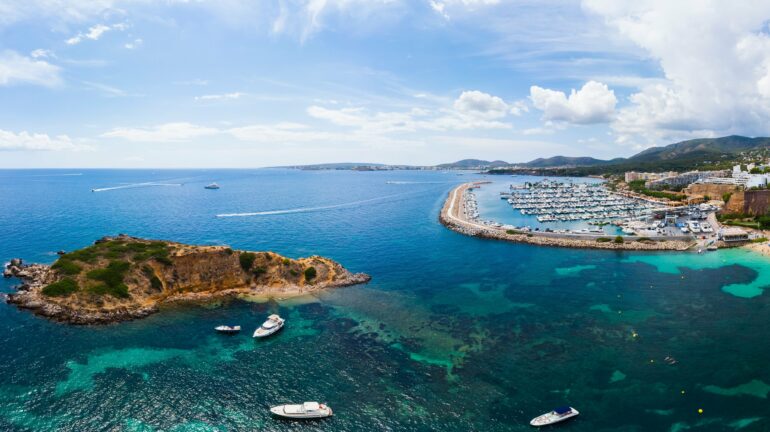
The sun hasn’t quite crossed the horizon yet when the balcony becomes Punta Negra’s prime vantage point. At seven in the morning, the calm is absolute. Beneath this rocky outcrop, the pool awaits its first swimmers while the staff arranges the towels with pinpoint precision. Beyond the pine trees, whose silhouettes have been sculpted by decades of sea breezes, the Mediterranean stretches out, dotted with sailboats still at rest. This panorama has remained unchanged since 1966, when the Blanes family opened a modernist resort here designed by architect Felipe Sánchez-Cuenca Martínez. Yet the atmosphere that reigns today on this headland reflects a profound transformation in the island’s hospitality industry.
The arrival of Mandarin Oriental at this protected site marks a strategic turning point. The project, led by Blasson Property with an estimated investment of 200 million euros, did not stop at restoring the historic structures. It has enveloped them in a contemporary ecosystem comprising casitas with soft stucco finishes, six gourmet restaurants, and a monumental spa. This development comes at a turning point for Mallorca, which is gradually moving away from its traditional seaside image to attract an international clientele with evolving expectations.
Conquering New Aerial Horizons
The timing of this opening is no coincidence. Raul Guerra, a leading figure in the group and director of marketing and sales, highlights a radical shift in the origin of traveler flows. The island is no longer just a summer retreat for Europeans; it has become a direct destination for global luxury. The introduction of long-haul routes—notably the United Airlines flight from Newark and the brand-new Etihad connection from Abu Dhabi—has changed the game. Americans, Saudis, Emiratis, as well as Brazilians and Mexicans, are now flocking to the Balearic Islands with spending habits that are shaking up local norms.
This new cohort of visitors travels differently—often accompanied by an extended family or domestic staff—and exhibits a spending propensity far greater than that of the traditional mainland clientele. To adapt to this demand, the hotel had to rethink its internal structure. Of the resort’s 131 guest rooms—including 26 suites—80% of the inventory features connecting doors. This architectural modification, simple in appearance, constitutes a decisive competitive advantage in the ultra-luxury market, making it possible to transform individual rooms into modular private apartments.
Architecture Blending Heritage and Fluidity
The reinvention of Punta Negra was entrusted to the firm Estudio Lamela, which collaborated with HKS Architects and local studios such as Palmer Blach Arquitectos. For the firm founded by Antonio Lamela, this project feels like a return to its roots. The firm’s founder, renowned for Madrid’s Torres Colón, knew this coastline intimately, having designed the Zodiac residences in Illetes and the Son Matías in Palma Nova as early as the 1950s. Here, the challenge was to respect the original 1966 design while infusing it with an organic modernity.
The result is a seamless transition between the historic building and the new structures. The landscaping serves as a unifying element, featuring wild and colorful plantings where butterflies flutter, contrasting with the dramatic verticality of monumental cacti. This “open” approach is reflected in the very philosophy of the place. Although located just 15 minutes from Palma and 20 minutes from the airport, the estate feels secluded from the world. Yet it rejects isolation: the spa and main pool are open to outside guests, attracting owners of nearby villas and Palma’s social scene in a skillfully orchestrated mix of visitors.
Art as a Bridge to Memory
Inside, French interior designer Laura Gonzalez, supported by BG Studio, has embraced a free-spirited and sun-drenched aesthetic. But it is the artistic dimension that gives the place its true depth. Curator Paloma Fernández-Iriondo, formerly of Sotheby’s in Madrid, was tasked with building a collection that is not merely wall decor, but a narrative tied to the island. She traveled throughout Mallorca in search of talent outside the traditional gallery circuits to commission unique works.

In the lobby, artist Fran Aniorte’s ceramic “Balearic constellations” welcome visitors. Further inside Casa Alma, Vera Edwards’ paintings engage with the very history of the establishment. In a poetic twist of fate, the artist discovered during the renovation that her own grandmother had created a mural for the original hotel in the 1960s. This historic work, depicting the conquest of Mallorca by James I in 1229, has been preserved and now hangs alongside her granddaughter’s creations. This artistic connection illustrates the hotel’s commitment to grounding itself in cultural continuity rather than offering standardized, detached luxury.
A World-Class Culinary Hub
The dining strategy is equally ambitious, aiming to make the site a culinary destination in its own right. Of the six planned restaurants, four are already open. Thalos offers Greek cuisine by the pool, while Sobretaula focuses on the art of tapas and Spanish mixology. Mediterranean flavors are explored at Leppoc, complemented by the meat-focused offerings of the Leña steakhouse.
Anticipation is now building around the next two openings: a restaurant by chef Nobu Matsuhisa—his first Matsuhisa-branded location in Spain—and Jacinta, a Mexican concept orchestrated by the Miami-based DZO Hospitality group. For the resort, the challenge lies in maintaining a delicate balance between the vibrancy of these outward-facing restaurants and the need for discretion among a clientele seeking, above all, the privacy of an exclusive retreat. The scale of the estate, which extends to the tranquil waters of two small public coves bordering the property, makes this coexistence possible.
When you leave the terraces to head down toward the sea and turn back to gaze at the hotel’s silhouette from the water, the endeavor appears to have succeeded. In the orange morning light, the building perched on its rocky base does not look like a newcomer, but rather like a guardian of time that has simply found a new lease on life. Modern luxury at Punta Negra seems to be defined this way: a keen awareness of the setting coupled with an uninhibited openness to the world.