Make Texture a preferred source on Google to support us
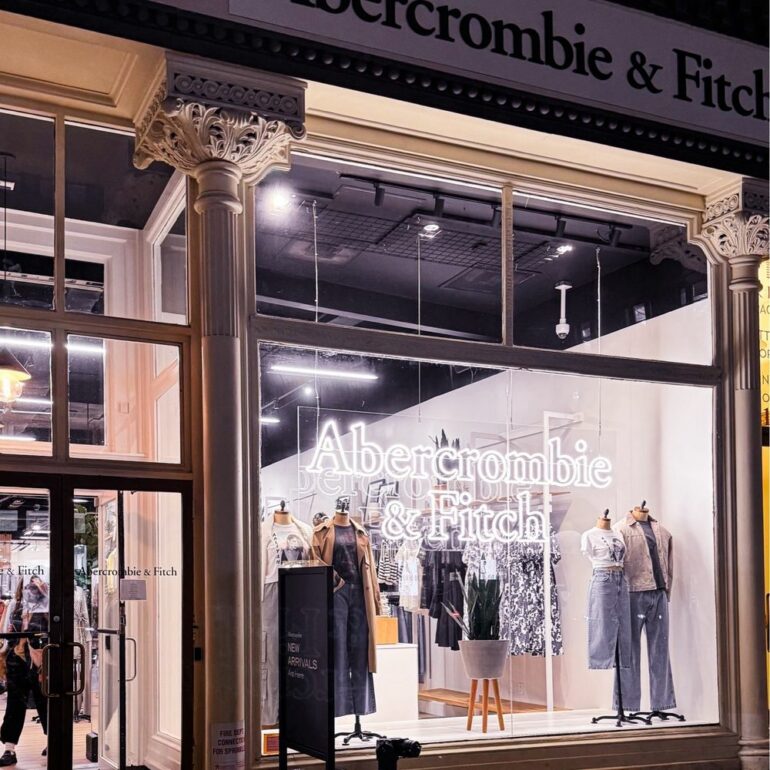
Add Texture to GoogleAt Abercrombie & Fitch, the brand name featured on the company’s sign isn’t the one that generates the most sales: Hollister accounts for 52% of revenue. But the third quarter of fiscal year 2026 reveals, above all, a rebalancing between the two divisions, which are now growing at similar rates. To understand the trajectory of this American fashion company, it’s not so much the record revenue that catches the eye as the way it’s achieved: two brands advancing together, geographic expansion that remains uneven, and profitability where one must distinguish between commercial drivers and financial support.
Two Drivers Rather Than a Single Engine
Hollister retains the top spot with $746.6 million in quarterly sales, up 11%. The Abercrombie division, which includes Abercrombie & Fitch and Abercrombie Kids, posted sales of $688.8 million, a 12% increase. The gap remains, but the growth trajectories are converging. On a like-for-like basis, the performance figures are similar: +5% for Hollister, +6% for Abercrombie.
This convergence changes the interpretation of the results. In the third quarter of 2025, Hollister posted double-digit growth while Abercrombie declined. A year later, the group no longer relies on one brand offsetting the other to achieve growth. Both divisions are contributing to the acceleration, and the one that had previously lagged behind is now posting the strongest growth, both in reported figures and in comparable sales.
The details matter more than a simple ranking of the brands. Hollister remains the dominant force without overshadowing its neighbor’s business. Abercrombie is once again making a positive contribution without causing Hollister’s growth to slow to single digits. For the group, this balance provides a solid foundation for its sixteenth consecutive quarter of growth: continuity does not rest on a single brand.
CEO Fran Horowitz attributes these better-than-expected results to customers’ positive reception of the products and marketing. The press release does not specify the collections or campaigns involved. However, it does show that the commercial response this time benefited both divisions, rather than just one.
Margins are rising, with a key driver
The sales growth is accompanied by a more pronounced improvement in operating income, which rose from $155 million a year ago to $223.2 million. The operating margin reached 15.5%, compared to 12% in the previous third quarter. In other words, the group is not only generating more revenue; it is also retaining a larger portion of it at the operating level.
One caveat is in order, however. The quarterly earnings include approximately $20 million in IEEPA customs duty refunds. This support is part of the reported performance, but it does not stem from apparel sales. Distinguishing this item prevents attributing the entire improvement solely to the brands, even though both are experiencing business growth.
On a full-year basis, this factor becomes particularly significant. Forecasts include approximately $120 million in refunds, representing about 220 basis points of operating margin and $2.15 in earnings per share. The reported profitability should therefore be viewed from two perspectives: that of rising commercial activity and that of a customs-related contribution quantified by the group itself.
This is also what makes the relative caution in the new outlook interesting. Abercrombie & Fitch is raising its annual revenue growth target and its earnings per share forecast, but is maintaining its operating margin range between 14.5% and 15%. This business optimism is not reflected in an upward revision of all indicators.
International growth, with a U.S. focus
The rebalancing among brands should not obscure another concentration—this time, a geographic one. The Americas still account for more than 80% of revenue. With quarterly revenue of $1.17 billion, up 11%, they remain critical to the group’s trajectory. The 5% increase on a like-for-like basis confirms that this core market continues to grow.
The Europe, Middle East, and Africa region totaled $217.7 million, an increase of 12%, with comparable sales up 4%. For a French reader, this is the closest level of detail available in the results: no figures specific to France are provided. This region contributes to the overall momentum, but its weight remains significantly lower than that of the Americas.
The Asia-Pacific region posted the highest growth rate: +24%, both at current and constant exchange rates. Its revenue, however, stood at $47.9 million. The distinction between growth rate and volume is essential. This region is growing rapidly, but it does not yet serve as a counterweight to U.S. dominance.

In total, quarterly net revenue reached $1.43 billion. Its 11% increase at current exchange rates translates to 6% at constant exchange rates. Business is therefore growing well beyond the impact of currency exchange rates alone, though these rates do amplify the reported growth. As with customs refunds, separating these factors allows for a more precise measurement of underlying business momentum.
Resources Allocated Between Stores and Shareholders
This growth provides the group with additional resources. As of October 31, its cash balance stood at $724 million, compared to $606 million a year earlier, for total liquidity of approximately $1.2 billion. The question then becomes how to use these resources: supporting the brands’ growth while continuing share buybacks.
During the first nine months of the fiscal year, Abercrombie & Fitch repurchased 3.9 million shares for $382 million. The number of shares outstanding has decreased by 9% compared to the beginning of the year. The company confirms its intention to allocate at least $500 million to these buybacks over the full fiscal year. This reduction in the number of shares is another factor to keep in mind when examining the trend in earnings per share.
At the same time, the physical store network continues to expand. For 2026, the company anticipates approximately 50 store openings and 20 closures, resulting in a net increase of about 30 locations. This is therefore not a uniform expansion: growth is accompanied by adjustments to the existing store portfolio. Expected investments for the year total approximately $260 million, with no specific breakdown by brand or region.
The Next Quarter as a Measure of Continuity
The annual targets now reflect the group’s confidence: revenue growth of approximately 6%, up from 5% previously, and diluted earnings per share ranging from $13.70 to $13.90, instead of $13.10 to $13.60. Fran Horowitz thus anticipates another record-breaking fiscal year, with a solid double-digit operating margin and growth in earnings per share.
One concrete milestone remains. For the fourth quarter, Abercrombie & Fitch forecasts sales growth of approximately 7%, an operating margin close to 15%, and earnings per share of $4.40 to $4.60. These targets apply to the entire group, with no separate forecasts for its two divisions. The upcoming earnings report will therefore reveal whether the restored balance between Hollister and Abercrombie extends beyond this quarter.