Make Texture a preferred source on Google to support us
Add Texture to GoogleThe French “cultural exception” has long been based on an unshakable premise, positioning the state and its institutions as the sole legitimate guardians of the preservation and exhibition of cultural heritage. From the Louvre to the Centre Pompidou, the government dictated the pace of retrospectives, validated artistic movements, and set art history in stone through didactic exhibitions. Today, this centralized model is faltering under the influence of a parallel landscape shaped by private collectors. These foundations, born of industrial fortunes or personal passions, are no longer content to serve merely as appendages or to fill in the blind spots of national museums. They impose a new grammar: that of subjectivity. The connoisseur of the art of living no longer visits these spaces merely to check off a list of masterpieces, but to engage with a radical subjectivity. Architecture, landscape, scenography, and the artworks themselves merge to create a total experience, where an individual’s perspective replaces the encyclopedic approach of a scientific committee.
A Clash of Titans in the Parisian Landscape
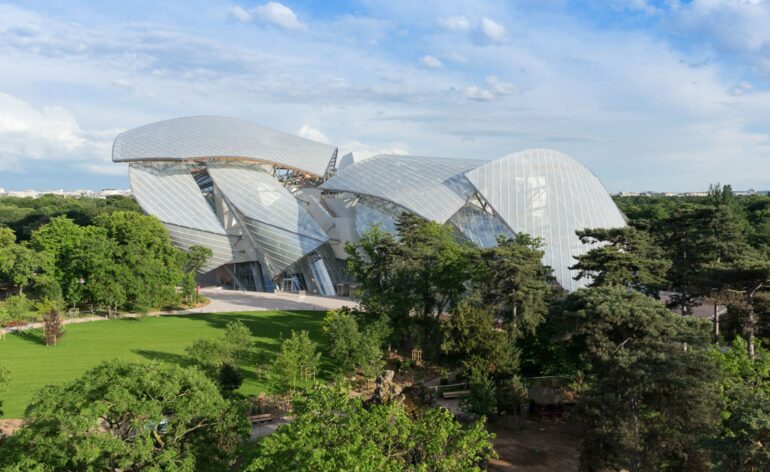
It is in Paris that this redefinition of cultural power finds its most spectacular expression, through a duel of aesthetics and visions. To the west, on the edge of the Bois de Boulogne, the Louis Vuitton Foundation asserts a strategy of monumental extroversion. By entrusting the design of the building to Frank Gehry, Bernard Arnault did not merely commission a showcase for his contemporary art collection; he demanded a new landmark in the Parisian skyline. The twelve glass sails that unfurl above the trees serve as a symbol of power, embodying the collision between the financial might of the luxury industry and the architectural avant-garde. The vast interior spaces, bathed in complex light, call for blockbuster exhibitions capable of accommodating paintings of dizzying proportions that would be lost in traditional galleries.
In the heart of the capital, François Pinault chose the opposite strategy to house his own collection. By taking over the Bourse de Commerce, the collector seized a piece of Parisian history to tame it from within. Japanese architect Tadao Ando’s design reads like a lesson in introspection: a cylinder of raw concrete cast beneath the painted 19th-century dome. The tension here arises from the clash between the frescoes glorifying yesterday’s global trade and the radical nature of the contemporary works—often influenced by Arte Povera or marked by harsh social critiques—that fill the galleries. Visitors glide along the passageways, drawn into a constant dialogue between frozen heritage and art in motion, proving that contemporary patronage also knows how to exploit history to better assert itself.
The South as a Laboratory for Physical Immersion
The influence of these private players extends far beyond the ring road, finding in the south of France a playground where geographical constraints become a tool for staging. On the island of Porquerolles, the Carmignac Foundation takes the logic of separation to its extreme. Access to the artworks requires a ritual of slowing down. Visitors must take a boat, walk through a windswept pine forest, and then agree to remove their shoes before entering the underground galleries built beneath a Provençal farmhouse. The sensation of the soles of one’s feet on the cool stone physically shapes the perception of the paintings by Botticelli and Roy Lichtenstein, as well as the photographs by photojournalists. Édouard Carmignac conceived this place not as a museum for casual visitors, but as a retreat, where the Mediterranean sun and the island’s silence filter the experience of art.
Further west, a private vision directly shapes the destiny of a city. With the Luma Arles project, Maja Hoffmann has transformed a barren railway wasteland into an epicenter of global creativity. The stainless-steel tower, also designed by Gehry, captures the harsh light of the Camargue and stands as a beacon above the former SNCF workshops. Here, the initiative goes beyond a simple exhibition: the foundation produces, funds, and hosts researchers, designers, and visual artists. It stimulates the local economy and sets a new cultural calendar that breaks free from the Parisian seasons. Visitors stroll through a landscaped park designed to rehabilitate industrial land, realizing that contemporary art, when supported by agile private funding, can serve as a tool for large-scale urban regeneration.
The Legacy of the Pioneers and the Cult of the Sanctuary
This surge of recent initiatives draws its legitimacy from a pioneering model that, as early as the 1960s, recognized that art required an environment conceived by and for creators. The Maeght Foundation, inaugurated in 1964 in Saint-Paul-de-Vence, remains the gold standard of this approach. Marguerite and Aimé Maeght did not commission a building simply to hang paintings; they invited Joan Miró, Georges Braque, and Alberto Giacometti to design the space alongside architect Josep Lluís Sert. The labyrinth of ceramics, the courtyard filled with slender bronze figures, and the mosaic pools demonstrate that emotion arises when the artwork is no longer treated as a piece of furniture but as the defining element of the architecture.

This quest for absolute integration finds a contemporary echo in self-contained spaces, where the artist himself becomes the chief architect of his own museum. In Le Muy, in the Var region, the Venet Foundation spans several hectares, serving as sculptor Bernar Venet’s personal pantheon. The park is home to his immense Corten steel arches, as well as a chapel designed by Frank Stella and site-specific installations by Donald Judd and James Turrell. Access is rare, limited to small groups during the summer months. This emphasis on intimacy and limited attendance runs counter to the logic of mass attendance at public institutions. One does not visit the Domaine du Muy on a whim over the weekend; one enters by appointment, aware that one is intruding upon the mental and domestic space of an active artist.
Subjectivity as the New Standard for Exhibitions
The impact of these venues lies in their freedom of expression. Freed from the dual obligation of neutrality and comprehensiveness that weighs on state museums, private foundations embrace their biases. Acquisition decisions are made within a few days, allowing them to purchase complete sets of works at major international art fairs, whereas public acquisition committees get bogged down in administrative procedures lasting several months. This agility is reflected in the gallery layout. The installations dare to make jarring juxtapositions and explore a collector’s obsessions without seeking to reassure the general public with overly didactic labels.
The cultured public turns to these foundations precisely because of this lack of objectivity. The appeal no longer lies in an artist’s institutional validation, but in the way a work resonates within a specific collection, illuminated by a sophisticated curatorial design. From the starkness of Parisian concrete walls to the crunch of pine needles underfoot in the Var, these spaces dictate a new rhythm. They compel the viewer to slow down, to accept the imbalance of a partial perspective, proving that contemporary art is experienced first and foremost through the space that chooses to house it.