
Make Texture a preferred source on Google to support us
Add Texture to GooglePurchasing a painting, a video installation, or a sculpture is no longer the purely contemplative act that characterized the Parisian salons of the last century. Beneath the monumental glass roofs of major auction houses or in the clinical silence of galleries’ white cubes, the art lover now encounters—and sometimes merges with—the wealth manager. The global art market has undergone a spectacular financial transformation, turning artworks into a fully-fledged alternative asset class. Yet approaching this world solely through the lens of quarterly returns exposes the novice to severe disappointments. The true value of a collection is built on a fine line: that constant tension that links the rigor of economic analysis to the absolute irrationality of the aesthetic impact.
The first pitfall lurking for the buyer lies in confusion regarding initial intentions. A painting is not a stock listed on a stock exchange. Its liquidity remains inherently uncertain, its value intrinsically subjective, subject to sudden shifts in taste, the whims of critics, or the sudden enthusiasm of a handful of international buyers. Focusing exclusively on an artist’s market value obscures the only benefit immediately and indisputably guaranteed by this purchase: the emotional return. Living with a work of art on a daily basis alters the intimate architecture of a space. This invisible return—intellectual and social in nature—cushions the shocks of a market that is, by definition, opaque. The most seasoned dealers, in fact, offer an immutable rule for newcomers. The eye must always come before the wallet, because in the event of a sudden collapse in value or a drying up of demand, the artwork will remain hanging on the living room wall.
Deciphering the Grammar of the Art Market
To hope to build capital while indulging their passion, art lovers must develop a structured perspective and understand the complex landscape of the art market. The frenzy that grips the aisles of major international art fairs often leads to hasty decisions. Yet building a coherent collection—one capable of weathering economic cycles—requires monastic patience. Navigating across different mediums demands that you forge your own taste through direct and repeated engagement with the works. Regular attendance at institutional retrospectives and close attention to influential curators help refine one’s judgment, enabling one to distinguish between what is merely a decorative fad and what is part of an artistic approach rooted in history.
This market is structurally divided into two spheres with starkly distinct rules. The first circuit—that of the galleries—facilitates the initial encounter between works fresh from the studio and their first buyers. Securing a major piece from an influential gallery is never simply a matter of being able to write a check. Gallery owners jealously guard the careers of their protégés, acting as true guardians of the temple. They screen prospective buyers, favoring private foundations, museums, or collectors already known for their loyalty. Winning over a dealer to secure a spot on the waiting list for a rising star is a high-stakes diplomatic exercise. The buyer must demonstrate a deep-seated commitment to the artist’s work, prove their ability to loan the artwork for future exhibitions, and certify that they are not seeking a mere short-term speculative gain.
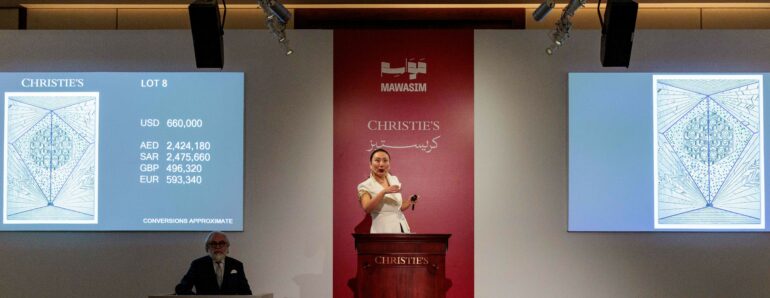
The secondary market, the arena of public auctions, follows a radically different script. The palpable adrenaline in the auction room, amplified by the cold immediacy of digital platforms, dictates the final price. Under the hammer, transparency is theoretically the norm: auctions are public, establishing the official price that will serve as a benchmark for future transactions. Yet this environment demands absolute composure. Competitive enthusiasm can quickly push a buyer to exceed the upper limit they had rationally set for themselves. Moreover, the increasingly frequent use of financial guarantees and irrevocable bids by third parties obscures the clarity of organic demand. Even before making a bid to the auctioneer, a meticulous review of the condition report determines the soundness of the acquisition. Extensive and concealed restoration, clumsy relining, or subtle discoloration drastically undermine the piece’s financial viability. Provenance—a veritable pedigree tracing the object’s history—plays an equally decisive role. A succession of prestigious owners validates a work’s historical significance and immediately reassures potential buyers.
Budgeting for the External Costs of a Collection
Acquiring a recognized signature also involves budgeting for a host of peripheral costs that are very often underestimated by novices. The hammer price is merely the tip of the transactional iceberg. At auction, the house’s commissions are systematically added to the hammer price, increasing the final bill by a substantial percentage. Then there are the purely logistical considerations. A monumental bronze sculpture or a painting requiring climate-controlled conditions necessitates specialized transportation, entrusted to companies whose rates reflect the level of risk involved. Insurance, based on the declared value and regularly reassessed, represents an unavoidable annual expense. Added to this are potential storage costs in free ports or ultra-secure warehouses for pieces that, due to lack of space or purely for investment strategy, cannot be housed in the buyer’s residence.
Framing, mounting, or technical installation—far from being mere aesthetic details—play a direct role in preventive conservation. Technical anti-reflective and UV-blocking glass, along with installation using materials guaranteed to be acid-free, require the expertise of skilled artisans, whose services significantly impact the overall budget. These maintenance costs alter the calculation of the final return on investment in the event of a resale, transforming an apparent capital gain into a financially neutral—or even loss-making—transaction.

The French Exception and the Tax Equation
Tax considerations come into play from the very beginning of a collection’s formation. National jurisdictions apply highly varied interpretive frameworks. France, historically committed to protecting its cultural heritage, maintains a specific framework that appeals to managers of large fortunes. The exclusion of works of art from the tax base for the Real Estate Wealth Tax serves as an undeniable incentive for wealth transfer and investment. Upon resale, French collectors may choose between a flat-rate tax levied on the total sale price or taxation of the actual capital gain, accompanied by a progressive deduction based on the number of years of ownership, resulting in full exemption after several decades. This mechanism structurally encourages long-term preservation, favoring a wealth-building approach over immediate speculation. However, the international circulation of artworks is hindered by customs barriers and import tax regimes that vary drastically from one continent to another, complicating the management of a collection spread across multiple residences worldwide.
The Balance Between History and Immediacy
In building this unique collection, the temptation to unearth the talent of tomorrow drives the vast majority of enthusiasts. The ultra-contemporary segment, driven by very young artists, regularly experiences spectacular surges in value. The allure of meteoric capital gains drives some buyers to bet on artists fresh out of art schools. This strategy carries a colossal risk of failure. The market digests, recycles, and forgets at a breakneck pace. An artist whose work causes a sensation at a season’s openings may well vanish from institutional radar the following decade. Without the relentless filter of time or the support of a solid critical apparatus, financial value evaporates as quickly as it was artificially created.
At the opposite extreme, so-called “heritage” works offer security that has withstood successive crises. The pioneering figures of modern art or the leading artists of the postwar era have rigorous catalogs raisonné, exhaustive bibliographies, and a lasting presence in world-class museum collections. Their inherent scarcity on the open market relentlessly props up prices. Investing in these historical segments requires a vastly greater financial foundation but offers tangible protection. The buyer is no longer betting on a hypothetical discovery; instead, they are purchasing a fragment of cultural history already validated by academic consensus.
Given the overwhelming professionalization of this field, collectors rarely proceed alone. Securing the confidential guidance of an independent art advisor, seeking the clinical eye of certified conservators before finalizing a major transaction, or discreetly gauging the opinions of museum curators helps solidify one’s choices. Art demands a methodical approach. While intuition remains the irreplaceable driving force behind the first encounter with a work, only a methodical analysis of its materiality, its history, and its economic context can transform a simple visual impact into a lasting legacy.