Make Texture a preferred source on Google to support us
Add Texture to GoogleIn the San Miguel Chapultepec neighborhood of Mexico City, Galería RGR becomes, for one season, the setting for a sensory experience that challenges our human perception of time. With the exhibition *El ojo de los arbustos* (*The Eye of the Bushes*), Mexican artist Galia Eibenschutz invites viewers to immerse themselves in the plant kingdom—not merely as spectators of nature, but as interpreters of its consciousness. Curated by Carlos E. Palacios, this first solo exhibition at the gallery brings together a body of work spanning from 2024 to 2026, the result of a long-term research project titled *El tiempo de las plantas*.
Deconstructing the Anthropocentric Perspective
Galia Eibenschutz’s work is based on a radical premise: adopting the condition of a plant to perceive the environment. This approach draws on meticulous observation of life cycles and communication among plants during regular walks in the forest. The goal is not to represent the flora, but to align with its rhythm—a stretched-out temporality disconnected from our human scales. This paradigm shift draws its inspiration from the theories of philosopher Emanuele Coccia, particularly his essay *The Cosmic Garden*, which proposes viewing the world from the perspective of plants.
The artist also draws on the legacy of Johann Wolfgang von Goethe. In his treatise *The Metamorphosis of Plants*, the writer and scholar advocated for such attentive observation of nature that it would allow one to mentally reconstruct its vital dynamics. For Eibenschutz, the goal is to capture the *Urpflanze*—this archetype of the original plant and the energy that animates it—and then to transcribe it through graphic and choreographic gestures. Drawing and painting thus become the seismographs of a silent life that is nonetheless in perpetual motion.
A Language Between Body and Paper
Born in 1970 in Mexico City, Galia Eibenschutz has followed a hybrid path where dance and the visual arts converge. Trained in drawing under José Miguel González Casanova at UNAM, she simultaneously explored classical ballet and contemporary dance. This dual background, complemented by a master’s degree in experimental theater from the DasArts Institute in Amsterdam, infuses each of her works. Her time in the artistic scene at La Panadería and her experience as an assistant to the pioneering artist Joan Jonas refined her understanding of space and performance. Later, her collaboration with the École des Sables in Senegal and her receipt of the McKnight Foundation Artist Fellowship in choreography anchored movement at the heart of her visual practice.
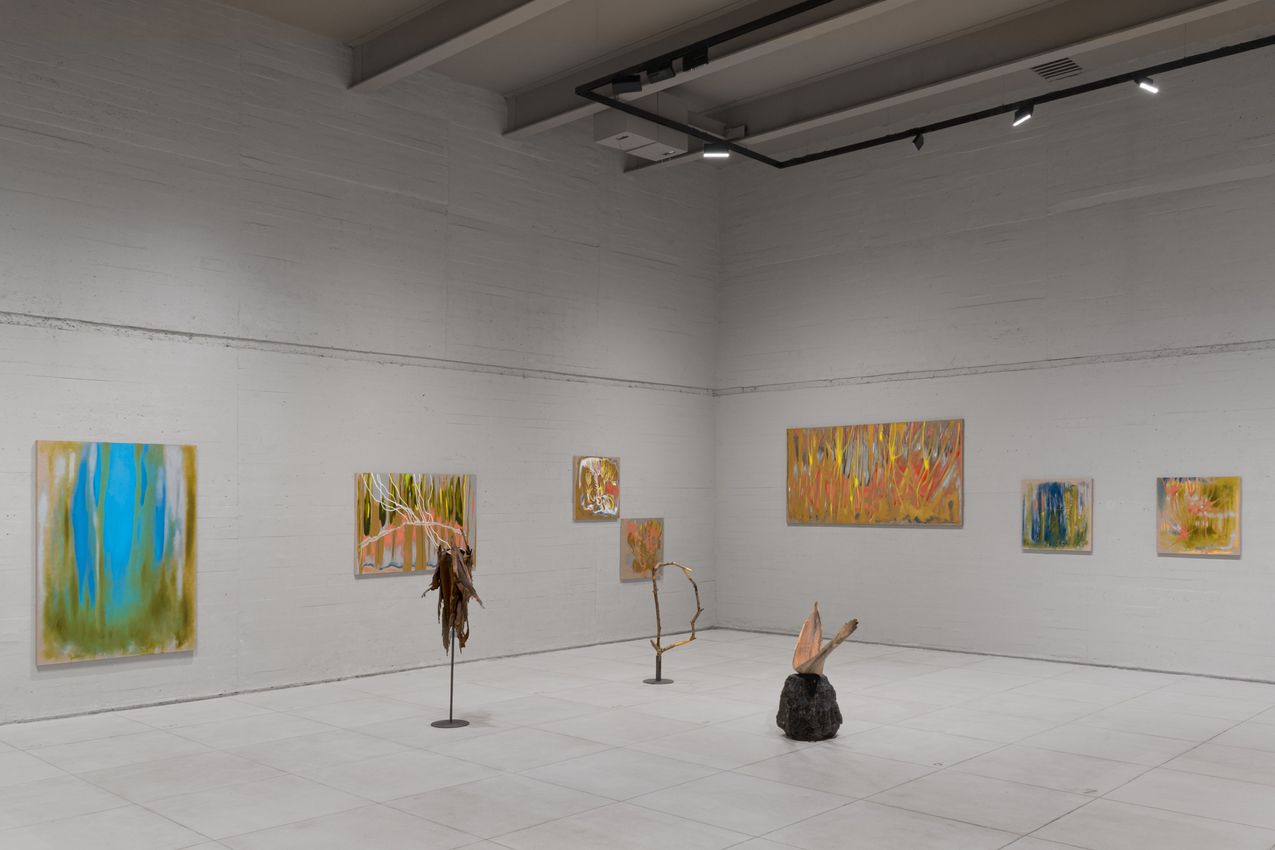
In the exhibition, this bodily fluidity is evident in works such as *Líneas – liana* (2026), a large-scale mixed-media piece on canvas (120 × 240 cm) where the lines seem to mimic organic growth. Works on paper, such as *Voz – arbre* (2025) or *Cavidad insecto* (2024), executed in colored pencil and pastel, reveal a particular attention to the structural details of living things: *Médula y duramen* (2024) and *Proceso de desintegración* (2024) explore the very anatomy of wood and its transience.
The Materiality of Plants
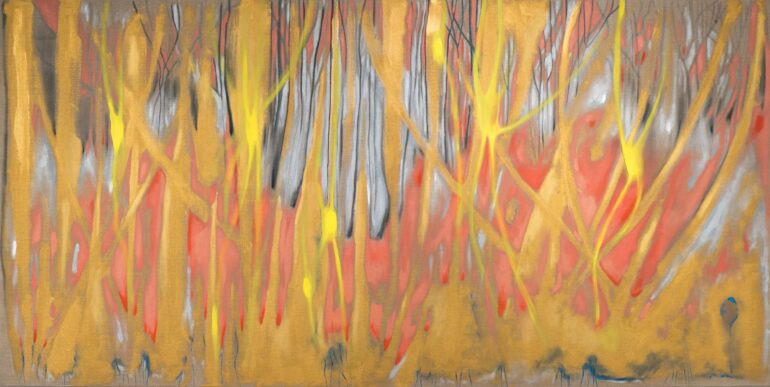
The exhibition’s eponymous work, *El ojo de los arbustos* (2026), illustrates the artist’s technical exploration. This canvas makes a powerful statement through the use of metallic powders mixed with acrylic lacquer and oil. While the technical documentation alternates between the use of silver powder and gold dust, the visual effect remains that of a luminous vibration evoking photosynthesis or the reflection of light on a canopy. Titles such as *Ciénaga* or *Semilla* round out this abstract yet deeply organic landscape.
Galia Eibenschutz has a strong presence on the Mexican institutional art scene. Her archive and career are documented by institutions such as the Museo Tamayo and the Fundación Casa Wabi, where she has completed residencies. This recognition underscores the relevance of her work in the contemporary context, where the question of our connection to the living world has become central. To accompany the exhibition’s opening, a performative activation titled *El tiempo de las plantas* was presented on November 19, 2026, allowing the public to witness the artist’s gesture come to life within the gallery space.
A Temporal Immersion
The exhibition, on view at General Antonio León 48 through January 9, 2027, is not limited to a presentation of paintings and sculptures. It functions as a mechanism for slowing down. By observing the works from the series *Voz – jardín* (2025), the viewer is invited to step out of the role of an outside observer and enter a space of resonance with the plant world. The prices of the works on display are not publicly disclosed, as the gallery prioritizes a personalized approach for collectors and institutions wishing to acquire these pieces.
Galia Eibenschutz’s work reminds us that the act of seeing is not exclusive to humans. By lending her hands to the shrubs and her body to the cycles of the seasons, the artist proposes an ecology of perception in which art becomes the necessary bridge between our urban hustle and bustle and the fertile silence of the forest.