Make Texture a preferred source on Google to support us
Add Texture to GoogleThere is a biting irony in seeing auction houses in New York or London go wild over rows of cheap chocolate bars or the uniform gray of a river under a leaden sky. For over a decade, Andreas Gursky has held the title of the most expensive photographer in history, a distinction earned through auction hammerfalls that have easily surpassed millions of dollars. Yet nothing in his work flatters the ego of the traditional collector. Where the art market often reveres spontaneous gestures, the physical rarity of a painting, or tormented expressionism, the German artist counters with clinical detachment and absolute flatness. The connoisseur of the good life and exceptional creations thus finds himself faced with a disconcerting paradox: how have the most literal depictions of our modern alienation—crowded supermarkets, frenetic stock exchanges, endless logistics warehouses—become the ultimate trophies of contemporary luxury? The answer lies not in the subject captured, but in the very redefinition of what an image is in the 21st century and its symbolic value.
The Scale of Vertigo: When Format Determines Rarity
The story takes root in the studious atmosphere of the Düsseldorf Academy of Fine Arts, under the tutelage of Bernd and Hilla Becher. These pioneers taught their students a rigorous, frontal typology, stripped of all sentimentality. Gursky inherited this visual grammar: no dramatic off-screen elements, no suggestive play of shadows. The gaze is intended to be purely analytical, almost entomological. If he observes humanity, it is from a distance, from the vantage point of a satellite mapping ant colonies.
But where his masters were content with modest formats to document industrial heritage, the student has brought about a radical shift in scale. He embraces the dimensions of classical history painting. His monumental prints, which require the viewer to step back a considerable distance, are not mere artistic flourishes. This gigantism transforms photography—traditionally perceived as a reproducible, intimate multiple that one slips into a portfolio—into an architectural object. Printed with diabolical precision and mounted behind thick Plexiglas panels using the Diasec process, these works acquire a sculptural materiality. By altering the format and physical weight of his prints, the photographer has changed the status of his medium, propelling it de facto into the same spatial and speculative arena as the monumental canvases of a Gerhard Richter.
The Priced Mirror of Our Own Excess
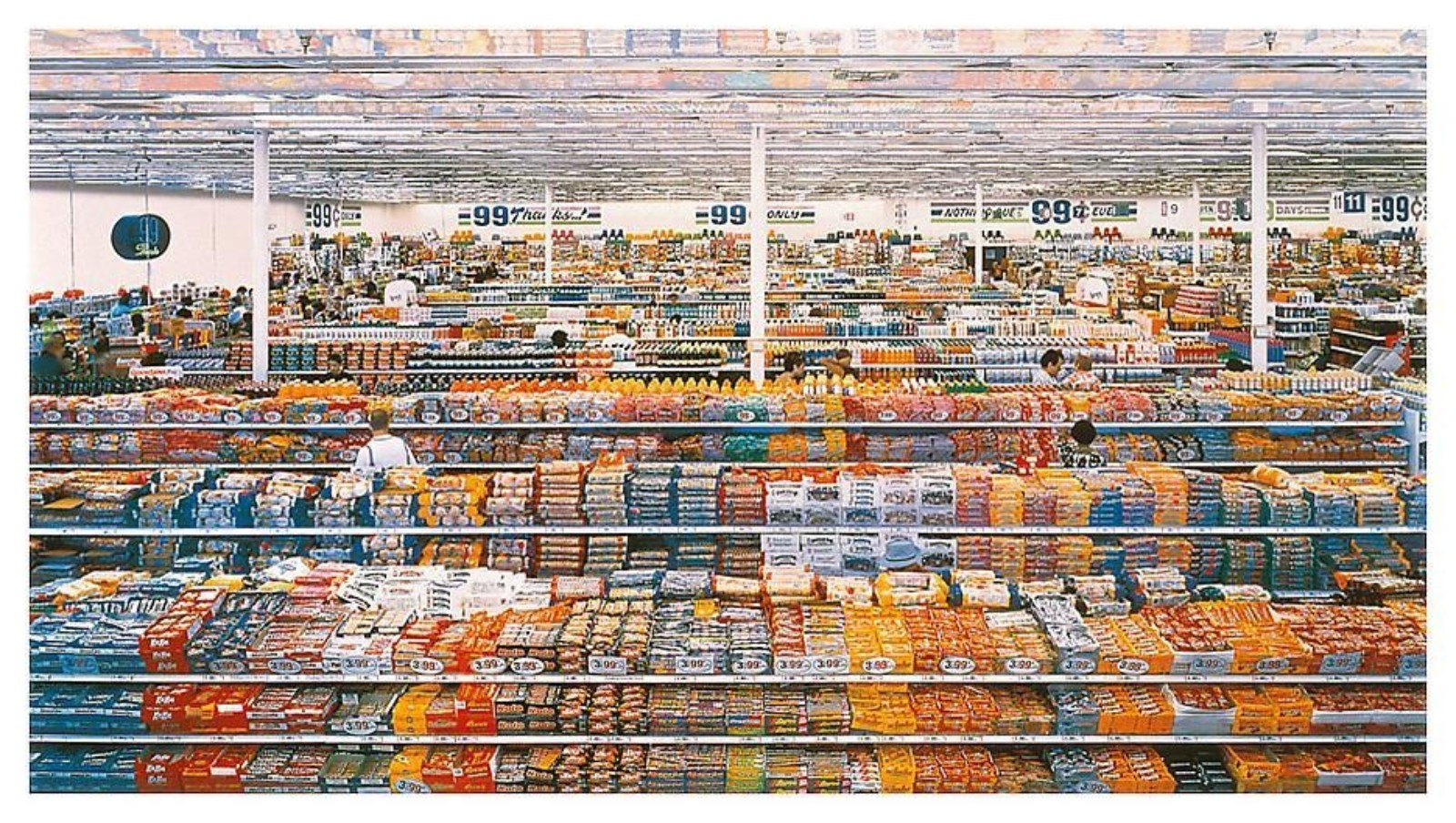
The choice of subjects contributes just as much to this quantified fascination. Gursky tracks the infrastructure of globalization with obsessive consistency. He freezes the trading floors of the Chicago and Tokyo stock exchanges at the height of their frenzy, saturating the viewer’s retina with garish colors and blurred silhouettes gesticulating beneath ticker screens. Elsewhere, it is the dizzying interior of an American discount store that unfolds like a kaleidoscope of mass consumption. In these saturated compositions, each fluorescent package becomes a tiny splash of pigment in an abstract pattern.
The cynicism of the situation is obvious to everyone, starting with the buyers themselves. When a fund manager or industrialist purchases one of these pieces for astronomical sums, they are essentially acquiring a mirror image of their own ecosystem. The German artist does not denounce anything in a militant way. He presents a visual account of late capitalism, pushed to its point of aesthetic saturation. The absence of moral judgment leaves the field open to all manner of interpretations. The image is so dense, so laden with sharp details from one edge of the frame to the other, that it crushes the individual under the weight of the collective structure—a formal vertigo that paradoxically seduces the very people who run these structures.
The Illusion of Reality and Pixel Painting
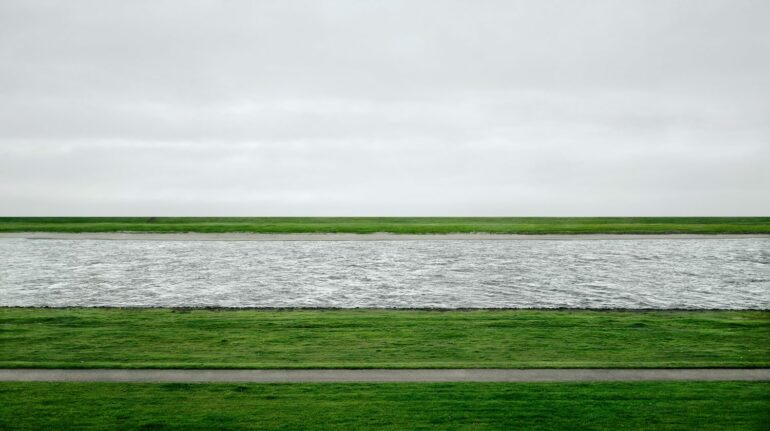
The tension reaches its peak when one scrutinizes the method used to create these supposedly documentary images. Gursky is an unapologetic manipulator, an architect of the pixel. His most famous photograph, *Rhein II*—which shattered world records at Christie’s with a hammer price of $4.3 million in 2011—is, in reality, entirely fictional. To the naked eye, it shows the Rhine stretching lazily beneath a heavy sky, framed by bands of vivid green grass. A minimalist, cold composition of hypnotic perfection.
Yet the original landscape was cluttered. Walkers, a power plant in the distance, and factories on the opposite bank marred the purity of the horizontal lines. Through digital post-production work of surgical precision, the artist has erased every imperfection, every trace of human activity, retaining only the essence of the river. The final image bears no resemblance to a snapshot of a decisive moment, as is typical of the humanist photojournalism tradition. It is entirely constructed, conceived after the fact. This paradox—using mechanical recording technology to generate a landscape that has never existed in the physical world—fascinates the discerning art lover. The buyer is not paying for an archival document; they are funding the creator’s absolute mental vision, stripped down to the bare essentials.
The French Imprint: An Urban Framework for Interpretation
France experienced this relentless analytical gaze firsthand through one of the pivotal works of the 1990s: *Paris, Montparnasse*. In tackling architect Jean Dubuisson’s colossal residential complex, Gursky engages in neither urban sociology nor architectural criticism. Through the meticulous juxtaposition of several successive shots, he eliminates all vanishing perspective and flattens the building’s kilometer-long facade. The result transforms this public housing complex into an immense geometric grid reminiscent of the modernist canvases of the 1920s.
The hundreds of windows become cells in a silent beehive teeming with fragmented domestic life, visible only when one gets within a few centimeters of the print. For the French viewer, the effect is striking. A behemoth of everyday Parisian life—often ignored or disparaged for its brutalist austerity—is transformed into a museum icon. This ability to extract the sublime from concrete banality largely explains the institutional appeal of his work, long celebrated through major exhibitions at the Centre Pompidou.
Price as the Ultimate Anchor
Maintaining such a high market value over time requires managing scarcity, which contradicts the reproducible nature of the camera. Editions are drastically limited, often to very small runs. The industrial logistics required for their production create a barrier to entry that few artists can overcome, reassuring a market that remains wary of the potential immateriality of contemporary photography.
Beyond the dizzying auction prices that make headlines in financial publications, the valuation of these works raises a nagging question. In an era when we consume and destroy thousands of visual streams on our screens every day, the German photographer offers a sudden, jarring halt: a definitive, heavy, immovable freeze-frame that demands an infinite amount of time to absorb. The astronomical price paid for a Gursky print ultimately acts as a counterweight. It is an attempt to lend gravity and weight to a medium threatened with evaporation. By shelling out millions to freeze a supermarket or a Parisian building in time, the art market buys the fleeting illusion that the chaos of our civilization can, for a moment, be brought into order and hung on the wall.