Make Texture a preferred source on Google to support us
Add Texture to GoogleA dress can still be worn even when it’s already regarded as a museum piece. By auctioning off Look 4 from “Plato’s Atlantis”—the last collection fully completed by Alexander McQueen—Christie’s New York is putting precisely this boundary to the test: what do we collect when a garment becomes a fragment of cultural history? This question is what makes this sale so compelling, beyond its estimated value of $150,000 to $300,000—or approximately 129,000 to 258,000 euros. For the value of this dress lies as much in its construction as in the world it envisioned—and in the place that vision now occupies in the memory of fashion.
Recognition Before the Auction
To understand what is happening on the market today, one must first look to the museum. After McQueen’s death in February 2010, “Plato’s Atlantis” was featured in “Alexander McQueen: Savage Beauty,” the posthumous retrospective organized by the Costume Institute at the Metropolitan Museum of Art in New York. The exhibition spanned the British designer’s nineteen-year career. This collection found its place within a comprehensive overview of his work, far removed from the mere cycle of the seasons.
This shift changes the way we view the dress. A collection presented for Spring/Summer 2010 belongs, by definition, to the fleeting moment of novelty. Its inclusion in a retrospective gives it a different duration: it becomes a subject to be studied, preserved, and passed on. It is the collection that has benefited from this recognition—an essential distinction when considering the status of “Look 4” as proposed by Christie’s.
The sale thus follows an initial shift—from the runway to the history of design—and facilitates a second shift: toward a private collection. The future buyer will acquire not only a garment but also the opportunity to own a tangible artifact from this final complete collection. This unique position sheds light on the announced estimate, though it does not, on its own, allow one to predict the outcome of the auction.
The Future Imagined in Paris
Presented in Paris in October 2009, “Plato’s Atlantis” took as its starting point a planet upended by rising sea levels. In it, McQueen envisioned a humanity whose bodies would evolve into fantastical aquatic creatures. The theme thus went beyond merely borrowing decorative elements from nature: it initiated a transformation of the human silhouette, as if clothing could give shape to an adaptation that is still impossible.
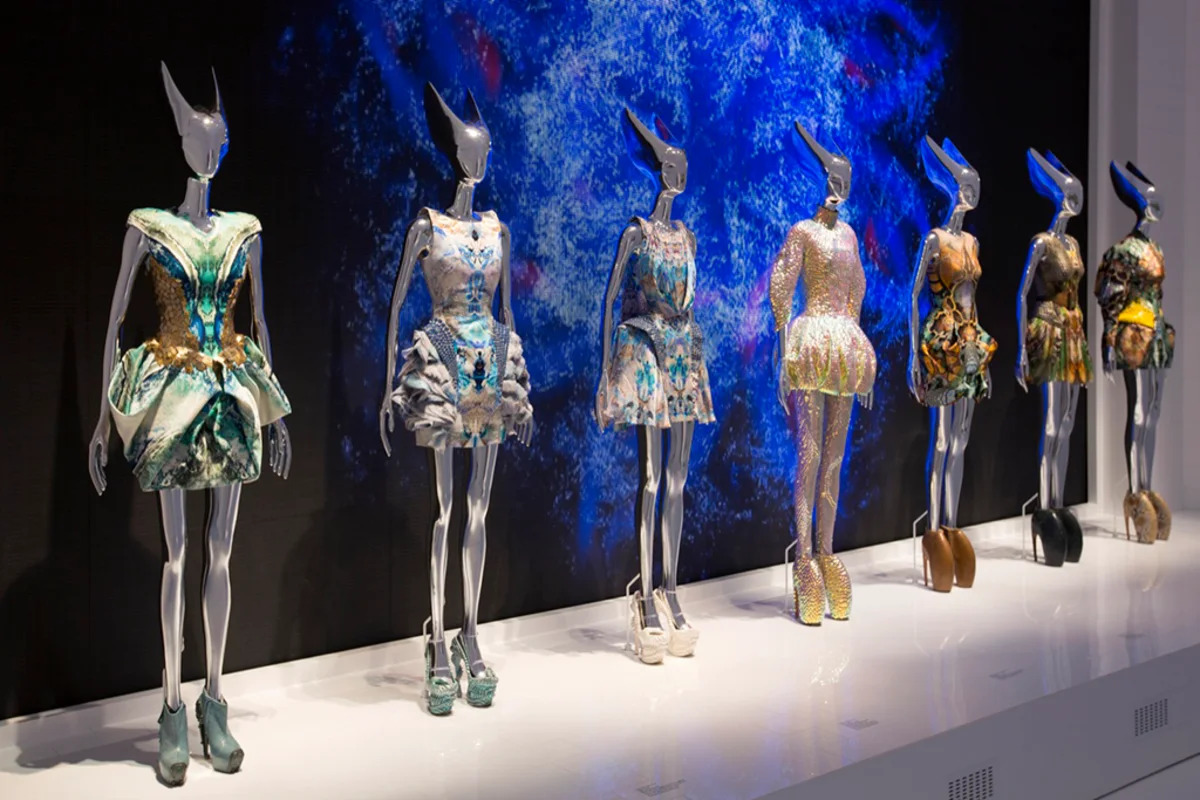
This narrative explains why the collection lends itself to a heritage-based interpretation. It preserves a vision of the future as much as it does a fashion proposal. The threat of submersion meets the invention of new forms of life; anxiety becomes a driving force for creation. Without reducing the dress to mere discourse, this scenario helps us understand why its volumes and patterns matter together. They belong to the same hypothesis about the future of the body.
The digital prints and advanced technical solutions used in the collection gave concrete expression to this fiction. The use of technology was not detached from the narrative: it made the forms possible. For a collector, the challenge is therefore to preserve an object in which imagination and manufacturing techniques converge, rather than a mere memento of a fashion show.
What the cut allows us to preserve
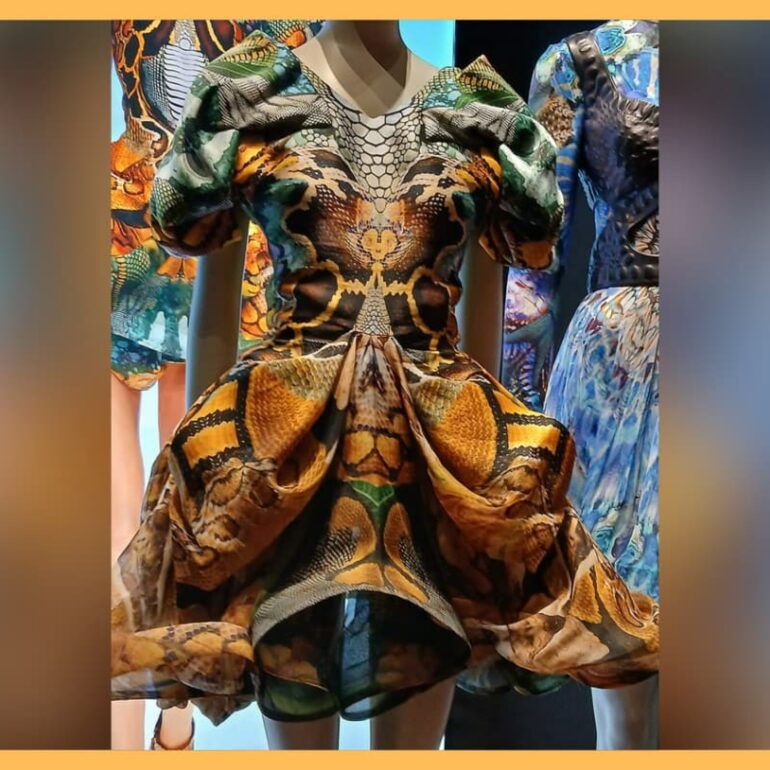
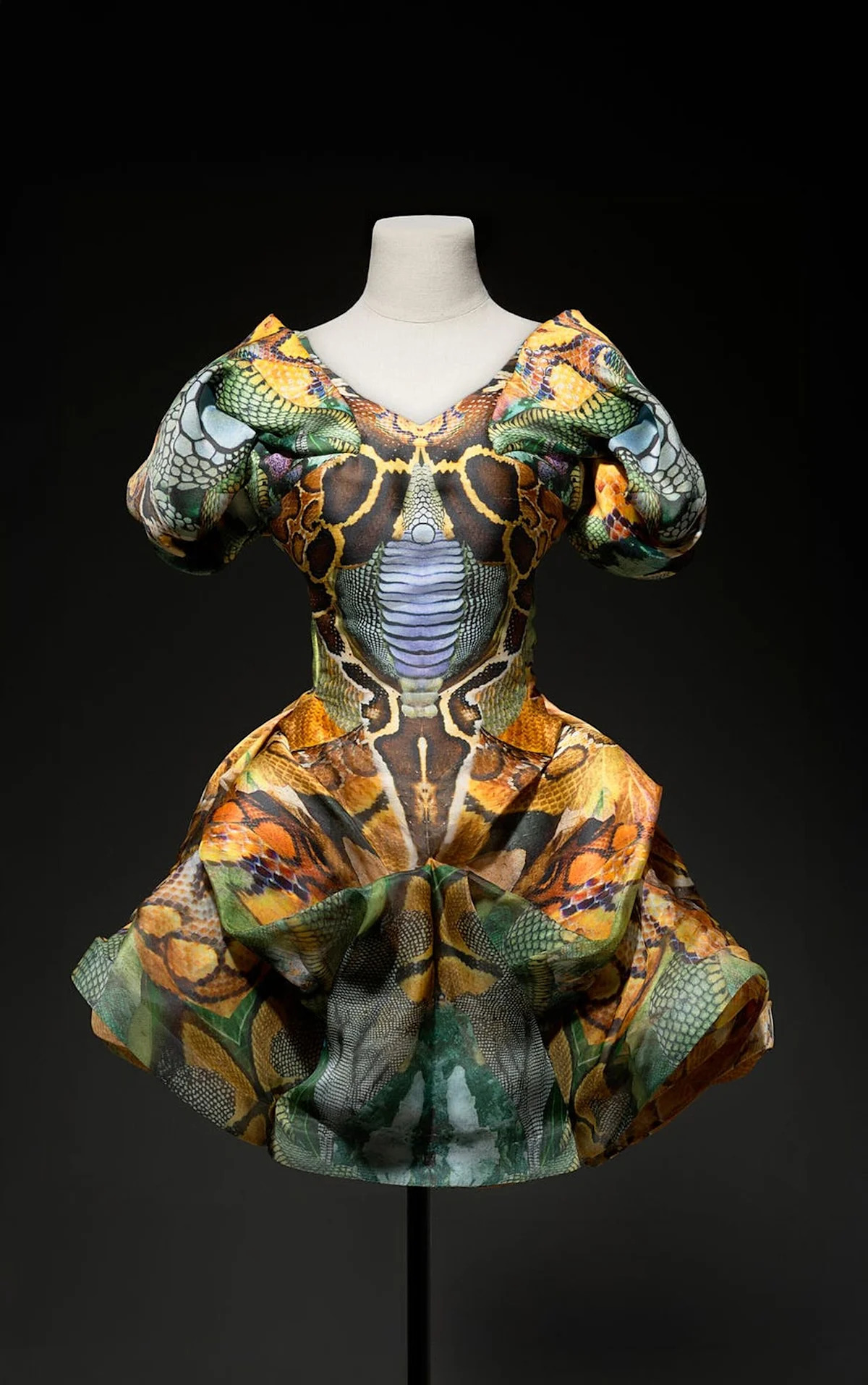
Look 4 makes this ambition clear on the scale of a single dress. Its sharply defined waist structures the silhouette, while the sculptural sleeves shift its proportions. The vibrant print, inspired by textures from the natural world, brings this construction to life. Nothing in this description completely separates the surface from the volume: the pattern contributes to the perception of the body that the cut organizes.
This is where the garment resists being reduced to an image. A photograph may capture its allure; the object itself retains the construction that produces that allure. The appeal of Look 4 lies in this interplay between an immediate visual effect and the design process. At Christie’s, the dress is, in fact, presented simultaneously as a design achievement, a testament to fashion history, and a wearable piece.
These three interpretations do not lead to exactly the same use. Wearing implies bringing the creation to life on a body. Collecting invites us to preserve its material and form. Studying it requires understanding how it was conceived. The auction brings these possibilities together without choosing between them. It is this ambiguity that makes the piece interesting: its cultural recognition has not erased its original function.

Open dissemination, individual ownership
Plato’s Atlantis is also part of the history of the circulation of fashion images. Its fashion show was broadcast live on the Internet, an event that Christie’s describes as a historic first. The Paris presentation was thus able to reach an audience beyond the venue. This technological dimension extended, through the very broadcast of the show, the creative exploration embodied in the garments.
The sale reveals a contrast: a creation associated with broadening access to fashion becomes the subject of a six-figure private acquisition. It is not the image of the dress that the auction will reserve for someone, but its physical presence. The distinction is crucial. One can be familiar with a silhouette, understand its story, and appreciate its construction without owning the garment; the market assigns a price to this very possibility.
The chosen format reinforces this connection. Look 4 will be featured in “Handbags & Fashion Online: The New York Edit,” an online auction running from November 25 to December 10, opening at 10 a.m. New York time. Here, the internet serves another purpose: no longer the bridge from the runway to its audience, but the bridge from the object to its next owner.
Heritage as a Selling Point
Rachel Koffsky Parker, Christie’s international head of handbags and accessories, emphasizes the cultural significance of the design and the role of custodian that its buyer would assume. The vocabulary of conservation thus intersects with that of auctions. This interpretation also reflects the auction house’s positioning: it justifies an estimate by highlighting the dress’s significance in McQueen’s career and in the evolution of fashion.
The catalog expands on this intersection between artistic creation and luxury goods. As the Handbags & Fashion department’s final sale of the year, it features “Scarcity & Infinity,” a section dedicated to bags from Louis Vuitton’s collaborations with Yayoi Kusama, Takashi Murakami, and Frank Gehry. Couture and runway pieces by Dior, Chanel, and Yves Saint Laurent are also featured. The McQueen dress stands out in this context because it is part of a collection whose narrative and craftsmanship are closely intertwined.
Before the auction determines its next owner, the dress will be on display from December 3 to 10 at Christie’s New York, located at 20 Rockefeller Plaza, during December Luxury Week, alongside jewelry, watches, and other collectibles. This will be an opportunity to reflect on what the estimate does not describe: the relationship between the sleeves and the waist, the effect of the pattern on the volume, and the way an idea of metamorphosis is embodied in a garment.