Make Texture a preferred source on Google to support us
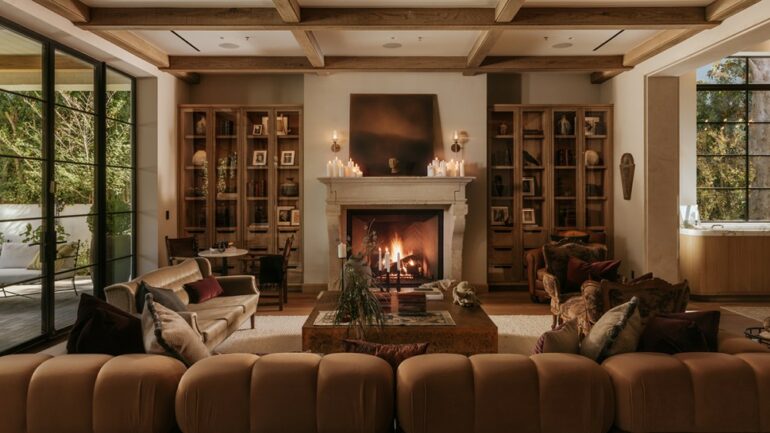
Add Texture to GoogleIn a house on North Roxbury Drive that has just been completed, there is a 350-year-old fireplace. It was salvaged from a château in the Loire Valley, dismantled, and then shipped to Beverly Hills, where it now heats a newly built home listed for $23,995,000. This paradox holds the key to La Reve, the residence designed by Jae Omar: a house that has never had an occupant, yet has crafted a past piece by piece, largely drawing on France.
The question remains: which France? This is neither a copy nor a pastiche of a manor house. It is the French countryside reconstructed from memory by a designer who lived in Paris, then filtered through the lens of old Hollywood. French readers will recognize familiar materials, transplanted into a setting that is anything but familiar.
The Countryside as Seen from Paris
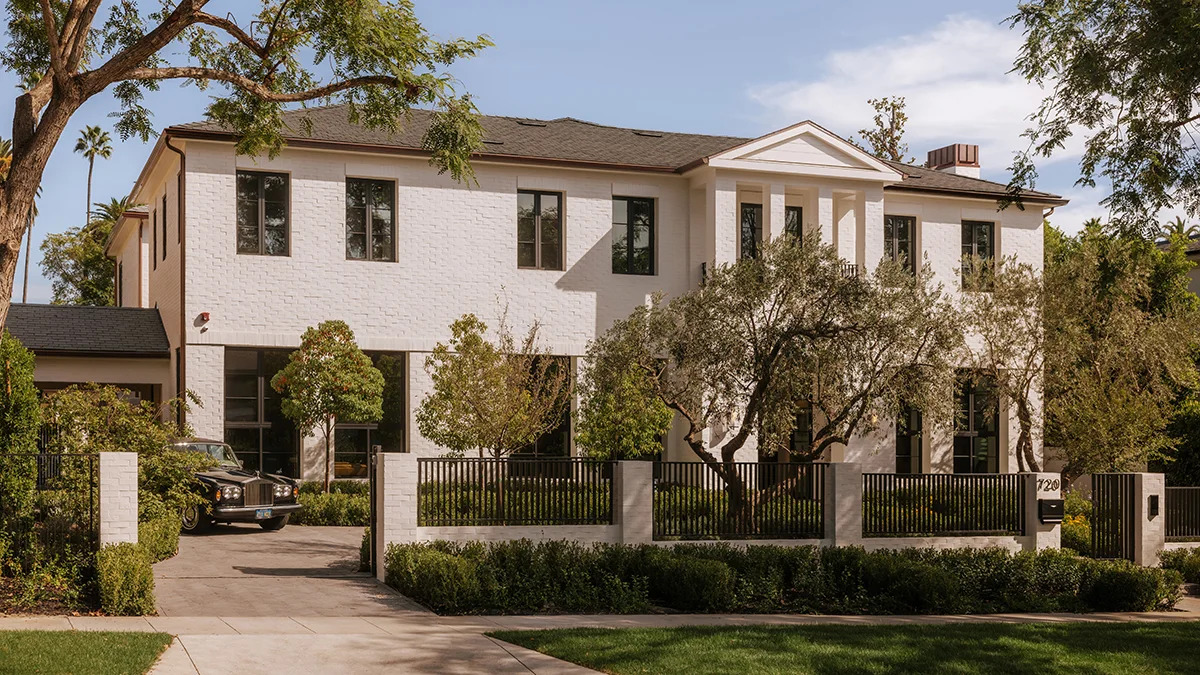
The property, also spelled Le Rêve, is presented as a neoclassical-style residence—what Americans call Classical Revival. The terminology doesn’t quite fit what we see. The approach taken by Jae Omar Design blends two references that, in principle, don’t mix: the French rural aesthetic, shaped by the designer’s years in Paris, and a glamour inherited from the golden age of Hollywood studios.
This Parisian perspective on the countryside is worth a closer look. It is not a farmhouse as experienced from the inside; it is the countryside as dreamed of from the capital, and then as reinvented ten thousand kilometers away. The façade sets the tone: curved, built with so-called “deconstructed” bricks, it displays a deliberate sense of wear and tear. Here, the old is crafted from the new—and they embrace it.
Fireplaces that crossed the Atlantic
The genuine antiques, however, arrived by ship. The home’s fireplaces were imported from Burgundy and the Loire Valley, and the most venerable of them all—the three-century-old hearth—comes from a château on the Loire. Antique oak beams round out this collection. For a heritage enthusiast, the project has a somewhat ambivalent quality: these elements were removed from their original locations, yet they have also been preserved and put back into use rather than lost. The house doesn’t settle this debate; it uses it as an argument.
Surrounding these period pieces, contemporary materials provide a sense of continuity. The floors are made of smoked French oak. The walls are finished with hand-applied plaster, whose irregularity mirrors that of the fireplace stones. The limestone comes from several French quarries—a detail that matters: it is not a uniform material ordered from a catalog, but a blend of different sources. The overall design seeks to blur the line between what is three centuries old and what is just a few months old.
A Trough in the Kitchen
The most evocative object in the house, however, is not French. In the chef’s kitchen, the prep sink is a former horse trough dating from before the Civil War—that is, from 19th-century America. This repurposed and restored farm implement serves as a reminder that the project’s rural nostalgia is not limited to France. It also evokes a local agricultural past—that of an America before industrialization, before cinema, and before Beverly Hills.
The rest of the kitchen is entirely custom-made. The oak cabinets are curved, and the Calacatta Gold marble features a leathered finish that makes it matte to the touch—a far cry from the mirror-like polish typically expected in this type of residence. This is where the Hollywood flair takes over, with a walk-in bar, a temperature-controlled wine cellar, and lighting fixtures by Bocci and Visual Comfort. The rustic elements and the Calacatta coexist without one trying to excuse the other.
The decor is included with the property
La Reve is being sold fully furnished, turnkey. The interior design and styling were entrusted to Iris Loeffler and the firm Vesta, who have created a cohesive ensemble: period furniture, oil paintings, and gilded mirrors hung in the style of a living room, in tight clusters covering the walls. This collection was intended to be sold with the house.

The nuance is important. The intention is clear, but the final inclusion of the furniture and paintings remains subject to negotiation in the sales contract, and there is no legal guarantee of this at this stage. For the buyer, the stakes are real. A house whose identity is so closely tied to its antiques loses part of its essence if it is emptied. Conversely, whoever signs for the entire collection acquires a home—and, with it, the story that has been woven around it.
The listed price, $23,995,000—which is often rounded up to $24 million—is equivalent to approximately 22.8 million euros at the November 2026 exchange rate. The property was listed in mid-November 2026 by The Beverly Hills Estates, with Scott Ammann as the listing agent. It is listed on the MLS under reference number 26107636.
A Distinctly Californian Layout
Behind the Burgundian-style fireplaces, the layout follows Los Angeles conventions. The living area, approximately 8,200 to 8,220 square feet (762 to 764 m²), is divided between the main house and a pool house. There are five bedrooms and seven bathrooms: six full bathrooms and a guest powder room. Upstairs, the master suite occupies an entire wing, featuring vaulted ceilings, a private balcony, and a walk-in closet.
The lot size warrants clarification. MLS listings indicate 0.35 acres, or approximately 1,416 m². While the idea of a lot close to half an acre—around 2,000 m²—is sometimes circulated, the official cadastral figure is the authoritative one. The lot size is still generous for this neighborhood, though it’s not particularly large.
Outside, the French influence fades almost entirely. A covered loggia houses a kitchen and an outdoor bar, designed for the al fresco lifestyle made possible by the local climate. The pool, designed in the spirit of a resort, is clad in handmade Moroccan tiles and bordered by basalt, a dark volcanic stone. The final scene one encounters upon leaving the house thus evokes neither the Loire Valley nor Paris, but rather North African craftsmanship set upon lava rock, beneath the Beverly Hills sky.