Make Texture a preferred source on Google to support us
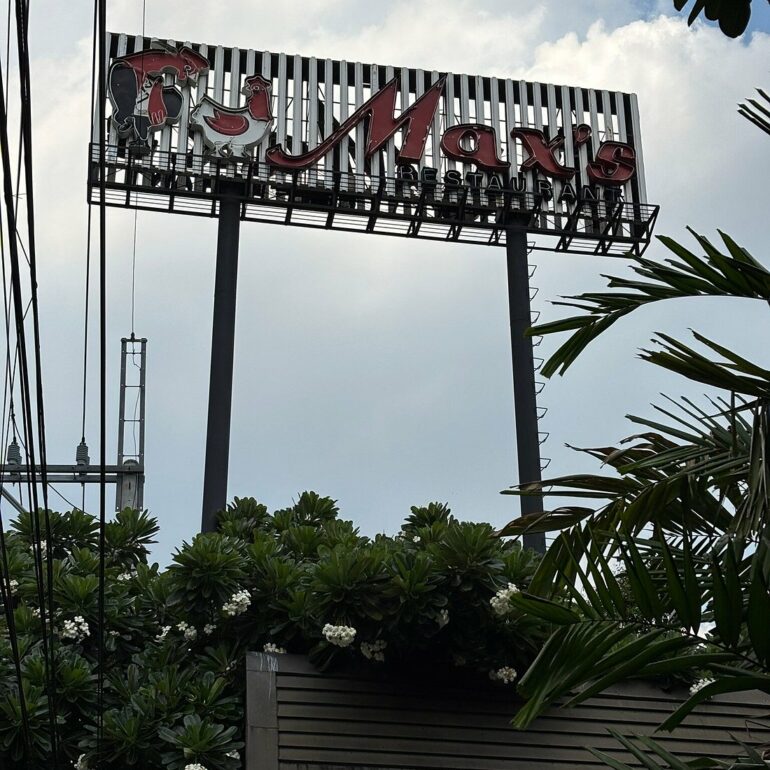
Add Texture to GoogleAt the corner of Scout Tuazon Street, amid the sweltering hustle and bustle of Metro Manila, a black wooden bird—the Eames’ famous “House Bird”—paradoxically sits atop the roof of a corrugated-iron shack. This detail, which might seem anachronistic in this neighborhood of the Philippine capital, epitomizes the profound transformation of Max’s Restaurant. Beneath this metal roof—salvaged from a construction company—Chef Mario, a veteran of the restaurant with thirty years of service, watches over a “kawa,” a massive metal wok filled with boiling oil. Here, there are no sophisticated machines or electronic timers: it is the chef’s eye and experience that determine the tenderness of the meat. We are at the General Store, the newest addition to the Max’s complex, where the original fried chicken recipe is served in its purest, almost raw form. For foreign visitors, this place embodies the resilience of a family culinary heritage that, after nearly being lost in the maze of purely financial management, is now opting for a return to its architectural and sensory roots.
Fried chicken is a religion in the Philippines. While the giant Jollibee now dominates the global market for local fast food, it was at Max’s that the story began, in the aftermath of World War II. At the time, thousands of American soldiers stationed in Manila, awaiting repatriation, would gather at the home of Maximo Gimenez, a Stanford-trained teacher whom his friends affectionately nicknamed “Max.” They came there to have a drink and chat. To feed these soldiers, who were homesick, Maximo asked his niece, Ruby, to prepare dishes that would remind them of home. Ruby then improvised a local version of American fried chicken. At a time when Filipinos mainly ate grilled chicken and fried pork, this breadcrumb-free take on the dish became an instant hit. What began as a simple act of neighborly hospitality has, over the decades, grown into a publicly traded empire with hundreds of locations across the archipelago, in the United States, and in the Middle East.
The Cousins’ Takeover
This meteoric success, however, came at a price. After a period under the leadership of professional managers—whose priorities were shareholder value and rapid revenue growth—the founding family decided to take back the reins. Today, what is known as the “cousins’ consortium”—seven of Ruby’s grandchildren, including Jim Fuentebella, the brand’s executive director—controls approximately 70% of the company’s shares. This change in leadership marked the end of systematic expansion in favor of qualitative consolidation. The priority is no longer to open new locations just for the sake of it, but to renovate existing ones, starting with the “parent house,” Scout Tuazon’s flagship store, which was once the family home.
For Jim Fuentebella, the challenge was to restore the brand’s soul. He entrusted this mission to Manila-based architect Sarah Canlas with a clear directive: to open up the spaces. The 5,000-square-meter complex has been completely reimagined to become a place for living and leisurely strolling, a far cry from the sterile aesthetic of fast-food chains. Guests can now stroll through an inner courtyard, sit in the shade of a central pandan tree, or retreat to “Ruby’s,” a cozy 12-seat lounge. This lounge, which serves coffee by day and cocktails by night, does more than just attract a new urban clientele; it radically transforms the experience of one of Max’s financial pillars: event hosting.
The Art of Celebration and the 16 Million Milestone
In the Philippines, life’s milestones—baptisms, weddings, birthdays—are inextricably linked to a family meal at Max’s. The flagship restaurant has three banquet halls and hosts an average of four events per day. Previously, signing reservation contracts was a mere administrative formality. Now, it has evolved into a full-fledged ceremony at Ruby’s, over a latte or a cocktail, thereby raising the bar for service. This strategy is paying off: last year, the holiday season alone enabled Scout Tuazon’s restaurant to achieve record revenue of 16 million pesos (approximately 223,150 euros). For this year, the Christmas reservation book was already fully booked as early as September.
This success is based on a menu that has remained virtually unchanged for eighty years. The signature order remains unchanged: half a spring chicken, two rolls, sweet potato fries, and a generous helping of banana ketchup—that Filipino condiment whose sweet-and-tangy flavor has defined the taste of childhood for generations of Filipinos. Jim Fuentebella often watches these tables where parents—who used to come here with their own grandparents—now return with their children. That’s the challenge: maintaining this intergenerational connection while appealing to an emerging middle class and an increasingly discerning younger generation.
Passing the Torch and New Lifestyles
At 58, Jim Fuentebella is preparing for the future. He has taken his nephew, Paulo—son of the group’s CEO, Carolyn Trota-Salud—under his wing. Paulo represents this fourth generation at a cultural crossroads: with a degree in business administration, he studied fashion in New York and ran a bakery on the idyllic island of Palawan before joining the family business. His mission is to “bridge the generational gap.” In a capital city increasingly choked by traffic, consumer habits are changing. Under the leadership of Carolyn Trota-Salud, the team is working on new formats tailored to public transportation hubs—a small revolution in a city historically centered around cars.
Innovation also takes place in the research and development (R&D) kitchen, where chefs from across the archipelago—such as from the island of Siargao—come to experiment with new plating techniques and recipes. The surprise hit of recent years? Sizzling tofu. This dish, which has become one of the most popular on the menu, meets a growing demand for vegetarian options, as well as a local preference for creamy textures. At rival Jollibee, fried chicken is always served with brown sauce (gravy); at Max’s, tofu serves as this moist and flavorful accompaniment.
Betting on a Slow Approach Amid Stock Market Speculation
While rumors of a Jollibee IPO in Hong Kong or New York are stirring up the international financial community, Max’s has chosen a more intimate, almost artisanal path—despite its scale. The General Store, with its separate street entrance and outdoor seating, evokes the relaxed atmosphere of the provinces or distant islands more than that of a metropolis of 14 million people. It is in this contrast that the brand’s strength lies today: knowing how to use the codes of contemporary design—Sarah Canlas for the space, Eames classics for the decor—while refusing to delegate the cooking of the chicken to frying algorithms.
The tour concludes with a stop at the adjoining bakery, where wedding cakes and the rolls that accompany each dish are on display. Here, luxury lies not in ostentation, but in the continuity of a tradition of craftsmanship that has endured from the postwar crises through to the era of globalization. By building on its architectural and culinary heritage, the “consortium of cousins” proves that the best way to move forward is sometimes to pause for a moment under a pandan tree, watch Chef Mario tend to his oil, and remember that it all began with a simple craving for fried chicken shared with friends one Thursday at noon.