Make Texture a preferred source on Google to support us
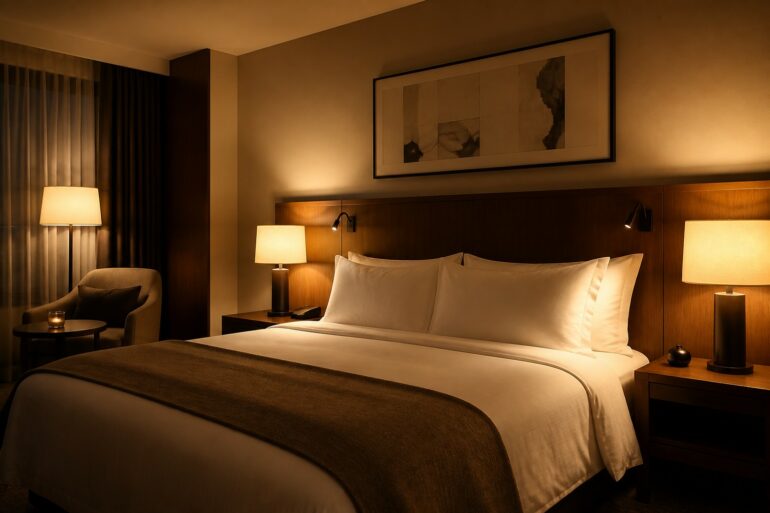
Add Texture to GoogleThe bedtime routine has long been marred by a major design flaw: the single central ceiling light. Nicknamed—with a touch of irony—”fitting room” lighting for its tendency to flatten spaces and strain the eyes, this overpowering fixture is living out its final days in the contemporary bedroom. By 2026, bedroom design will prioritize a decentralized approach, where light no longer merely illuminates but sculpts an atmosphere conducive to rest and relaxation. This shift is based on a technical golden rule: moving away from direct light sources in favor of layered lighting.
The Science of Layering and Warmth
To transform a bedroom into a sanctuary, designers now rely on a combination of three distinct layers: ambient lighting, functional lighting (for reading), and accent lighting. This method allows the space to be adapted to different times of the evening, avoiding any visual overstimulation before bedtime. Color temperature plays a key role here. To respect the circadian rhythm and promote melatonin production, current recommendations suggest light sources ranging from 2,200 K to 2,700 K. This spectrum, ranging from very warm white to warm white, mimics the light of twilight and naturally prepares the body for rest.
The inclusion of dimmers has become an essential standard. When paired with dimmable bulbs, they allow for precise adjustment of light intensity, eliminating any glare. This pursuit of softness is also reflected in the choice of materials. In 2026, there is a marked return to natural, diffusing textures: washi paper, pleated linen, cotton, as well as opal or frosted glass. These materials act as filters, softening the harshness of the light to transform it into an enveloping glow.
Sculptural Silhouettes Designed for Relaxation
Beyond its function, the light fixture asserts itself as a centerpiece of the furnishings. The Timberline floor lamp, reissued by the Danish brand GUBI, perfectly illustrates this trend. Originally designed in the 1970s by Mads Caprani, it stands out for its arched structure combining birch and bent oak. Its adjustable, pleated linen shade rests on a crescent-shaped cast-iron base. Available in late 2026 for €799 (or US$1,299), it embodies this fusion of organic design and soft lighting. For smaller spaces, the table lamp version from the same collection is available for €499.
On a more ethereal note, Isamu Noguchi’s Akari Light Sculptures retain their status as icons of serenity. Handcrafted in Gifu, Japan, by Ozeki & Co. and distributed in Europe by Vitra, these sculptures made of washi paper and bamboo transform electricity into a soft, sun-like glow. The classic table models (types 1A or 3A) range in price from €180 to €350, while the monumental floor-standing pieces can exceed €1,200. These light fixtures are not merely sources of light, but artistic installations that soothe the eye with their visual lightness.
The freedom of portable, wireless lighting
Advances in battery technology now free us from the constraints of wiring, offering unprecedented flexibility on bedside tables. The Bellhop Unplugged lamp, designed by Edward Barber and Jay Osgerby for Flos, has become a benchmark in its category. Rechargeable via USB-C, this portable lamp casts a soft, downward glow—ideal for not disturbing your partner. Available in polycarbonate in various colors for a price ranging from €230 to €280, it now comes in a Bellhop Glass version for an even more subtle light diffusion.
At Louis Poulsen, a classic by Verner Panton has been scaled down for contemporary use. The Panthella 160 Portable (approximately €175 to €250 depending on the finish) features the 1971 design with an opal acrylic shade. Its touch-sensitive dimming allows you to adjust the light from a subtle nightlight to a brighter setting. While manufacturers claim a battery life of about 8.5 hours at full power, it’s important to note that performance varies depending on ambient temperature and the brightness level used.
Invisible Architecture and Focal Points
Bedroom design in 2026 isn’t limited to table lamps. Articulated-arm wall sconces, offered by brands such as Visual Comfort and Franklite, are gaining popularity. By mounting directly to the wall or the headboard, they free up space on the nightstand, creating a more streamlined look. In addition, the use of concealed indirect LED strips along the bed frame or headboard adds architectural depth without any visible light sources.
For the center of the room, if a pendant light is used, it incorporates flexible materials or three-layered blown glass to conceal the bare bulb. The goal is always the same: to eliminate visual hot spots. Although the industry highlights the benefits of these choices for sleep quality, it remains difficult to precisely quantify the actual physiological benefit, as this depends on a range of environmental factors. However, choosing thoughtful lighting remains the most immediate way to transform the sensory perception of a private space.