
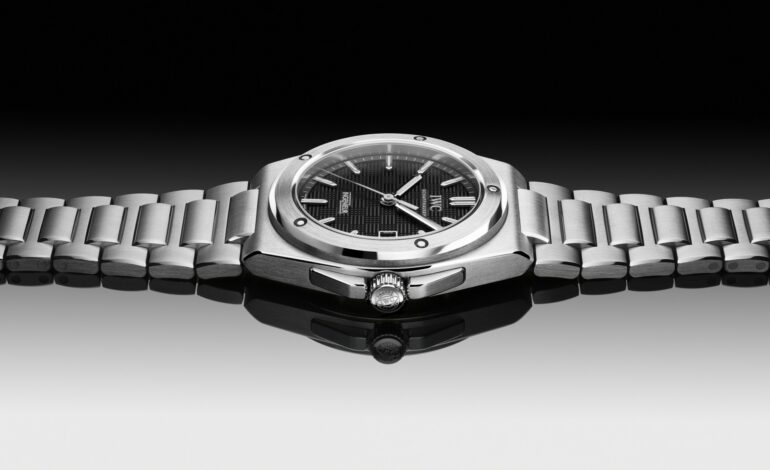
This is the story of a business misunderstanding that, over the decades, has become one of the most studied design lessons in Swiss watchmaking. Between 1976 and 1983, IWC Schaffhausen managed to sell only 598 pieces of its Reference 1832. At the time, the very concept of a luxury steel watch with a fully integrated bracelet was perplexing. Designed by Gérald Genta, the Ingenieur SL challenged watchmaking conventions: its massive proportions dominated the wrist, and its bezel featured five clearly visible screws. Customers in the 1970s shunned this brutalist aesthetic. Yet what appeared to be a stinging failure turned out to be simply ahead of its time. The radical legibility of Genta’s design ultimately prevailed over the cold logic of immediate profitability.
Fifty years later, the manufacture celebrates this half-century of heritage with a surprisingly understated approach. Far from literal reissues or commemorative extravaganzas, IWC is offering two limited editions of 1,150 pieces each. These variations build on the comprehensive redesign of the line carried out in 2023, which had already laid the groundwork for a modernity that respects the design language of the 1832 model. The original design is preserved, yet it is expressed through a strictly contemporary aesthetic, stripped of any artificial nostalgia.
The Art of Subtle Accents
The first bold decision in these anniversary editions is evident on the dials. IWC has chosen to set aside the famous textured pattern, often associated with the model, to revive a much rarer historical variant: a fully brushed silver surface. This choice offers a unique visual depth and lends the watch’s face a sense of calm, allowing the light to catch on the metal hour markers and rhodium-plated hands—all generously coated with Super-LumiNova.
The tribute to the 50th anniversary is not displayed anywhere in capital letters. The brand has settled for an almost subtle typographic change: the traditional lightning bolt, which historically highlighted the name “Ingenieur,” has been replaced here by the number “50.” This quiet substitution alone encapsulates the project’s philosophy. The watch doesn’t need to shout its age to assert its legitimacy.
Two case sizes, two mechanical approaches
Where the project takes a particularly nuanced turn is in the deliberate dichotomy between the two offered sizes. While the overall aesthetic remains consistent, the 40-millimeter case (reference IW328910) and the 35-millimeter case (reference IW324909) embody radically different visions of what a technical watch should be today.
The 40-millimeter version is aimed at purists of functionality. It houses the Caliber 32111, a movement equipped with a double-pawl winding mechanism that guarantees an impressive power reserve of 120 hours. Above all, it remains faithful to the specifications of the original Ingenieur by encasing its movement in an inner cage made of soft iron. This anti-magnetic shield, designed to withstand the disruptive fields of industrial environments, naturally makes the case back opaque. On this model, the integrated bracelet retains a fully satin-finished surface, reinforcing the look of an unyielding precision instrument.

The 35-millimeter version marks a deliberate shift toward mechanical expressiveness. The shielding gives way to a transparent sapphire case back that reveals the Caliber 47110. The design then shifts toward traditional watchmaking: the mainplate is adorned with Côtes de Genève, and the circular graining complements the gold-plated oscillating weight. To emphasize this shift toward a more sophisticated aesthetic, the central links of the bracelet feature a mirror polish. The Ingenieur no longer hides behind its utilitarian function; it stands proudly as an object of contemplation.
Anchoring the Collection Amid Expansion
This dual launch comes at a pivotal moment for the collection. Since its grand return to the forefront in 2023, the Ingenieur family has experienced spectacular growth. The manufacture has explored new material frontiers, offering the silhouette in titanium, 18-karat 5N gold, and even ceramic—both black and tinted. Mechanical complexity has also skyrocketed with the integration of perpetual calendars and tourbillons.
Faced with this exponential move upmarket, there was a significant risk that Gérald Genta’s design would lose its original impact, diluted by the avalanche of complications and exotic materials. These two stainless steel anniversary editions therefore serve as a call to order. They refocus the design on the very essence of the watch: clean, taut lines, ergonomics reimagined for integration, and absolute chromatic simplicity.
The acclaim for this design has, in fact, extended far beyond the closed circle of watch collectors. In late September, during Milan Fashion Week, IWC organized a week of events centered on this silhouette, placing the watch at the crossroads of art, fashion, and contemporary creativity. The 1832 model, once misunderstood upon its release, has ultimately transcended its status as a mere timepiece. It is now recognized for what it fundamentally is: a masterpiece of late-20th-century industrial design, whose lines continue to shape contemporary watchmaking aesthetics.