
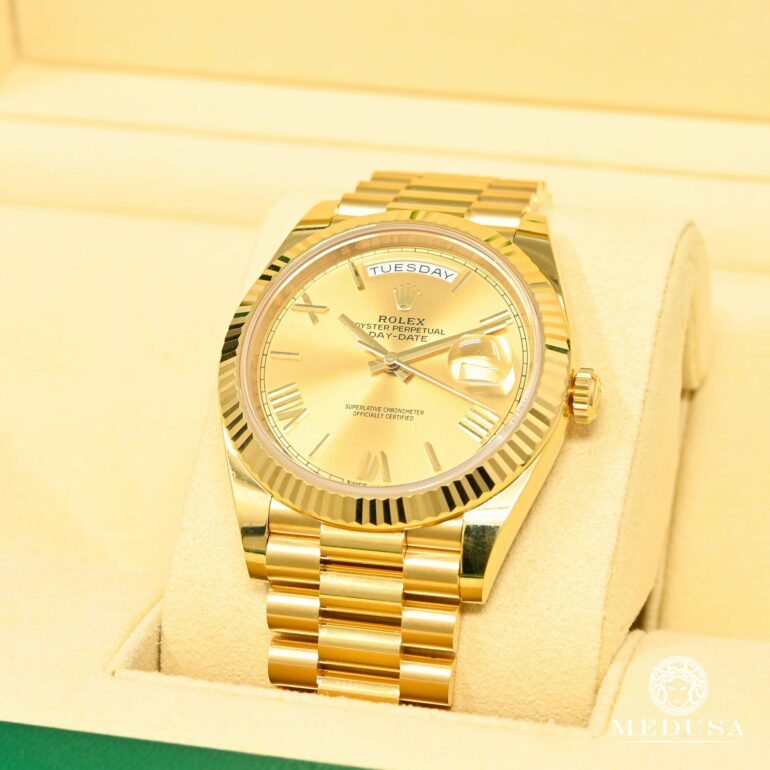
The prestigious Geneva-based watchmaker is adjusting its prices for the second time in 2026. This decision reinforces the watch market’s shift toward the ultra-luxury segment and highlights the strategic importance of gold in its manufacturing cost structure.
Gold: The New Pricing Compass
On June 1, Rolex quietly raised its prices for the second time in 2026, targeting key markets such as the United States, the United Kingdom, and Hong Kong. According to Bloomberg, this adjustment averages 5 percent, with an increase of about 2.5 percent for two-tone models. Notably, models in steel, platinum, or titanium remain strictly unchanged. True to its culture of discretion, the company with the crown declined to comment on this development.
Far from being a mere price hike, this decision reflects a genuine adaptation to a macroeconomic environment in which gold has emerged as a highly strategic factor. Since the beginning of 2024, the price of the precious metal has nearly doubled, driven by massive purchases by central banks and investor demand for safe-haven assets during times of uncertainty. In this reshaped landscape, the gold case transcends its status as a symbol of prestige to once again become a raw production cost, subject to the market’s relentless fluctuations.
The Resilience of the Ultra-Exclusive
Despite this accepted inflation, the appetite of high-net-worth clients shows no sign of waning. The South China Morning Post notes that a white-gold Cosmograph Daytona now sells for $59,100 in the United States. This valuation reflects a 14% increase since January and a spectacular 33% surge since 2024. Given its pace, this type of fluctuation moves watchmaking away from its sole role as a functional object and irrevocably brings it closer to that of a financial asset.
Industry analysts—notably at Vontobel, WatchCharts, and Data and Data—depict a market where the most coveted pieces are selling with disconcerting ease, leaving supply structurally unable to keep pace. Desirability remains undiminished at the top of the pyramid, paradoxically at a time when other segments of the luxury industry are showing relative caution.
A Spectacular Polarization of the Industry
This dynamic is part of a groundswell sweeping through the entire sector. Data from the Swiss watch industry speaks for itself: exports of timepieces priced above 20,000 Swiss francs have far exceeded their pre-pandemic levels. They now account for more than two-thirds of the total export value, compared to just 22% in 2019. The watch industry’s center of gravity has thus shifted dramatically toward ultra-exclusivity, effectively leaving the mid-range segments behind.
This phenomenon extends beyond Switzerland’s borders. Cartier recently raised the prices of some of its gold watches, with increases reaching 10% in a single month. In other industries, major conglomerates are carrying out similar spin-offs to insulate their flagship brands from price-related concerns, as Asics has done with Onitsuka Tiger. LVMH, for its part, is refocusing its efforts on its most profitable segments, whether in high-end cosmetics or fine jewelry.
The Art of Selection by Value
Rolex’s successive price adjustments highlight an inescapable, though rarely acknowledged, reality: the contemporary luxury industry is sorting its clientele. By freezing the prices of its more affordable steel models while passing on rising costs to gold pieces—which enjoy unwavering demand—the manufacturer is engaging in a form of natural selection.
Market observers, such as Rennwrist and WatchesOff5th, see this series of price increases—in January and then in June—as a carefully calibrated adjustment strategy. This approach is driven by a complex array of factors ranging from soaring raw material prices to inflation, currency fluctuations, and logistical challenges, as highlighted by Dream Watch. Beyond these pragmatic considerations, the conclusion is clear: luxury watches have definitively established themselves as a safe haven.
As long as very wealthy collectors and enthusiasts remain on board, Rolex will have plenty of leeway to test the limits of its appeal. The real unknown no longer lies in the acceptance of these price increases, but in their sustainability in the face of potential upheavals in the pre-owned market. Should that market slow down, the well-oiled machinery of prestige could then reveal new dynamics.