
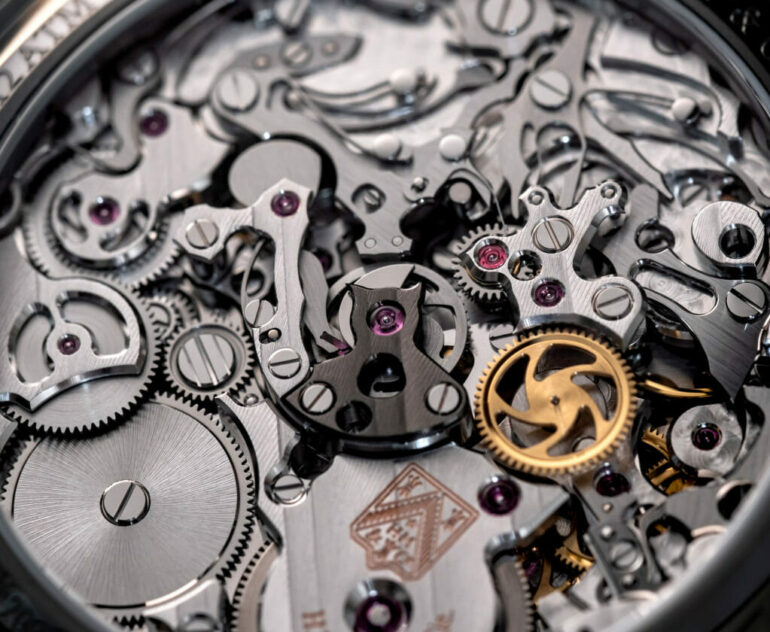
Behind the sophisticated appearance of fine watches lies a level of craftsmanship that meets the highest standards. It is an intimate alchemy in which tradition interacts with technical virtuosity, elevating each timepiece to the status of a unique and fascinating miniature work of art.
The Value of Patience
It must be admitted that the cost of a luxury watch can sometimes be bewildering at first glance. Yet, beyond the mechanical complexity housed within the case, it is above all the discipline of the craftsman’s hand, the precision of his eye, and his selfless dedication that are expressed in each piece. In the world of fine watchmaking, time is not merely measured: it is consumed, stretched, and shaped, line by line, gesture by gesture.
This is where the essence of this art lies: a timepiece transcends its primary function as an instrument when it becomes a patiently sculpted object. While contemporary movements shine for their precision and efficiency, true emotion springs from discreet, even imperceptible operations. These finishing touches transform pure technique into a creation in its own right.
A living tradition, far from folklore
The great Swiss and French watchmaking houses laid the groundwork for this world as early as the 19th century, at a time when human craftsmanship reigned supreme. While machines today produce movements of remarkable reliability and can even reproduce certain decorative motifs, hand-finishing remains the undisputed hallmark of the very high end. Its nobility lies precisely in this minute yet vibrant touch of human sensitivity.
Cartier, for example, at its Maison des Métiers d’Art in La Chaux-de-Fonds, carries on this legacy by bringing together enamelers and marquetry artisans to collaborate on specialized techniques such as cloisonné, champlevé, and grisaille. This approach is essential. In an industry where automation is gaining ground, true rarity is no longer measured solely by mechanical complications, but by the soul and identity infused into the piece.
The Language of Craft
Beveling, to begin with, involves smoothing and polishing the edges of the components. The treatment of internal angles—a task of formidable complexity—still requires human intervention. This is the ultimate proof of fine craftsmanship: these microscopic details tolerate neither approximation nor haste.
Next comes the bluing of the screws. This deep hue, achieved by heating the steel with millimeter-precise control, lends a graphic dimension to the movement. Far from being purely aesthetic, this step requires absolute mastery of heat and time. A split second of inattention, and the artisan must start all over again.
The Côtes de Genève, or Geneva stripes, lend a gentle, almost hypnotic quality. Applied to the bridges and plates, these regular bands sculpt the light into subtle plays of contrast. This signature decoration has become an indispensable hallmark, meticulously cultivated by specialized workshops in French-speaking Switzerland such as MBG Watch Decor or DHVJ, elevating this practice to the status of an art form on par with pearl-graining.
Enamel, guilloché, painting: the aesthetics of fragility
Enameling is undoubtedly one of the most perilous arts. The principle seems simple on the surface: glass powder is applied to metal and then fused at very high temperatures. But each firing threatens to crack, distort, or destroy the work. Champlevé involves hollowing out the metal to hold the color, while cloisonné encloses the enamel within a network of fine metal wires. Plique-à-jour, an extremely rare technique, recreates the magic of stained glass, and paillonné captures the brilliance of gold leaf embedded in the material.
The smoked dial, decidedly modern in its appearance, plays on subtle color gradients. By intensifying the color along the edges or in the center, it creates a striking illusion of depth on a flat surface. While the result may seem naturally obvious, it actually requires absolute dexterity.
Guilloché work follows an entirely different rhythm: that of rhythm and geometry. The repetition of the pattern demands relentless precision. Houses such as Breguet and Chopard continue to use traditional lathes for this technique, which was once used to conceal microscopic imperfections in the metal. Over the centuries, it has risen to the level of mathematical poetry.

At the crossroads of ornamentation and technical mastery
Stone setting brings the vocabulary of fine jewelry into the confined space of watchmaking. Calibrated, aligned, and then set, the gemstones come together to form a sparkling surface. Whether it’s pavé setting, grain setting, or invisible setting, the goal remains the same: to make the physical constraints disappear in favor of light.
Hand engraving and hand painting further this quest for ultra-personalization. A dial becomes a canvas, a case is adorned with scrollwork, and a movement plate reveals an exclusive motif. At Jaeger-LeCoultre, the back of the iconic Reverso has always served as a privileged canvas for this creativity. It is a labor of love, where risk-taking stands in stark contrast to standardized production.
Finally, skeletonization—which lays bare the heart of the watch by hollowing it out as much as possible—goes far beyond mere aesthetics. This balancing act demands architectural precision: every removal of material must be carried out with extreme care so as not to compromise the stability of the entire piece. Beneath an apparent lightness lies an iron discipline.
The Paradox of Prestige
These time-honored techniques are not mere decorative flourishes, though their aesthetic power is undeniable. They establish a fundamental hierarchy within the watchmaking ecosystem: the definitive boundary between mass production and the exceptional piece, between industrial repetition and absolute uniqueness.
They also hold the key to the value of these timepieces. The price of a luxury watch does not reflect the weight of its materials, but rather the sum of the hours devoted by the artisans, the rigor of their inspections, and the endless succession of manual refinements.
Ultimately, fine watchmaking offers a fascinating promise: to make visible the time spent sculpting time itself. A magnificent paradox that underpins all the power and desire it inspires from generation to generation.