
Make Texture a preferred source on Google to support us
Add Texture to GoogleRoute 27 stretches out relentlessly, devouring the asphalt beneath a sky that grows wider as we head east. In the rearview mirrors, the manicured lawns of Southampton and the monumental hedges of East Hampton gradually fade from view. These summer strongholds of the New York elite—symbols of an ultra-rigid resort culture where exclusivity reigns supreme—eventually give way to a radically different landscape. Beyond the narrow Napeague isthmus, the landscape suddenly becomes barren. Centuries-old oaks give way to low, thorny vegetation, constantly sculpted by gusts laden with sea spray. The Atlantic Ocean, until now carefully concealed behind the wrought-iron gates of the grand estates, suddenly imposes its raw presence. We arrive in Montauk. Geographically part of the Hamptons, this small town is nonetheless their absolute antithesis. It is here, at the tip of the Long Island peninsula, that the land comes to an abrupt end. This deliberate isolation, far from the hustle and bustle of high society, has cemented its status as the ultimate refuge for a select group of travelers fleeing predictable luxury.
The Geographical Divide
For many decades, this terminal peninsula cultivated a reputation as a rugged outpost. Regulars of the historic Hamptons rarely ventured there, preferring the hushed comfort of the country clubs located further inland. The area belonged exclusively to professional sailors, mixed with a handful of surfers braving the icy waters in makeshift wetsuits. Today, while a significantly wealthier clientele has inevitably set its sights on this strip of land, the original spirit endures, fiercely protected by an uncompromising geography. Sandwiched between the restless swells of the Atlantic to the south and the darker, current-churned waters of Block Island Sound to the north, Montauk simply does not allow for any large-scale urban expansion.
People don’t come all the way out here to show off in a vintage convertible or to shop the luxury boutiques lining a main street. The local aesthetic celebrates imperfection and wear: driftwood washed ashore by storms, combined with cedar shingles whose color has been bleached by salt to a ghostly gray. The very real opulence has had to adapt to the harsh climate and now chooses to hide behind humble architecture, skillfully mimicking the modest fishermen’s huts of yesteryear. The concept of understated wealth finds its most accomplished expression on these shores. This deliberate rejection of ostentatious opulence is the cornerstone of the area’s identity. Travelers who settle here seek a visceral disconnect that other parts of the region—often overcrowded and frenetic—can no longer offer. They flee the paralyzing traffic jams of August to find a commodity that has become extremely rare along the East Coast: open space and anonymity.
A Celebration of Slowed-Down Time
Crossing this invisible boundary that separates Montauk from neighboring villages also means embracing a complete change of pace. The social frenzy—that urgency to be seen that typically characterizes the American summer season—instantly dissolves into the vastness of the surrounding moors. Days are no longer organized around the social calendar or exclusive art openings, but are shaped by the relentless rhythm of the tides and the direction of the wind.
Even the light here has a different texture—almost sharp—definitely free of that haze of stagnant heat that frequently envelops the rest of Long Island during the summer. It strikes harshly against the steep clay cliffs and endless pebble beaches, where walkers are spaced hundreds of meters apart. Only the dark, silent silhouettes of surfers, stationed offshore as they patiently await the swell, punctuate a seascape that is constantly in motion. This constant harshness of the climate—this perpetual wind that forces one to wear a thick cashmere sweater even at dusk in the middle of July—naturally weeds out the summer visitors. Those who crave absolute relaxation under perfectly aligned beach umbrellas quickly turn back toward less hostile shores. Only those who find true nobility in this harshness remain.
This unpretentious approach extends even to the region’s dining tables. Far from pretentious menus with complex descriptions, the local cuisine embraces simplicity. Here, luxury means the day’s catch, landed just a few hours earlier, simply grilled and enjoyed facing the sea at rough-hewn wooden tables swept by the sand. It is a conscious return to the essentials that, paradoxically, requires a perfect mastery of hospitality to satisfy visitors accustomed to the strictest international standards.
The Architecture of Extreme Isolation
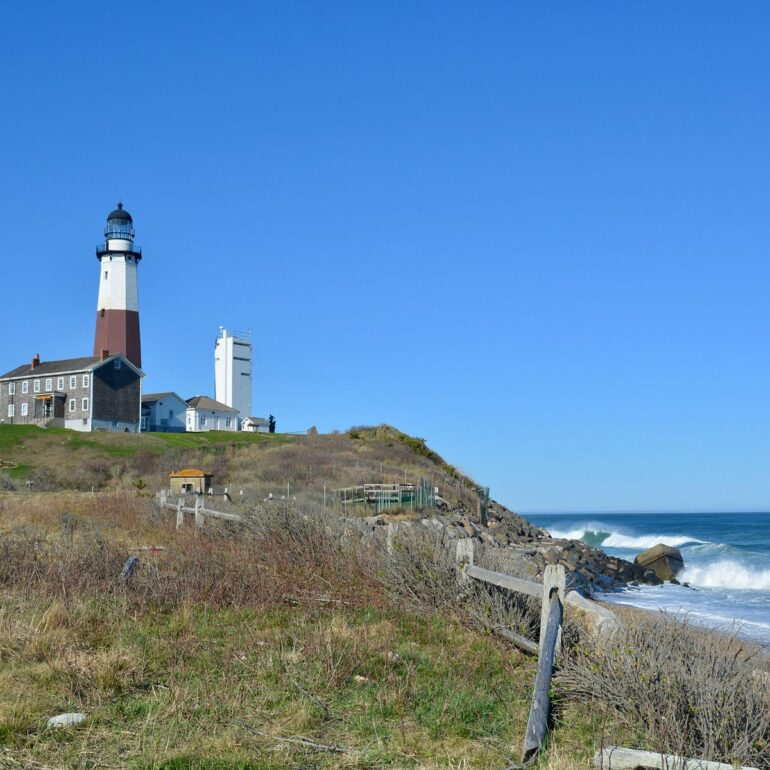
Locals have long dubbed their territory “The End.” This blunt name has far less to do with tourist folklore than with a simple physical observation—a dizzying reality that strikes you the moment you reach the tip of the peninsula. On this rocky promontory battered by fierce winter storms, the imposing Montauk Lighthouse, built by order of George Washington, marks the definitive boundary of New York State. Beyond the powerful beam of its lantern, there is nothing but the ocean—an unbroken expanse of water stretching all the way to Europe.

This geographical dead-end setting gives the town a unique intensity. One never passes through Montauk by chance on the way to another destination. One comes here specifically to encounter the end of the earth. This topographical feature discourages casual tourism and necessitates rooted, highly intentional stays. In an era dominated by constant connectivity and urban saturation, this psychological “end of the world” becomes a precious refuge.
State parks preserve vast expanses of scrubland and dense coastal forests where narrow trails allow visitors to wander for hours. While walking through the tall grass of Camp Hero State Park, visitors come across abandoned military installations. These gigantic concrete structures, slowly being swallowed up by wild vegetation, add a mysterious dimension to the landscape, serving as a reminder that this place was long considered the first line of naval defense for an entire country.
A Sanctuary of Waves and Wind
The duality of this haven is strikingly evident in its harbor, which remains one of the busiest maritime commercial hubs on the Atlantic coast. Unlike the glitzy marinas of Sag Harbor or Shelter Island, where massive, immaculate yachts sit quietly at dock awaiting evening service, the piers at Montauk reek of diesel fuel and salt-soaked ropes. It is a true working port, teeming with activity. Heavy industrial trawlers share the limited space there with sport fishing boats whose hulls are irrevocably scarred by the waves. The often nocturnal ballet of these boats, leaving the bay in thick fog, deeply anchors the community in a tangible and harsh reality.
Watching the crews unload by hand—amid the din of winches and shattering ice—crates full of massive tuna and striped bass brings home the obvious truth: Montauk endures the ocean just as much as it lives off it. The entire spatial and economic organization of the town is subject to the violence of the elements. Residents are constantly grappling with the spectacular erosion that relentlessly gnaws away at the coastline, forcing them to tirelessly rethink their defenses against rising waters. It is precisely this constant chaos—this obvious impossibility of fully controlling nature—that fascinates travelers often weary of overly predictable destinations.
As it’s time to pack up and head back west, the contrast becomes even more striking. The famous Route 27 is now traveled in the opposite direction, and the untamed landscapes quickly give way to the relentless order of hedges trimmed to perfection and lawns that are arrogantly perfect. But far behind, at the very tip of the peninsula, the unceasing roar of the Atlantic continues to crash against the clay cliffs, completely oblivious to real estate fluctuations and mere passing trends.