
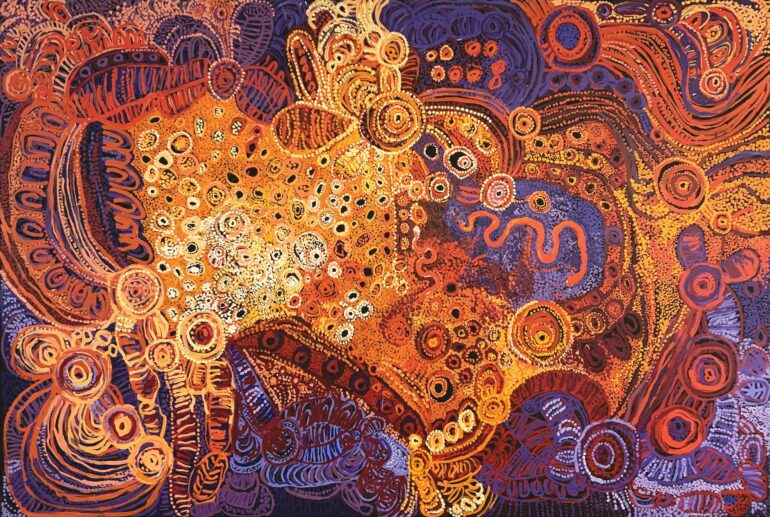
The 2026 Adelaide Biennial, curated by Ellie Buttrose, stands out for its conceptual coherence in an often sensationalist art scene. With its theme, “Yield Strength,” it highlights the malleability and resilience of materials and societies in the face of pressure.
The Adelaide Biennial of Australian Art: A Rare Commitment to Conceptual Integrity
The Adelaide Biennial retains the rare elegance of a major national exhibition that eschews the mere stringing together of prestigious names in favor of genuine curatorial thought. The 2026 edition, centered on the theme “Yield Strength” (deformation limit), is fully in line with this approach. According to the Art Gallery of South Australia (AGSA), the event will bring together twenty-four artists from February 27 to June 8, 2026, with the exhibition spanning the AGSA, the Samstag Museum of Art, and the Adelaide Botanic Garden. Established in 1990, it remains the oldest biennial dedicated to Australian contemporary art, thereby confirming its status as an essential cultural barometer.
Prioritizing Formal Tension Over Spectacle
The title chosen by curator Ellie Buttrose goes beyond a mere aesthetic formula. Borrowed from the vocabulary of materials engineering, the term “yield strength” refers to the stress threshold beyond which a material undergoes permanent deformation. This lens permeates the entire exhibition, serving as a subtle metaphor for our own plasticity and social dynamics. The exhibition explores what yields, what resists, and what transforms under pressure, emphasizing irreversible alteration rather than mere resilience, as the journal *Art Almanac* aptly points out.
This approach lends the biennial a unique gravity. Rather than resorting to easy shock value, the curatorial design cultivates delicate connections. The exhibition prioritizes nuanced conceptual juxtapositions, at times with an austere elegance. It is a bold gamble, supported by the expertise of Ellie Buttrose, whose direction of the Australian Pavilion—awarded the Golden Lion at the 2024 Venice Biennale—is an absolute guarantee of intellectual rigor.
The Aesthetics of Effort: Materials and Systems of Constraint
One of the major strengths of this edition lies in its ability to create a dialogue between artisanal craftsmanship and infrastructure mechanics. AGSA presents a lineup of artists—including Robert Andrew, Kirtika Kain, Archie Moore, Erika Scott, Joel Sherwood Spring, and Emmaline Zanelli—united by a particular focus on materiality and power dynamics.
Joel Sherwood Spring’s work *Diggermode 2: Cloud Ceding*, for example, weaves fascinating connections between territorial extraction mechanisms and the immaterial power of the digital realm. Part of a genealogy of control—ranging from colonial cartography to the abstraction of cloud computing—the installation deploys measuring instruments with clinical restraint: surveying chains, fences, and meteorological monitoring structures. Here, the cloud sheds its celestial dimension to re-establish itself as a technology of absolute control.
Jennifer Mathews extends this spatial reflection with *Yard*. This stainless-steel agricultural fence transforms the space into a circuit of sorting and orientation. While the gesture is formally minimalist, its significance is nonetheless political: the infrastructure designed to contain livestock echoes the administrative logics that govern our urban bodies. A sculpture with familiar lines whose tension creates a striking visual shortcut.
Traces and Wear: The Aesthetics of Exhaustion
The curatorial dialogue between Emmaline Zanelli and Erika Scott ranks among the most memorable elements of the exhibition. In *Pocket Money*, Zanelli documents young people’s entry into the workforce through thankless and repetitive tasks: cashiering, cleaning, and maintenance. Artist Profile identifies a veritable “economy of exhaustion” here, where consumption is no longer a matter of pleasure but asserts itself as the bare minimum necessary for survival. The body of work ties into the exhibition’s central theme, aptly exploring the tensions of identity in the face of hardship and routine.
For its part, Erika Scott’s *Necrorealist Sunscreen* depicts a suspended post-catastrophe landscape. Water tanks, abandoned office chairs, and household debris pile up in a scene of unsettling precision. The work avoids melodrama to capture what remains as the world continues to drift past the breaking point, offering a form of absurd poetry that is formidably effective. This is precisely where the biennial draws its strength: by rejecting the monotony of a polished setting in favor of juxtapositions that offer genuine resistance.
Archie Moore and Kirtika Kain: The Memory of Materials
In the heart of the Adelaide Botanic Garden, Archie Moore presents *Remnants of My Father*, an installation blending personal archives, administrative documents, and material symbolism. The core of the work revolves around *Heart of Gold*, an imposing gold-plated heart, flanked by pyrite—aptly named *Fool’s Gold*. Through this interplay of mirrors, Moore questions the illusions of the Australian mining dream, masterfully interweaving filial memory and macroeconomics to give his narrative universal significance.
Kirtika Kain continues this tactile exploration of history, transforming tar, gold, turmeric, and copper into powerful surfaces of tension. Her canvases and corroded plates embody the weight of social legacies without allowing themselves to be confined by them. This is a meticulous observation of how identity and materials mutate under pressure, sketching out a demanding aesthetic pushed to its structural limits.
Launched with a series of performances and talks curated by Ellie Buttrose and Matthew Lutton, the biennial immediately established itself as a vibrant platform, anchoring the exhibition in the public sphere to avoid the pitfall of being merely a museum event. But the true tour de force of *Yield Strength* undeniably lies in its constant attention to the physicality of forms and the way bodies tense or contract.
Ultimately, the 2026 edition of the Adelaide Biennial is thoroughly compelling when it embraces its own formal friction, eschewing gratuitous pomp to create a space of freedom where each work is allowed to reveal its own flaws. Moving away from compromise and the consensus-driven spectacle, this exhibition turns its conceptual integrity into an act of resistance. A refreshing approach that reminds us that, in the landscape of contemporary art, rigor and precision remain the ultimate luxuries.