
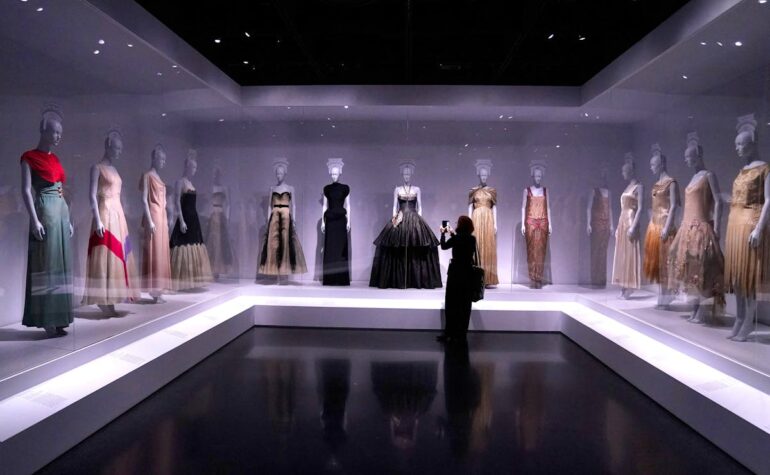
The Met’s “Costume Art” exhibition explores the representation of the clothed body throughout history, establishing a fascinating dialogue between clothing, works of art, and symbolism. It’s a bold approach that affirms, more than ever, fashion as an artistic discipline in its own right.
The Fabric of a True Visual Language
In the spring of 2026, the Metropolitan Museum of Art will unveil an extraordinary exhibition. Far from being viewed solely through the lens of the fashion industry, fashion is celebrated here as an autonomous visual language. “Costume Art” explores how the clothed body has been represented through textiles and works of art drawn from the museum’s vast collections. Andrew Bolton, chief curator of the Costume Institute, weaves unexpected connections, navigating between formal rigor and political messages, playful lightness and profound symbolism. (metmuseum.org)
While the approach is rooted in a museum tradition, it is executed here with masterful methodology. The Met has brought together nearly 400 objects, rigorously categorized by body types and themes spanning the history of art. This broad perspective allows ornamentation to engage in a remarkably fluid dialogue with sculpture, painting, and antiquities. (metmuseum.org)
The Body as a Backdrop
At the heart of this retrospective lies a truth all too often forgotten: clothing never floats in a vacuum. It shapes, corrects, or challenges the flesh it envelops. The museum thus traces the countless representations of the clothed body, from prehistoric times to the present day, incorporating the concepts of age, size, gender, and disability. The exhibition catalog establishes clothing as the central subject of the artwork. (metmuseum.org)
Viewing clothing as an organic extension or a physical critique gives it a dimension that goes far beyond simply spotlighting fashion houses. This vision is part of the long-standing ambition to bring together the decorative arts and the fine arts, emphasizing that the boundary separating them has always been nothing more than an administrative convention. (metmuseum.org)
An architectural showcase dedicated to fashion
The exhibition also celebrates the opening of a brand-new space of approximately 1,100 square meters, adjacent to the Great Hall. This marks a major milestone for the museum, as this gallery will host the Costume Institute’s exhibitions each spring, as well as cross-disciplinary projects related to fashion and art. Its interior design was entrusted to the expertise of the New York-based firm Peterson Rich Office. (metmuseum.org)
This permanent exhibition design reflects the importance now accorded to fashion. By establishing it in a dedicated space, the Met grants fashion permanent status, breaking with the ephemeral nature of seasonal exhibitions. It is a clear statement: fashion transcends mere social entertainment to become a lasting part of cultural heritage. (metmuseum.org)

The Met Gala: A Blend of Glamour and Philanthropy
Although the exhibition is fundamental, it shines in tandem with the Costume Institute’s unmissable annual gala, scheduled for May 4, 2026. Under the evocative theme “Fashion is Art,” the event will be co-chaired by Beyoncé, Nicole Kidman, Venus Williams, and Anna Wintour. The funds raised during this evening, renowned for its stylistic extravagance, form the financial cornerstone of the department’s programming. (metmuseum.org)
This duality is the institution’s hallmark: on one hand, a celebration where fashion becomes a dazzling theatrical performance; on the other, an introspective exhibition that dissects its conceptual mechanisms. A creative tension that keeps the Costume Institute pulsing between refined scholarship and high-profile media exposure. (metmuseum.org)
While critics praise the inclusivity of this approach, certain nuances are emerging. Specialized platforms point out that, although body diversity is addressed, the exploration of complex intersections—such as identity, gender, or disability—deserves to be explored in greater depth. Exhibiting the body requires going beyond simple classification to touch on the essence of the individual. (metmuseum.org)
Ultimately, “Costume Art” stands out more as a thought-provoking exploration than as an absolute truth. The museum brilliantly reaffirms its ability to elevate fashion to the status of an object of art history. It remains to be seen whether the public will view this as a brilliant curatorial demonstration or a lasting invitation to change their perspective on a discipline that usually flashes across the runway only to be forgotten in the blink of an eye.