
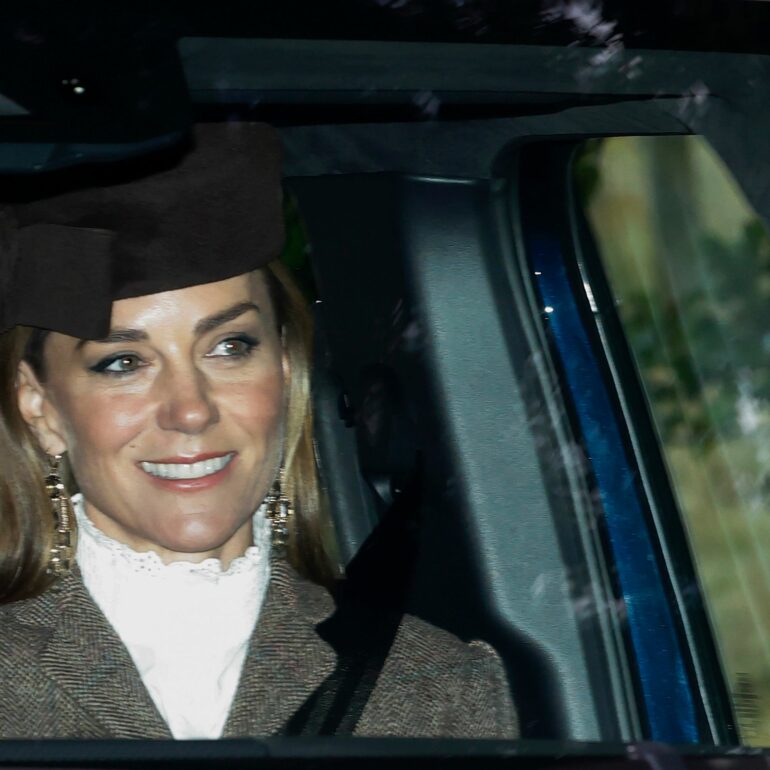
The Scottish landscape, with its distinctive light and timeless terrain, once again serves as the backdrop for a moment of pure institutional representation. It is here, far from the hustle and bustle of London, that Prince William and Princess Kate have chosen to make their presence known. Their arrival—closely watched yet marked by a certain restraint—was not as a couple, but as a complete family unit. By stepping through the doors of this religious service, the royal couple did more than simply honor a tradition; they presented a vision of the royal line, accompanied by their three children. This appearance in Scotland—a land steeped in symbolism for the Crown—underscores a commitment to stability and continuity, evident in the simple physical presence of five figures moving together toward a place of contemplation.
The Geometry of a Family in Motion
Observing this arrival, one first notices a natural choreography. There is, in the way William and Kate move with their three children, a form of visual balance that seems to have been refined by time and the practice of public duties. The group of five forms a cohesive whole in which each member occupies a specific place. The Prince and Princess of Wales flank their children, creating a protective yet open circle—an image of a close-knit family unit that collectively faces the outside world. This unity of movement suggests quiet preparation and a familiarity with protocol that nonetheless does not obscure the unique dynamics of a family with three children, whose different ages and temperaments are reflected in the rhythm of their steps.
Appearing in this way, as a complete family, for a service in Scotland, shifts the focus of media attention from the individual to the collective. It is no longer just the future king or his wife who are at the center of the scene, but rather the promise of continuity embodied by the younger generation. By accompanying their parents in this solemn setting, the three children gain firsthand experience of the obligations associated with their rank. Their presence is not merely incidental; it constitutes the very heart of the message conveyed that day. This exemplifies education by example, where the path to public service becomes a space for transmitting the values of restraint and dignity inherent to the institution they all represent, to varying degrees.
Scotland as the Setting for the Ceremony
The choice of location—referred to simply as Scotland—is never neutral in the royal narrative. It is a land that demands a certain rigor, respect for the elements, and a necessary distance from frivolity. Upon arriving for this service, William, Kate, and their children become part of a long-standing tradition. The religious service, by its very nature, demands silence and contemplation that contrast with the more dynamic or athletic appearances to which the family has sometimes accustomed us. Here, the focus is on continuity. The walk toward the sacred building, under the Scottish sky, becomes a metaphor for their own journey: a steady path, guided by duty, where each family member must find their own rhythm without disrupting the harmony of the whole.
This northern stop also offers a chance to see the royal couple in a more subdued light. Far from the pomp of grand state ceremonies, attending a religious service in Scotland calls for a more understated elegance, an adaptation to the local setting. The arrival of the five family members reflects their successful integration into this landscape—not as passing visitors, but as key participants in a tradition that finds a special resonance in the Scottish moors and churches. It is in this context that the presence of the three children takes on its full meaning: they discover that their role is rooted in specific territories, each with its own codes and its own requirements for representation.

The Dynamics of the Five in the Service of Protocol
In the structure of this public appearance, the division of roles between William and Kate seems perfectly honed. They are not merely parents guiding their children; they are the guardians of a public image that must be impeccable. The silent camaraderie that emanates from the group of five is the result of careful spatial management. Arriving side by side, the prince and princess present a united front—a solid foundation on which their three children can rely. This solidarity is palpable in the way they navigate the transition from outside to inside the place of worship. Every gesture, every glance exchanged among family members, helps to humanize a role that might otherwise seem too rigid.
The presence of their three children at this service in Scotland also reveals the evolution of the royal family’s communication strategy. By increasingly involving them in spiritual or solemn events, William and Kate are laying the groundwork for the future. They are not expected to be mere spectators, but to participate fully in the most formal aspects of royal family life. Their arrival at the service is therefore not just a Sunday outing; it is another step in the development of their public identity. The children are learning to navigate between the privacy of their sibling relationships and the inevitable public scrutiny that comes with their name—all under their parents’ watchful eye.
A Message of Stability Through Family Presence
The act of arriving together for a religious service in Scotland serves as a signal of normality and perseverance. At a time when institutions are often called into question, the sight of this couple and their three children walking in unison conveys a sense of continuity. There is no need for long speeches to express William and Kate’s commitment; their mere presence, surrounded by the next generation, is enough to reaffirm their role. Scotland, with its ruggedness and untamed beauty, magnifies this display of quiet strength. The group of five, by its very composition, embodies a renewal that does not break with the past but draws strength from it to move forward.
Ultimately, this scene from royal life on Scottish soil underscores the importance of the collective over the individual. While William and Kate remain the figureheads, it is the family as a whole that bears the weight of representation. As they arrive for the service, they are not merely attending a ceremony; they affirm a sense of unity that has become their hallmark. Every member of this quintet, from the oldest to the youngest, contributes to the weaving of a national narrative in which the family stands at the center, like an unshakable foundation in the face of change. It is in this collective movement toward the entrance to the service that the future of a lineage—one that seems to have found its foundation in respect for traditions and the strength of family bonds—is most clearly revealed.