
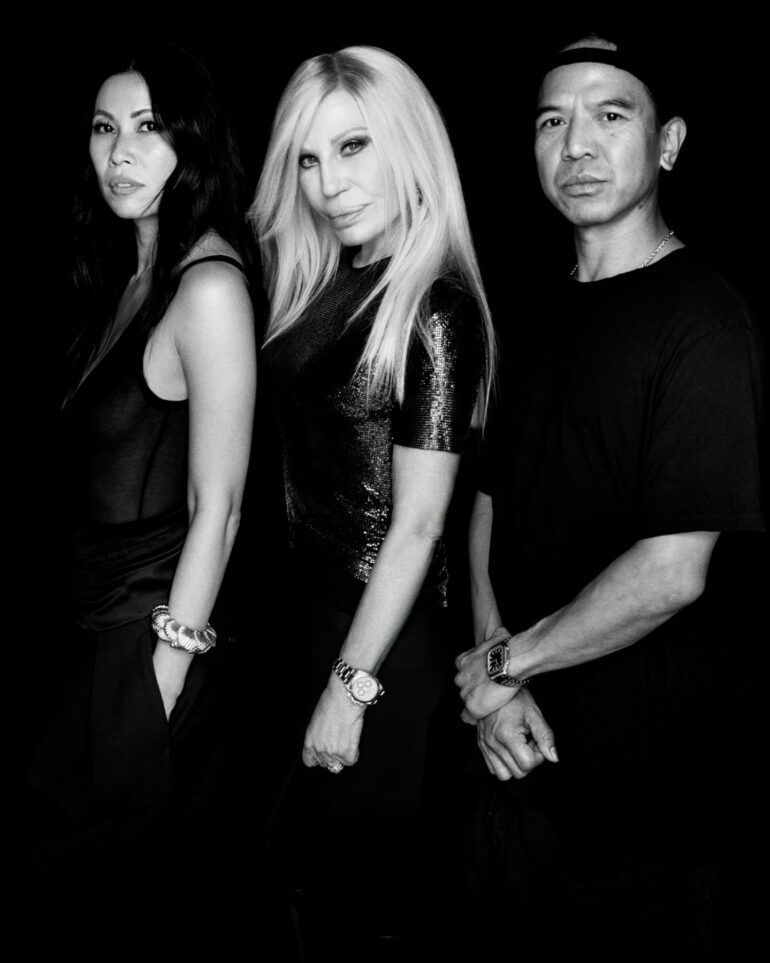
The name remains a secret, and the first products won’t be available until 2027, but the launch regions have already been mapped out: the United States, Latin America, the Asia-Pacific region, and the Middle East. For her new project with the California-based Revolve Group, Donatella Versace is taking the stage through distribution before unveiling the collection. This timeline says a lot about the venture. This isn’t about taking the helm of a brand steeped in history, but about building a fashion and beauty offering centered on a personality who already has an established following. With 12.2 million followers, the designer has an audience. The challenge now is to give them a new reason to buy.
Can a first name become a new starting point?
Donatella Versace spent nearly thirty years leading the creative direction of the fashion house founded by her brother Gianni. During that time, she embodied both the brand’s clothing and its values to such an extent that it became difficult to distinguish between her own image and that of the brand. Her departure from the creative director role in March 2025 broke this professional continuity. At the time, Versace still belonged to Capri Holdings, before its sale to the Prada Group.
The agreement with Revolve therefore shifts the question. How can a designer so closely associated with a family-run fashion house make her personal voice heard elsewhere? Her fame is an obvious asset, but it also invites constant comparison with her past work. The project will need to find its own niche without her name—which is still unknown—simply serving as a new label for a familiar image.
In her presentation of the partnership, Donatella Versace emphasizes the freedom to connect with younger generations in a different way, through beauty and fashion. She champions an open and daring creativity, inspired by music, film, and art. No products have yet been unveiled to gauge how this vision will translate. The intention, however, is clear: to build on shared cultural affinities to forge a more personal connection with its audience.
Revolve: The Choice of Platform
The chosen partner provides a clear framework for this ambition. Founded in 2003 by Michael Mente and Mike Karanikolas, Revolve Group has developed an online offering featuring 1,600 brands across two platforms, Revolve and Fwrd. Its portfolio also includes Revolve Los Angeles, Revolve Beauty, and Revolve Man. In 2025, the group reported total revenue of $1.23 billion. Behind the creative promise, therefore, lies a commercial infrastructure already up and running.
Mike Karanikolas, co-founder and co-CEO, describes the partnership as a convergence of Donatella Versace’s creative authority and Revolve’s technological, logistical, and international capabilities. He also emphasizes the opportunity to build a new venture for the long term. The choice of words matters: the group is not merely describing a publicity stunt, but a business to be built from the ground up.
That is where the significance of the agreement lies. A figure long associated with the artistic direction of a fashion house has chosen a player in the digital retail sector for this new phase. The creation and distribution of the collection are being planned together from the very announcement. This reveals nothing about prices or the exact nature of future products—two details still missing. But it immediately positions public access as one of the project’s driving forces, rather than as an issue to be addressed after the collection is released.
Youth: A Proven Connection
Discourse about new generations accompanies many launches. At Donatella Versace, it can at least draw on concrete collaborations. Anthony Vaccarello, Jonathan Anderson, and Christopher Kane are among the designers with whom she has worked and whose careers she has supported. This focus on younger talent has been a key part of her role as creative director, alongside her commitment to upholding the house’s signature style.
Other initiatives have pushed the boundaries of her territory. With Fendi, the Fendace collection brought together two distinct styles. Collaborations with H&M and Riachuelo, meanwhile, have extended her aesthetic to more affordable retail brands. These experiences do not predict the positioning of the future project: there is no way to deduce a price range from them. They do, however, show that moving from one context to another does not, for her, constitute a break in her approach.
Raissa Gerona, president of brands and partnerships at Revolve Group, specifically highlights this ability to understand the expectations of a young audience and to connect fashion with culture. The challenge will be to transform this understanding into desirable products. An audience follows an influencer for many reasons; it does not necessarily buy into all of their commercial offerings. Between attention and purchase, there is still a lot of work to be done.

Beauty as an Extension of Fashion
The announced partnership spans fashion and beauty, though it has not yet specified how these two fields will be integrated. Their joint presence prevents the project from being reduced to just another clothing line. It opens up a broader space for the designer’s personal expression, while leaving the essential questions for the consumer unanswered: which categories will be offered, based on what approach, and with what respective weight in the product lineup?
For Revolve, this partnership follows other agreements with personalities who have their own following. In 2025, the group announced a joint venture with Cardi B, marking its entry into the beauty industry, as well as another with Sofia Richie Grainge. The partnership with Donatella Versace is thus part of a series of initiatives in which the partner’s personality takes center stage. However, the terms of these deals should not be conflated: the announcement regarding the designer does not detail the structure of their partnership.
Her contribution is distinguished by a long career in design and brand leadership. Revolve is welcoming a fashion celebrity, to be sure, but also a professional who has had to evolve a brand identity over several decades. It is this experience—more than just the number of followers—that makes the project worthy of attention.
A structure is in place, but much remains to be defined
Another development signaled the start of a new chapter: in January, the creation of Platinum Future was made public. This company operates in the fields of fashion and industrial design. With a share capital of 30,000 euros, it is wholly owned by Donatella Versace, who serves as its director and sole shareholder. This development lends an entrepreneurial dimension to the post-Versace era, going beyond a simple return to design.
However, the details released do not specify any legal connection between Platinum Future and the agreement with Revolve. Simply linking the two is not enough to establish their respective roles. Similarly, the geographic scope disclosed for the launch does not allow us to predict future distribution elsewhere. At this stage, the project has a partner, announced markets, and a timeline, but much of its identity remains off-camera.
The decisive moment is set for 2027: the first products are expected to launch at the same time as the name is revealed. We will then have to see what Donatella Versace has chosen to sign her name to, and under what name she has decided to start anew.